
 India
India Australia
 Singapore
 Philippines
5.05 MIN READ
Why Restricting Administrative Privileges Is Critical to Cyber Resilience
 Niten Devalia | Feb 11, 2026
In many cyber incidents, the initial compromise is not what causes the most damage. The real harm happens after attackers gain administrative privileges. Once that happens, they can disable security tools, move freely across systems, steal data, and deploy ransomware at scale.
This is why Restrict Administrative Privileges is one of the most critical controls in the Essential Eight. It focuses on limiting what users and attackers can do, even if an account is compromised.
At Exigo Tech, we see this control as a cornerstone of cyber resilience. It doesn’t stop people from doing their jobs. It stops small mistakes from turning into major incidents.
What Does “Restrict Administrative Privileges” Mean?
Restrict Administrative Privileges means ensuring that users only have the level of access they genuinely need to perform their roles and nothing more.
In practice, this means:
- Most users do not have local or domain administrator rights.
- Administrative access is granted only when required.
- Elevated access is time-limited and monitored.
- High-risk accounts are tightly controlled.
This principle is often referred to as least privilege, giving the minimum access necessary to do the job.
Why Administrative Access Is So Dangerous
Administrative privileges give full control over systems. With admin access, a user (or attacker) can:
- Install or remove software.
- Disable antivirus or security controls.
- Access sensitive system files.
- Create or modify user accounts.
- Move laterally across the network.
If an attacker compromises a standard user account, the damage may be limited. If they compromise an admin account, the entire environment can be at risk.
Many major ransomware attacks escalated so quickly because attackers gained admin privileges early in the attack.

Why Too Many Users Have Admin Rights
Despite the risk, excessive administrative access is still common.
Some of the most common reasons include:
Convenience
It’s easier to give admin rights than to deal with permission requests.
Legacy Practices
Admin access was granted years ago and never reviewed.
Application Requirements
Some older applications require elevated privileges to run.
Lack of Tools or Processes
Without proper controls, managing admin access feels complex.
Fear of Disruption
IT teams worry that removing admin rights will break workflows.
While these concerns are understandable, leaving admin access unchecked creates far greater risk.
Why Restricting Admin Privileges Is Essential Eight–Critical
The Essential Eight focuses on preventing attackers from gaining full control of systems. Restricting administrative privileges directly supports this goal by limiting how far an attacker can go.
Even if:
- A user clicks a phishing link.
- Credentials are stolen.
- Malware executes.
Restricted privileges significantly reduce the attacker’s ability to escalate, persist, and spread.
This control does not rely on perfect user behaviour. It assumes mistakes will happen, and limits the impact when they do.
What Happens When Admin Privileges Are Not Restricted
When admin access is widespread, organisations face:
- Faster ransomware deployment.
- Greater data exposure.
- Increased downtime during incidents.
- Harder recovery efforts.
- Higher regulatory and reputational risk.
In many incident investigations, unrestricted admin access was the single factor that allowed an attack to escalate rapidly.
Benefits of Restricting Administrative Privileges Properly
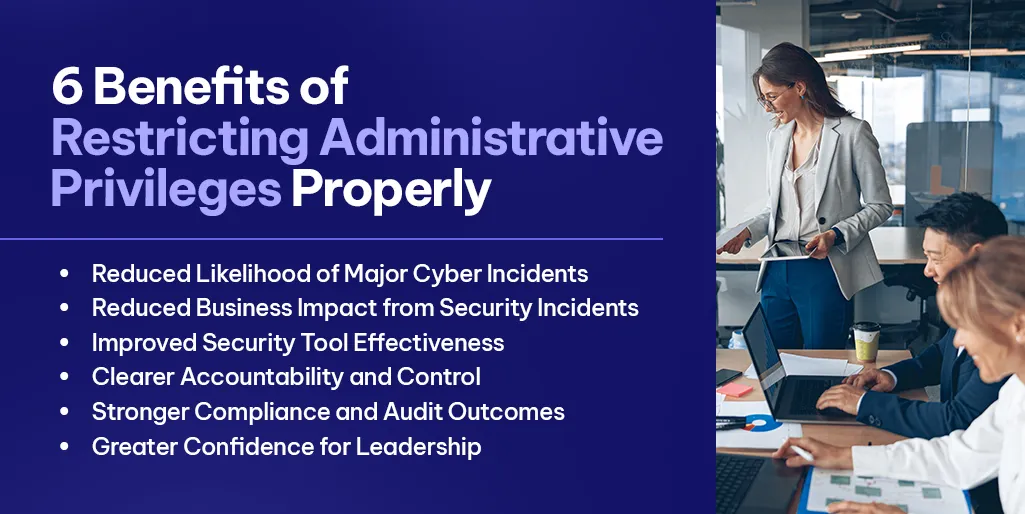
When implemented correctly, this control delivers strong security and operational benefits.
Reduced Likelihood of Major Cyber Incidents
Attackers struggle to escalate privileges and spread without admin access.
Reduced Business Impact from Security Incidents
Even if a system is compromised, damage is contained, and recovery is simpler.
Improved Security Tool Effectiveness
Security controls are harder to disable when admin rights are limited.
Clearer Accountability and Control
Admin actions are more visible, controlled, and auditable.
Stronger Compliance and Audit Outcomes
Least-privilege access is a common regulatory and audit expectation.
Greater Confidence for Leadership
Executives can be confident that one compromised account won’t affect the organisation.
Common Mistakes Organisations Make
Restricting admin privileges is often attempted, but not always done well.
Common mistakes include:
- Removing admin rights without providing alternatives.
- Allowing permanent admin access “just in case”.
- Not separating admin and standard user accounts.
- Ignoring service and application accounts.
- Failing to monitor admin activity.
These mistakes can frustrate users and weaken the control.
What Good Admin Privilege Restriction Looks Like
Effective implementation balances security and usability.
Good practices include:
- Separate standard and admin accounts.
- Just-in-time or temporary elevation of privileges.
- Clear approval workflows for elevated access.
- Monitoring and logging of admin activity.
- Regular review of who has admin rights.
The goal is not to block work; it is to control risk intelligently.
Why Restricting Admin Privileges Does Not Reduce Productivity
One of the biggest myths is that restricting admin access slows people down.
In reality:
- Most users rarely need admin rights.
- Elevation can be provided when required.
- Standardised environments reduce support issues.
When implemented properly, productivity improves because systems are more stable and secure.
Why Choose Exigo Tech For Restricting Administrative Privileges
Restricting administrative privileges requires more than flipping a switch. It requires planning, tooling, and ongoing management.
As your Managed Intelligence Partner, we:
- Assess current privilege exposure.
- Design least-privilege access models.
- Implement controlled elevation processes.
- Support users through change.
- Monitor and refine access over time.
We focus on reducing risk without disrupting operations, and on turning access control into a strength, not a pain point.
Limiting Privileges Is About Limiting Damage
Cybersecurity is not about assuming perfect behaviour. It’s about designing systems that fail safely.
Restricting administrative privileges ensures that when something goes wrong, and eventually it will, the impact is limited, controlled, and recoverable.
That is why it remains one of the most effective and practical controls in the Essential Eight.



 Exigo Tech - Ask AI (Beta)