 Australia
 Singapore
 Philippines
 India
India5.47 MIN READ
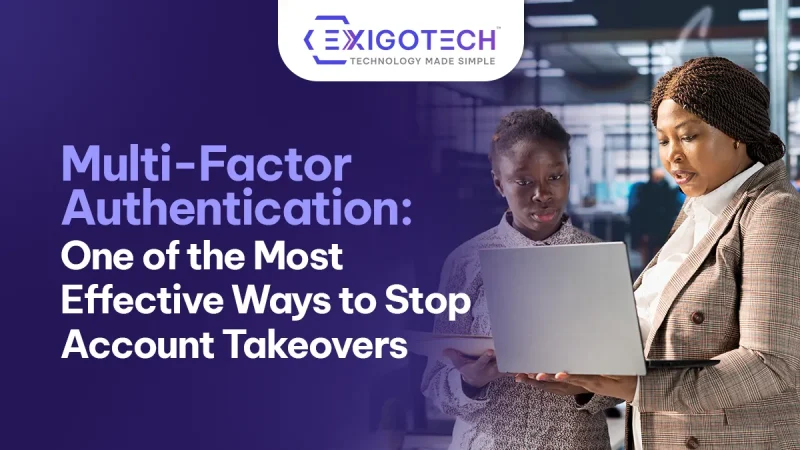
Multi-Factor Authentication: One of the Most Effective Ways to Stop Account Takeovers
 Niten Devalia | Feb 02, 2026
Most cyberattacks today do not start with complex hacking. They start with stolen usernames and passwords. Phishing emails, fake login pages, malware, and data breaches all aim for the same thing: credentials.
Once attackers have valid login details, they can move freely through systems, access sensitive data, and deploy ransomware, often without triggering alarms.
That’s why Multi-Factor Authentication (MFA) is one of the most important controls in the Essential Eight. It adds a second layer of protection that makes stolen passwords far less useful to attackers.
At Exigo Tech, we consider MFA not just a security feature, but a basic requirement for protecting modern digital environments.
What Is Multi-Factor Authentication?
Multi-Factor Authentication means users must provide more than one form of verification to log in.
Instead of just:
- Something you know (password)
Multi-Factor Authentication (MFA) adds:
- Something you have (phone, app, hardware token)
- Or something you are (biometrics)
So even if a password is stolen, attackers still cannot log in without the second factor.
This simple step blocks a very large percentage of real-world attacks.
Why Passwords Alone Are No Longer Enough
Passwords were never designed to protect modern cloud-connected environments.
Today, passwords are stolen through:
- Phishing emails.
- Fake websites.
- Malware on personal devices.
- Data breaches on unrelated services.
- Social engineering attacks.
Once attackers obtain credentials, they can:
- Access email accounts.
- Reset other passwords.
- Impersonate employees.
- Move deeper into the network.
Without Multi-Factor Authentication, a single stolen password can quickly turn into a full business compromise.
Why Multi-Factor Authentication Is Critical to the Essential Eight
The Essential Eight focuses on blocking common attack paths. Credential theft is one of the most common and successful techniques used by attackers.
Multi-Factor Authentication directly protects:
- Remote access
- Cloud services
- Email platforms
- Administrative accounts
- Internal systems
It reduces the risk that a single mistake, such as clicking on a phishing link, leads to a major incident. In many investigations, MFA would have stopped the attack entirely, even after credentials were stolen.
Why Multi-Factor Authentication (MFA) Is Still Not Fully Adopted
Despite its effectiveness, MFA is still not consistently implemented across organisations.
Common reasons include:
User Resistance
Some users find Multi-Factor Authentication inconvenient and push back against change.
Partial Implementation
MFA is enabled for some systems but not others, leaving gaps that attackers can exploit.
Legacy Systems
Older applications may not support modern authentication methods.
Fear of Disruption
Teams worry Multi-Factor Authentication will impact productivity or create support issues.
Lack of Policy Enforcement
MFA is available but not mandatory for all users.
These challenges are real, but they are manageable with the right approach.
Where Multi-Factor Authentication Should Be Applied
Effective MFA strategies protect more than just remote VPN access.
MFA should be enforced on:
- Email and cloud platforms.
- Remote access systems.
- Privileged and administrator accounts.
- Business-critical applications.
- Any external access points.
Attackers look for the weakest login path. If Multi-Factor Authentication is missing anywhere important, that is where they will try first.
Benefits of Implementing Multi-Factor Authentication Properly
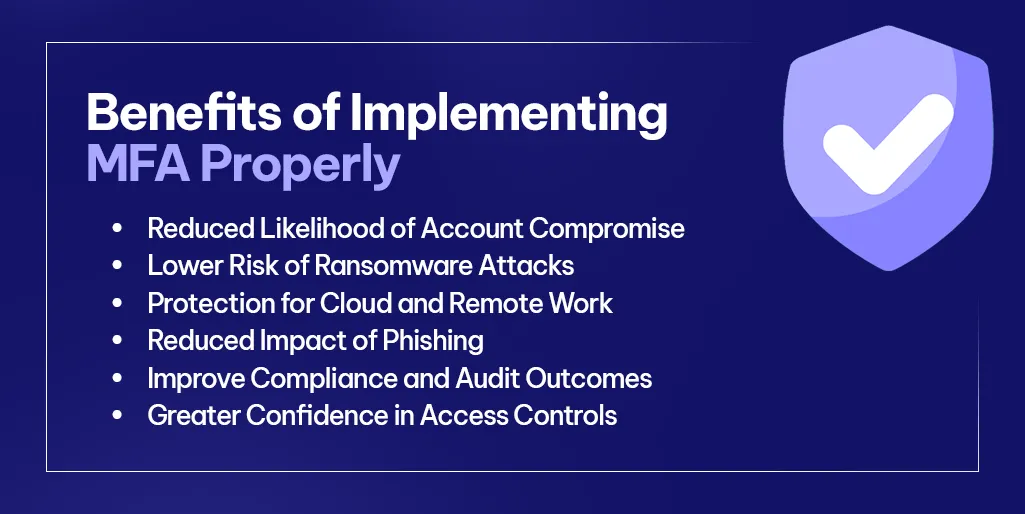
When Multi-Factor Authentication is implemented consistently and correctly, organisations see strong security and operational benefits.
Reduced Likelihood of Account Compromise
Even if passwords are stolen, attackers are blocked from logging in without the second factor.
Lower Risk of Ransomware Attacks
Many ransomware attacks begin with compromised accounts. MFA breaks that entry path.
Protection for Cloud and Remote Work
As more services move to the cloud, MFA protects access regardless of location.
Reduced Impact of Phishing
Phishing attempts may still happen, but their success rate drops dramatically.
Improved Compliance and Audit Outcomes
Many standards and regulations now expect Multi-Factor Authentication to be in place for sensitive systems.
Greater Confidence in Access Controls
Leadership can be confident that access is not based on passwords alone.
Common Mistakes Organisations Make with MFA
Multi-Factor Authentication only works when it is implemented thoroughly and thoughtfully.
Common mistakes include:
- Applying MFA only to admins but not general users.
- Excluding critical systems due to “temporary exceptions”.
- Not enforcing Multi-Factor Authentication on cloud email platforms.
- Allowing weaker authentication methods without review.
- Not monitoring for MFA bypass attempts.
Attackers actively look for accounts and systems where MFA is missing or poorly enforced.
What Good Multi-Factor Authentication Implementation Looks Like
Strong MFA implementation is:
- Mandatory for all users, not optional.
- Enforced consistently across systems.
- Integrated with identity management platforms.
- Regularly reviewed and tested.
- Supported by clear user guidance.
Good implementation balances security with usability and avoids unnecessary friction.
Why Choose Exigo Tech to Manage Multi-Factor Authentication
As your managed intelligent partner, we treat MFA as part of a broader identity and security strategy, not just a checkbox requirement.
We help organisations:
- Design MFA policies that align with business operations.
- Integrate MFA across cloud and on-prem systems.
- Support users through onboarding and adoption.
- Monitor authentication risks and suspicious activity.
- Continuously improve access security over time.
Our goal is simple: strong protection without unnecessary disruption.
Multi-Factor Authentication Is About Reducing Risk, Not Blaming Users
No amount of training can stop every phishing attempt or mistake. Multi-Factor Authentication assumes that users will sometimes be tricked, and builds protection around that reality.
Instead of relying on perfect behaviour, MFA reduces the damage when something goes wrong.
That is why it remains one of the most powerful and practical controls in the Essential Eight.
 Exigo Tech - Ask AI (Beta)