
 Australia
 Singapore
 Philippines
 India
India5.02 MIN READ
Copilot Optimisation and Readiness Assessment: Turning AI into Real Business Value
 Alpesh Prajapati | Feb 27, 2026
Microsoft Copilot is transforming how organisations work. From drafting emails and summarising meetings to generating reports and analysing data, Copilot promises major productivity gains across Microsoft 365.
But enabling Copilot is not the same as being ready for it.
Many organisations rush to activate AI tools without reviewing data access, permissions, governance, and user adoption strategies. The result? Inconsistent outputs, limited ROI, and in some cases, increased data exposure risk.
Copilot is powerful. But like any powerful tool, it amplifies what already exists, both strengths and weaknesses.
This is why Copilot Readiness Assessment and Copilot Optimisation are critical steps before and after deployment.
At Exigo Tech, we approach Copilot as your managed intelligence partner, ensuring that AI works securely, strategically, and measurably across your organisation.
Why Copilot Readiness Matters More Than Most Organisations Realise
If your Microsoft 365 environment contains:
- Excessive file sharing.
- Poor permission hygiene.
- Outdated or sensitive documents widely accessible.
- Unstructured information sprawl.
- Inconsistent governance.
Copilot will surface that content instantly. The risk is not that Copilot creates new vulnerabilities. The risk is that it exposes existing ones faster and more clearly.
A Copilot Readiness Assessment ensures your environment is structured, secure, and governed before AI is layered on top.
What Is a Copilot Readiness Assessment?
A Copilot Readiness Assessment is a structured review of your Microsoft 365 environment to determine whether it is prepared for AI deployment.
It typically evaluates:
- Data Access and Permissions: Who can access what? Are permissions aligned with job roles?
- SharePoint and OneDrive Governance: Are files structured logically? Are external sharing controls appropriate?
- Microsoft Teams Structure: Are channels and files managed consistently?
- Sensitive Information Exposure: Is confidential data stored in accessible locations without proper classification?
- Identity and Access Controls: Are authentication and access policies strong enough to support AI usage?
The objective is simple: ensure Copilot operates in a secure, controlled, and well-governed environment.
Why Turning Copilot On Without Preparation Is Risky
Without readiness planning, organisations may face:
- Overexposure of sensitive content.
- Confusion about data surfaced by AI.
- Inconsistent results due to unstructured data.
- User frustration from poor outputs.
- Lack of measurable productivity gains.
Copilot performs best when data is organised, secure, and governed.
Copilot Optimisation: Getting Real ROI After Deployment
Readiness is only the first step. True value comes from optimisation.
Many organisations enable Copilot but fail to:
- Track usage patterns.
- Identify high-value use cases.
- Train users effectively.
- Measure productivity impact.
- Refine governance policies.
Copilot Optimisation ensures the tool evolves with your organisation.
It includes:
-
Usage Analysis
Understanding how teams are using Copilot and where adoption is low.
-
Workflow Integration
Embedding Copilot into key business processes rather than treating it as an optional assistant.
-
Prompt Engineering Guidance
Helping users generate more accurate, useful outputs.
-
Policy Refinement
Adjusting permissions and governance as usage patterns develop.
-
Performance and Impact Measurement
Tracking tangible outcomes such as time savings, document generation efficiency, and improved collaboration.
Benefits of Copilot Readiness and Optimisation
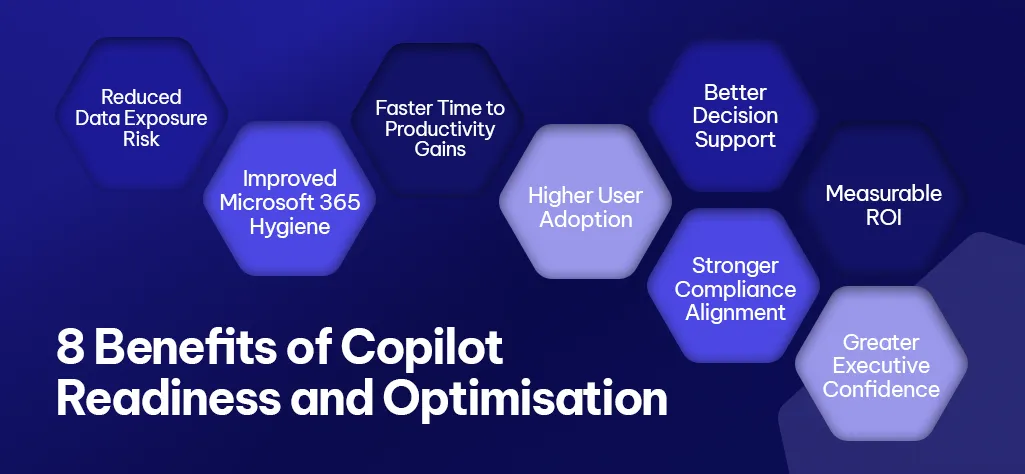
When approached strategically, Copilot delivers measurable advantages.
-
Reduced Data Exposure Risk
Permission reviews and governance improvements limit unintended access to sensitive information.
-
Improved Microsoft 365 Hygiene
Structured content and controlled sharing improve overall operational efficiency.
-
Faster Time to Productivity Gains
Clear use cases and structured rollout accelerate measurable outcomes.
-
Higher User Adoption
Training and optimisation increase user confidence and engagement.
-
Better Decision Support
Well-governed data improves AI-generated insights and recommendations.
-
Stronger Compliance Alignment
Data classification and access controls reduce regulatory risk.
-
Measurable ROI
Usage tracking and optimisation enable clear reporting of productivity improvements.
-
Greater Executive Confidence
Leadership gains assurance that AI is deployed responsibly and strategically.
Copilot Is a Business Initiative, Not Just an IT Deployment
Copilot improves:
- HR workflows.
- Finance reporting.
- Sales documentation.
- Executive communication.
- Project collaboration.
- Customer engagement.
Because of this, readiness and optimisation must involve both technical and operational perspectives.
Successful Copilot deployment requires:
- IT governance.
- Data security.
- Business process alignment.
- Change management.
- Executive sponsorship.
Without this coordination, adoption remains inconsistent.
Common Mistakes Organisations Make
When implementing Copilot, we often see:
- Purchasing licences before assessing readiness.
- Ignoring SharePoint and Teams sprawl.
- Overlooking legacy sensitive documents.
- Failing to define success metrics.
- Treating Copilot as a one-time rollout.
- Assuming users will automatically understand how to use it effectively.
These mistakes limit value and increase risk.
Structured assessment and ongoing optimisation prevent these issues.
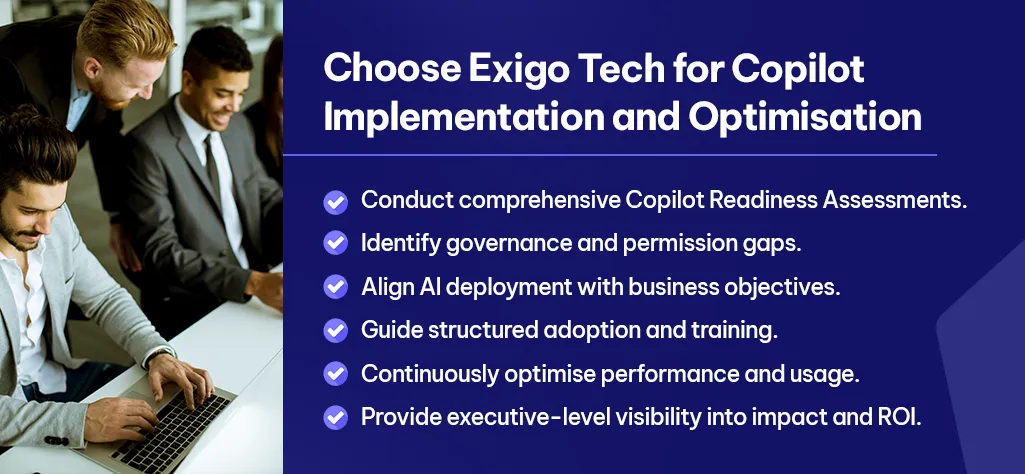
Why Choose Exigo Tech for Copilot Implementation and Optimisation
Copilot is not just another software feature; it is an AI capability embedded into everyday work.
As your Managed Intelligence Partner, we:
- Conduct comprehensive Copilot Readiness Assessments.
- Identify governance and permission gaps.
- Align AI deployment with business objectives.
- Guide structured adoption and training.
- Continuously optimise performance and usage.
- Provide executive-level visibility into impact and ROI.
We ensure Copilot enhances productivity while strengthening governance and security.
From AI Access to AI Advantage
Copilot has the potential to transform how organisations create, analyse, and collaborate. But unlocking that value requires preparation and refinement.
A structured readiness assessment reduces risk. Continuous optimisation drives measurable improvement.
When AI is deployed intelligently, with governance, oversight, and strategy, it becomes a competitive advantage rather than an uncontrolled experiment.


 Exigo Tech - Ask AI (Beta)