 Australia
 Singapore
 Philippines
 India
India7.01 MIN READ
Compliance and Cybersecurity Challenges Facing Australian Local Governments
 Niten Devalia | Sep 25, 2026
Local governments sit at the intersection of technology, public services, community trust, and sensitive information.
Councils manage everything from rates and permits to community services, planning, waste management, infrastructure, payments, and public records. Increasingly, these services depend on cloud platforms, digital portals, mobile applications, connected devices, and third-party providers.
For Australian councils, the challenge is not simply preventing cyberattacks. They must also protect personal information, maintain reliable public services, manage third-party risks, meet applicable privacy and records obligations, and demonstrate appropriate governance.
Hence, cybersecurity and compliance need to be treated as interconnected business priorities rather than separate IT projects.
Why Local Governments Are Increasingly Exposed
Councils hold valuable information and operate services that communities depend on.
Their environments may include:
- Resident and ratepayer information
- Property and planning records
- Payment information
- Employee data
- Community service records
- Infrastructure information
- Council correspondence
- Public-facing digital services
At the same time, councils often operate complex technology environments with legacy systems, cloud applications, remote access, contractors, and multiple technology suppliers.
This combination creates a broad attack surface that needs continuous protection.
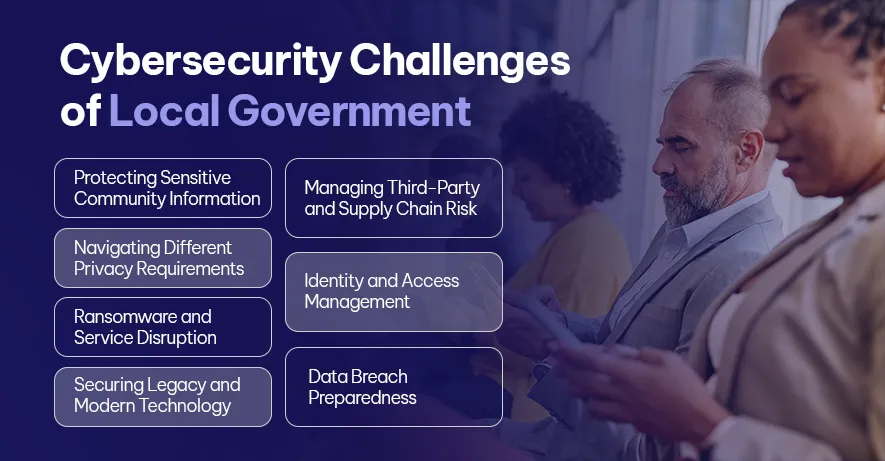
Challenge 1: Protecting Sensitive Community Information
- Councils collect and manage significant amounts of personal information.
- Depending on the jurisdiction and service, this can include information relating to residents, ratepayers, employees, applicants, contractors, and community programs.
- Security controls need to protect this information from unauthorised access, modification, loss, or disclosure.
- For councils, this means understanding what information they hold, where it is stored, who can access it, and how long it should be retained.
Challenge 2: Navigating Different Privacy Requirements
- One of the complexities for Australian local governments is that privacy requirements are not identical across the country.
- This makes jurisdiction-specific compliance particularly important.
- Councils need to understand the requirements applicable to their location and ensure policies, systems, contracts, and processes reflect those obligations.
- A national cybersecurity strategy can provide a foundation, but privacy governance should be tailored to the council’s specific legal environment.
Challenge 3: Ransomware and Service Disruption
Cybersecurity incidents can have a direct impact on essential community services.
A ransomware incident affecting council systems could disrupt:
- Customer service
- Payments
- Online portals
- Planning processes
- Internal communications
- Records access
- Operational services
The consequences therefore extend beyond data loss.
Cybersecurity resilience needs to focus on maintaining critical services, detecting incidents quickly, containing threats, and restoring operations effectively.
Challenge 4: Securing Legacy and Modern Technology
Councils often need to support technology with very different lifecycles.
A council may simultaneously operate:
- Legacy on-premises applications
- Microsoft 365
- Cloud infrastructure
- Line-of-business applications
- Public websites
- Mobile applications
- Operational technology
- IoT and connected devices
Maintaining consistent security across this environment can be difficult.
Older systems may not support modern authentication or security controls, while newer cloud platforms introduce different configuration and governance requirements.
A comprehensive technology and security assessment can help identify gaps across the entire environment rather than focusing on individual systems.
Challenge 5: Managing Third-Party and Supply Chain Risk
Councils rely on external providers for many services, including technology, infrastructure, software, consulting, payments, and community services.
This creates another layer of cybersecurity risk.
A supplier with access to council systems or information can potentially become an entry point for attackers.
Councils should therefore evaluate:
- Vendor security controls
- Data access requirements
- Identity and authentication
- Contractual responsibilities
- Incident notification procedures
- Data storage arrangements
- Business continuity capabilities
Challenge 6: Identity and Access Management
Compromised credentials remain a major cybersecurity concern.
Council employees, contractors, elected representatives, and third-party providers may require access to different systems and information.
A strong identity strategy should include:
- Multi-Factor Authentication (MFA)
- Role-Based Access Control
- Conditional Access
- Privileged account management
- Regular access reviews
- Strong joiner, mover, and leaver processes
The objective is straightforward: users should only have the access they need to perform their responsibilities.
Challenge 7: Data Breach Preparedness
Preventing every cyber incident is unrealistic.
Councils also need to prepare for what happens when something goes wrong.
A practical incident response framework should define:
- Who leads the response
- How incidents are detected
- Escalation procedures
- Communication responsibilities
- Legal and privacy considerations
- Recovery processes
- Post-incident reviews
For councils, this preparation can help reduce disruption and improve the speed and consistency of response.
Building a Stronger Cybersecurity and Compliance Framework
Local governments should take a risk-based approach rather than treating compliance as a checklist.
A practical framework should include:
Identify
Understand critical systems, sensitive information, users, suppliers, and technology dependencies.
Protect
Implement appropriate identity, endpoint, network, data, and access controls.
Detect
Use monitoring, logging, and security technologies to identify suspicious activity.
Respond
Maintain clear incident response procedures and responsibilities.
Recover
Ensure critical systems and services can be restored following an incident.
Govern
Regularly review risks, policies, suppliers, controls, and compliance requirements.
This approach aligns with the broader Australian cyber security principles published by the Australian Signals Directorate.
Cybersecurity Should Support Council Services
Security cannot come at the expense of usability or service delivery.
Councils need technology that allows employees to work efficiently while ensuring residents can access digital services securely.
This means cybersecurity decisions should consider:
- Community experience
- Operational continuity
- Accessibility
- Data protection
- Risk
- Cost
- Long-term technology strategy
The goal is not simply to deploy more security tools. It is to create a resilient technology environment that supports reliable public services.
Why Choose Exigo Tech as Your Managed Intelligence Partner
Exigo Tech helps Australian local governments strengthen cybersecurity, improve technology resilience, and manage compliance requirements through a practical, outcomes-focused approach.
As your Managed Intelligence Partner, we provide:
- Cybersecurity assessments
- Managed Security as a Service (MSaaS)
- Microsoft 365 security
- Microsoft Entra ID and identity security
- Cloud security and governance
- Endpoint protection
- Data protection and governance
- Backup and disaster recovery
- Security monitoring and response
- Ongoing managed IT services
Our approach brings together infrastructure, cloud, security, data, and business applications to help councils manage technology as an integrated environment.

 Exigo Tech - Ask AI (Beta)