 Australia
 Singapore
 Philippines
 India
India7.31 MIN READ
10 Practical AI Use Cases for Modern Businesses
 Alpesh Prajapati | Oct 09, 2026
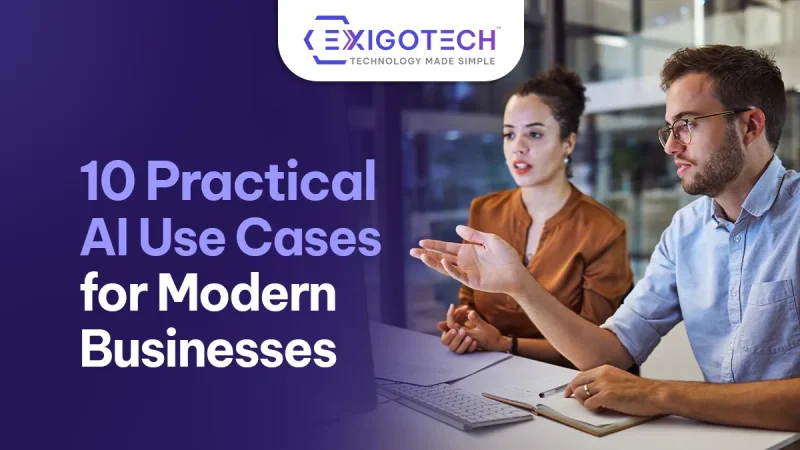
Artificial intelligence has moved beyond experimentation. Businesses are increasingly using AI to automate repetitive work, improve decision-making, accelerate customer service, and help employees work more efficiently.
For many organisations, the challenge is no longer whether to use AI. It is identifying where AI can deliver meaningful business value.
From intelligent document processing to AI-powered forecasting and employee assistance, practical use cases are emerging across almost every business function. The organisations seeing the most value are generally those that connect AI adoption to specific operational challenges rather than introducing AI simply because the technology is available.
Here are ten practical AI use cases that are transforming business operations and how organisations can approach them.
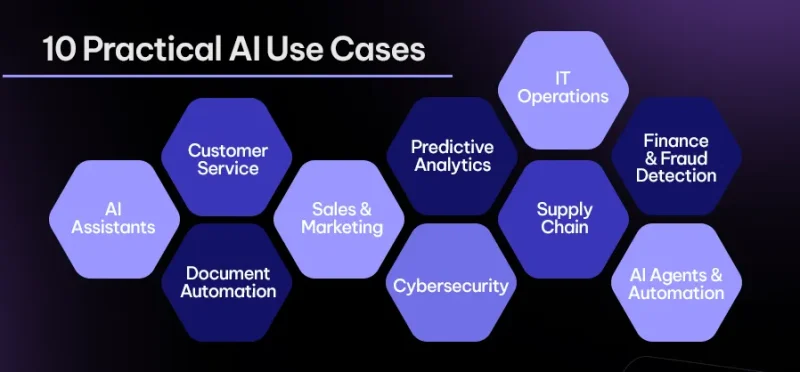
1. AI-Powered Employee Assistants
Employees spend significant amounts of time searching for information, summarising content, preparing documents, and managing routine communication.
AI assistants can help employees:
- Summarise meetings
- Draft emails
- Create documents
- Analyse information
- Generate presentations
- Find relevant business content
Microsoft 365 Copilot, for example, brings AI capabilities into applications employees already use, including Teams, Outlook, Word, Excel, and PowerPoint.
2. Intelligent Customer Service
AI can help customer service teams respond to enquiries faster while maintaining consistent service.
AI-powered systems can:
- Answer common questions
- Summarise customer interactions
- Recommend responses
- Retrieve relevant information
- Route enquiries
- Support service agents
AI agents can also handle routine interactions independently, while more complex requests can be escalated to human employees.
This creates an opportunity to improve response times without requiring every interaction to be handled manually.
3. Document Processing and Data Extraction
Many organisations still spend hours processing invoices, forms, contracts, purchase orders, and other documents.
AI can extract information from documents and automatically transfer relevant data into business systems.
For example, an organisation could use AI to identify:
- Supplier details
- Invoice numbers
- Purchase amounts
- Contract information
- Customer details
This reduces manual data entry and helps employees focus on tasks that require human judgement.
4. Sales and Marketing Intelligence
AI can analyse customer and sales information to help teams identify opportunities and prioritise activities.
Potential applications include:
- Lead prioritisation
- Customer segmentation
- Sales forecasting
- Proposal generation
- Campaign analysis
- Personalised content
CRM platforms can use AI to surface relevant customer information and help sales teams determine where to focus their attention.
The objective is not to replace sales teams but to give them better information at the right time.
5. Predictive Analytics and Forecasting
Traditional reporting explains what happened.
AI-powered analytics can help organisations identify what may happen next.
Businesses can use AI to analyse historical and current information to identify patterns related to:
- Demand
- Sales
- Customer behaviour
- Cash flow
- Inventory
- Operational performance
This can support more informed planning and help organisations respond to changing business conditions earlier.
6. Cybersecurity and Threat Detection
AI is increasingly becoming part of modern cybersecurity operations.
Security teams can use AI to analyse large volumes of security data and identify unusual activity.
Applications include:
- Threat detection
- Anomaly detection
- Identity monitoring
- Alert investigation
- Incident analysis
- Security recommendations
Microsoft security technologies and managed security services can combine AI-driven capabilities with human expertise to help organisations respond to threats more efficiently.
AI does not eliminate cybersecurity risk, but it can help security teams process information at a scale that would be difficult to achieve manually.
7. IT Operations and Predictive Maintenance
AI can also improve the reliability of technology environments.
By analysing system performance, logs, and operational data, AI can help identify unusual behaviour before it becomes a major incident.
For example, AI can assist with:
- Detecting performance anomalies
- Identifying recurring incidents
- Predicting potential failures
- Automating routine remediation
- Supporting IT service desks
This approach moves IT operations from reactive troubleshooting towards more proactive management.
8. Supply Chain Optimisation
Supply chains generate large volumes of operational data.
AI can analyse this information to help businesses understand demand patterns, inventory levels, supplier performance, and logistics activity.
Potential applications include:
- Demand forecasting
- Inventory optimisation
- Supplier risk analysis
- Delivery planning
- Route optimisation
- Procurement insights
For industries such as manufacturing, logistics, and distribution, these capabilities can support more efficient planning and resource allocation.
9. Financial Analysis and Fraud Detection
Finance teams can use AI to automate repetitive analysis and identify unusual transactions.
Applications include:
- Expense analysis
- Invoice processing
- Cash flow forecasting
- Financial reporting
- Fraud detection
- Anomaly identification
AI can help finance teams analyse larger volumes of transactions while highlighting information that may require human investigation.
Human oversight remains important, particularly when AI-generated insights influence financial decisions.
10. AI Agents and Business Process Automation
The next stage of AI adoption goes beyond generating content.
AI agents can perform sequences of tasks based on defined objectives and business rules.
For example, an AI agent could:
- Receive a customer enquiry.
- Retrieve relevant customer information.
- Check an order or account status.
- Generate a response.
- Escalate the request if human intervention is required.
When combined with automation platforms such as Microsoft Power Platform and Copilot Studio, AI agents can become part of broader business workflows.
This creates opportunities to automate processes that previously required multiple manual steps.
What Makes an AI Use Case Valuable?
Not every process needs AI.
Before implementing an AI solution, organisations should consider:
-
Business Impact
Will AI meaningfully improve productivity, revenue, customer experience, or operational efficiency?
-
Data Availability
Does the organisation have reliable, accessible data to support the use case?
-
Security and Privacy
Can the process be automated without exposing sensitive or regulated information?
-
Human Oversight
Where should employees remain responsible for reviewing or approving AI-generated outcomes?
-
Integration
Can the AI solution connect with the organisation’s existing applications and workflows?
These questions help separate practical AI opportunities from technology experiments that may not deliver meaningful value.
Building the Right AI Foundation
Successful AI adoption depends on more than selecting an AI tool.
Organisations also need:
- Data governance
- Identity and access controls
- Cybersecurity
- AI governance policies
- Clear use cases
- Employee training
- Integration capabilities
- Ongoing monitoring
A strong foundation allows businesses to scale AI responsibly rather than deploying isolated tools across different departments.
Why Choose Exigo Tech as Your Managed Intelligence Partner
At Exigo Tech, we help organisations move from AI experimentation to practical business adoption.
As your Managed Intelligence Partner, we combine AI, automation, data, cloud, security, and business applications to create solutions aligned with operational objectives.
Our capabilities include:
- Microsoft 365 Copilot
- Copilot Studio
- AI Agents
- Azure AI
- Power Platform
- Data and Analytics
- AI Strategy and Readiness
- AI Governance
- Managed IT and Security Services
We focus on identifying where AI can solve real business problems and building the technology foundations required to scale those solutions securely.
 Exigo Tech - Ask AI (Beta)