India
 Australia
 Singapore
 Philippines
8.02 MIN READ
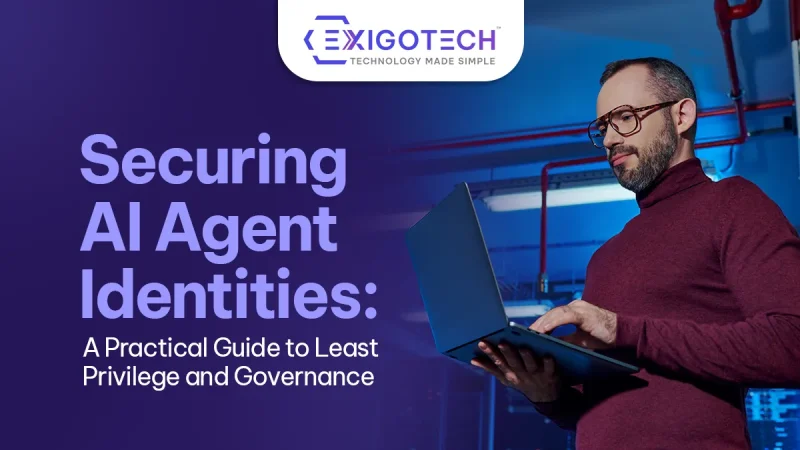
Securing AI Agent Identities: A Practical Guide to Least Privilege and Governance
 Niten Devalia | Nov 16, 2026
AI agents are moving beyond answering questions. They can retrieve business information, call APIs, update records, trigger workflows and interact with multiple enterprise systems. As organisations introduce these capabilities, a new security challenge emerges: how do you control the identity and permissions of software that can act autonomously?
Traditional identity security focuses on employees, administrators and external users. AI agents introduce another category of identity that needs clear ownership, controlled access and ongoing oversight. Without these safeguards, an agent may retain excessive permissions, access information beyond its intended purpose or continue operating after its business owner has moved on.
For Australian businesses adopting Microsoft Copilot Studio, Microsoft Foundry and other agentic AI solutions, identity governance needs to be part of the deployment process from the beginning.
Microsoft Entra provides capabilities to manage AI agent identities, apply access controls and govern their lifecycle. The priority is to combine these tools with clear business accountability and a least-privilege security model.
Why AI Agents Need Their Own Identity Security Strategy
An AI agent is not simply another employee account or a conventional software application. Depending on its design, it may operate independently, act on behalf of a user or delegate tasks to other agents.
Each arrangement creates different access requirements.
Three common problems emerge when agent identity security is not planned properly:
- Identity ambiguity: Shared credentials or unclear identity models make it difficult to determine which agent performed an action and under whose authority.
- Excessive permissions: Agents receive broad access during development and retain it after the initial use case changes.
- Unclear accountability: No individual or team is responsible for reviewing the agent’s access, approving changes or retiring it when it is no longer needed.
Treating agent identity as a core security requirement helps organisations establish accountability before expanding AI autonomy.
Apply Least Privilege to Every AI Agent
Least privilege means granting an identity only the access it needs to perform its approved tasks. For AI agents, this principle must cover more than the initial application permissions.
An agent may call multiple tools, access different data sources and trigger downstream workflows. Its effective permissions are therefore determined by the combined access available across the entire workflow.
A practical least-privilege approach should include:
- Define the agent’s purpose: Document the business process it supports, the actions it is allowed to perform and the information it needs to access.
- Restrict resource access: Grant access to specific applications, APIs, SharePoint sites or data resources rather than entire environments wherever practical.
- Control tool usage: Allow only approved tools, connectors and actions. An agent designed to retrieve information should not automatically have permission to delete records or change security settings.
- Separate sensitive actions: Require appropriate human approval or time-limited privilege elevation for high-impact operations, such as financial approvals, permission changes or sensitive data exports.
- Review combined permissions: Examine the agent’s effective access across all connected systems. Several individually narrow permissions can still create excessive access when combined.
These controls should be tested against realistic scenarios, including unexpected instructions and attempts to access resources outside the agent’s approved scope.
Establish Clear Ownership and Accountability
Every production AI agent should have a clearly identified owner and a defined business purpose.
Microsoft Entra Agent ID supports the management of agent identities, including ownership and sponsor information. These roles help organisations connect technical administration with business oversight.
A useful ownership record should identify:
- The agent’s business purpose and responsible department.
- Its technical owner and business sponsor.
- Approved data sources, tools and integrations.
- Required permissions and the rationale for each.
- Review dates and conditions that trigger reassessment.
- The person or team authorised to suspend or retire the agent.
Govern the AI Agent Lifecycle
Agent identity security must cover the entire lifecycle, from initial creation through deployment, modification and retirement.
Discovery and registration
- Maintain an inventory of AI agents across approved platforms and business environments. Record their identities, owners, sponsors, permissions, deployment locations and connected services.
- Include agents created by different teams, not just those developed centrally. Unregistered or poorly documented agents can create gaps in security visibility.
Approval and deployment
- Before an agent enters production, validate its business purpose, access requirements, data handling and security controls. Confirm that the appropriate owner has approved the deployment and that the agent has been assigned a suitable identity.
- Development and testing environments should have access restrictions appropriate to the information and systems they contain.
Ongoing review
- Reassess permissions when an agent gains new tools, accesses additional data or changes its role. Periodically review unused identities, stale credentials and permissions that are no longer necessary.
- For higher-risk agents, consider more frequent access reviews and stronger monitoring.
Retirement and revocation
- When an agent is no longer required, disable or retire its identity through a controlled process. Remove access grants, revoke relevant credentials or tokens where supported, and check downstream systems for residual permissions.
- Retirement should also cover connected workflows, API credentials and dependent agents. Simply deleting an entry from an inventory does not guarantee that all access has been removed.
How Microsoft Entra Supports AI Agent Security
Microsoft Entra provides an identity control plane for managing access across users, applications and AI agents. Its capabilities can help organisations apply identity security and governance principles to non-human identities.
- Microsoft Entra Agent ID provides a framework for creating and managing agent identities, assigning owners and sponsors, and supporting identity lifecycle governance. Organisations can use it to improve visibility and accountability for supported agent deployments.
- Conditional Access can help enforce policies for supported agent identity scenarios. Policies must be designed for agent-specific authentication patterns rather than assuming that every agent behaves like an interactive human user.
- Identity governance capabilities can support access reviews, lifecycle processes and controlled access management where the relevant functionality and licensing are available.
- Audit and monitoring capabilities help security teams investigate identity activity, review permission changes and establish accountability for actions performed by agents.
Why Choose Exigo Tech as Your Managed Intelligence Partner
Securing AI agents requires coordination across identity, application access, security architecture and AI governance. Exigo Tech helps organisations establish practical controls that support AI adoption without overlooking identity-related risks.
- Identity and Access Management: Review identity architecture, permissions and access policies across Microsoft environments.
- Zero Trust Security: Strengthen access controls, authorisation and security monitoring around critical resources.
- AI Governance and Readiness: Establish agent ownership, approval processes, lifecycle standards and oversight requirements.
- Microsoft Security Solutions: Apply relevant Microsoft Entra capabilities to support agent identity management and protection.
- Managed Security Services: Support ongoing monitoring, security reviews and continuous improvement as AI environments evolve.
As your Managed Intelligence Partner, Exigo Tech helps connect AI innovation with accountable access, security governance and sustainable operational practices.

 Exigo Tech - Ask AI (Beta)