 India
India Australia
 Singapore
 Philippines
6.01 MIN READ
How to Build AI Governance Policies: An Australian Compliance Guide
 Ben Opit | Jul 31, 2026
Artificial Intelligence is rapidly becoming part of everyday business operations.
From Microsoft Copilot and Power Platform to AI-powered customer service, document generation, and analytics, Australian organisations are embracing AI to improve productivity and drive innovation.
However, as AI adoption accelerates, so do the risks.
Without clear governance, employees may use unapproved AI tools, expose sensitive information, or inadvertently create compliance issues. At the same time, Australia’s regulatory landscape is evolving, with growing expectations around transparency, privacy, and responsible AI use.
An AI governance policy helps organisations establish the rules, responsibilities, and controls needed to use AI safely and responsibly.
At Exigo Tech, we help businesses implement secure AI governance as their Managed Intelligence Partner, enabling organisations to innovate with confidence while meeting security and compliance requirements.
What Is an AI Governance Policy?
An AI governance policy is a framework that defines how artificial intelligence can be used within an organisation.
Rather than focusing only on technology, it establishes clear expectations around:
- Approved AI tools
- Data protection
- User responsibilities
- Risk management
- Compliance obligations
- Security controls
- Ongoing oversight
The objective is to ensure AI supports business goals without introducing unnecessary operational, legal, or cybersecurity risks.
Why Australian Businesses Need AI Governance
Many organisations have adopted AI faster than they’ve developed policies to manage it.
Employees are increasingly using tools like Microsoft Copilot, ChatGPT, and other AI applications to:
- Draft documents
- Summarise meetings
- Analyse data
- Generate reports
- Create presentations
- Write code
While these capabilities improve productivity, they also create new risks if sensitive business information is entered into unapproved AI platforms.
An AI governance policy provides consistent guidance across the organisation, helping employees use AI responsibly while reducing business risk.
Understanding Australia’s AI Compliance Landscape
Australian organisations should build AI governance with existing and emerging regulations in mind.
Key considerations include:
Privacy Act Requirements
Businesses handling personal information must ensure AI systems comply with Australian privacy obligations, including appropriate collection, storage, use, and disclosure of data.
Automated Decision-Making Transparency
As Australia’s regulatory framework evolves, organisations using AI in decisions that significantly affect individuals should be prepared to document and explain how those systems operate.
Industry Compliance
Depending on the sector, businesses may also need to consider:
- Financial services obligations
- Healthcare privacy requirements
- Government procurement standards
- Industry-specific cybersecurity frameworks
An effective governance policy helps organisations prepare for both current and future compliance expectations.
Step 1: Define Your AI Objectives
Governance should support business strategy, not restrict innovation.
Begin by identifying:
- Why AI is being adopted
- Business processes that will benefit
- Expected productivity improvements
- Acceptable business outcomes
Clear objectives ensure governance enables responsible adoption rather than creating unnecessary barriers.
Step 2: Identify Approved AI Solutions
Not every AI application should be available for business use.
Your policy should clearly define approved platforms, such as:
- Microsoft Copilot
- Microsoft 365 Copilot
- Microsoft Copilot Studio
- Azure AI Services
- Approved Power Platform AI capabilities
Where third-party AI tools are permitted, approval processes should be clearly documented.
Step 3: Classify Business Data
AI governance begins with understanding your data.
Organisations should identify information that is:
- Public
- Internal
- Confidential
- Highly sensitive
- Regulated
Once classified, policies should specify which data types can and cannot be processed using AI tools.
Step 4: Define Acceptable AI Usage
Employees need practical guidance.
Your policy should explain:
- Appropriate AI use cases
- Prohibited activities
- Handling of customer information
- Use of confidential business data
- Human review requirements
- Content verification responsibilities
Clear rules reduce uncertainty while encouraging responsible AI adoption.
Step 5: Strengthen Security Controls
AI governance should align with existing cybersecurity practices.
This includes:
- Multi-Factor Authentication (MFA)
- Microsoft Entra ID
- Conditional Access
- Role-Based Access Control
- Microsoft Defender
- Secure identity management
Security controls help ensure AI systems operate within approved organisational boundaries.
Step 6: Implement Microsoft Purview
Microsoft Purview plays a critical role in AI governance.
It helps organisations:
- Apply sensitivity labels
- Protect confidential information
- Prevent data leakage
- Manage data retention
- Support regulatory compliance
- Monitor information usage
These capabilities help ensure AI only accesses appropriately governed information.
Step 7: Establish Governance Roles
AI governance should not sit solely with IT.
Clearly define responsibilities across:
- Executive leadership
- IT teams
- Security teams
- Compliance officers
- Legal teams
- Business unit leaders
Shared accountability leads to stronger governance and more consistent decision-making.
Step 8: Monitor AI Usage
Governance is an ongoing process.
Regularly review:
- AI adoption trends
- User activity
- New AI applications
- Security incidents
- Compliance risks
- Policy effectiveness
Continuous monitoring allows organisations to adapt as AI technologies evolve.
Step 9: Educate Employees
Policies are only effective if employees understand them.
Training should cover:
- Responsible AI use
- Privacy obligations
- Data protection
- Prompt best practices
- AI limitations
- Human oversight
Regular education helps create a culture of responsible AI adoption.
Common AI Governance Mistakes
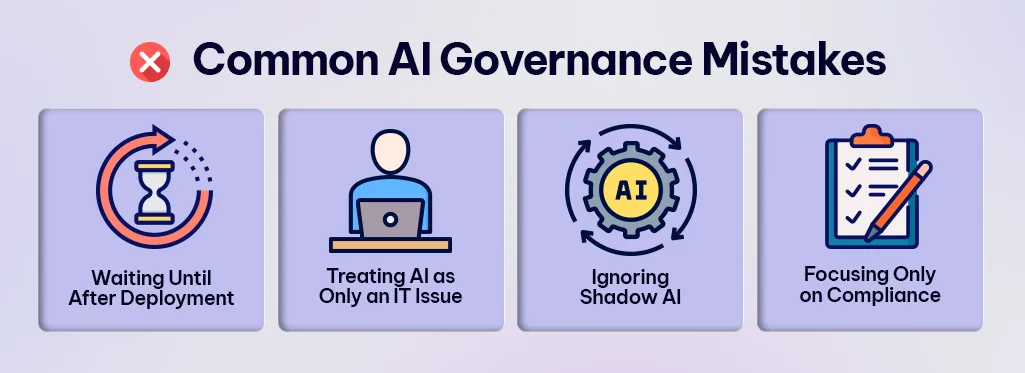
Many organisations make governance more difficult than necessary.
Common challenges include:
Waiting Until After Deployment
Governance should begin before AI is widely adopted, not afterwards.
Treating AI as Only an IT Issue
AI affects legal, compliance, HR, security, and business operations. Governance should involve multiple stakeholders.
Ignoring Shadow AI
Employees often adopt AI tools independently if approved alternatives are unavailable.
Policies should address both approved and unauthorised AI usage.
Focusing Only on Compliance
Good governance balances compliance with innovation, enabling employees to use AI safely rather than preventing adoption altogether.
Why Choose Exigo Tech as Your Managed Intelligence Partner
At Exigo Tech, we help Australian organisations build practical AI governance frameworks that support secure innovation and long-term business success.
As your Managed Intelligence Partner, we provide:
- AI Governance Consulting
- Microsoft Copilot Readiness Assessments
- Microsoft Purview implementation
- Microsoft Entra ID optimisation
- Microsoft 365 Security Health Checks
- Data governance and compliance advisory
- Security policy development
- Ongoing managed IT and cybersecurity services
Our approach aligns technology, governance, and business strategy to help organisations adopt AI with confidence.
Strong AI Governance Enables Confident Innovation
AI offers enormous opportunities for Australian businesses, but only when supported by clear governance.
By defining approved AI tools, protecting sensitive data, strengthening security controls, and educating employees, organisations can reduce risk while unlocking the full value of AI.
Rather than slowing innovation, effective governance provides the foundation for responsible AI adoption, helping businesses remain secure, compliant, and prepared for Australia’s evolving regulatory landscape.



 Exigo Tech - Ask AI (Beta)