 India
India Australia
 Singapore
 Philippines
5.41 MIN READ
Why Licensing Should Be a Strategic Conversation, Not Just a Procurement Task
 Niten Devalia | Mar 20, 2026
In many organisations, licensing decisions are treated as routine administrative tasks.
A renewal date approaches, a vendor quote arrives, procurement reviews the pricing, and the licences are renewed. But modern technology environments are no longer simple.
Licensing now directly affects cloud costs, security capabilities, infrastructure design, and long-term digital transformation initiatives. When licensing is handled purely as a purchasing exercise, organisations often miss opportunities to optimise costs, improve governance, and align technology investments with business growth.
This is why licensing should no longer be viewed as a transactional process.
It should be a strategic conversation that connects IT, finance, and procurement.
As part of our Licensing Campaign, we are exploring why licensing must move beyond renewals and become a structured part of technology planning.
The Traditional Licensing Approach
Historically, software licensing was relatively straightforward.
Organisations would purchase licences or fixed subscription agreements, usually tied to a specific product or platform. Renewals were predictable, and the impact on broader technology strategy was limited.
Today, the landscape is very different.
Modern environments include:
- Cloud infrastructure platforms.
- SaaS productivity tools.
- Security solutions.
- Backup and recovery platforms.
- Virtualisation technologies.
- AI and automation capabilities.
Each platform introduces multiple licensing tiers, consumption models, and commercial structures. When licensing decisions are made without broader strategic input, organisations often end up with fragmented agreements and unnecessary complexity.
Why Licensing Decisions Now Impact the Entire Technology Stack
Licensing no longer influences just access to software. It directly shapes how technology environments operate.
For example:
- Cloud licensing affects workload architecture and cost optimisation.
- Security licensing determines which protection capabilities are available.
- Collaboration platform licences influence productivity and automation opportunities.
- Infrastructure licensing impacts scalability and hybrid deployment strategies.
Because of this, licensing decisions should align with long-term technology planning. Treating licensing purely as a procurement decision ignores the broader impact it has on infrastructure, cloud economics, and operational efficiency.

The Importance of Aligning IT, Finance, and Procurement
One of the biggest challenges organisations faces is that licensing decisions often sit between multiple teams.
- IT Teams: Focus on technology capability and operational performance.
- Finance Teams: Focus on budgeting, cost predictability, and commercial oversight.
- Procurement Teams: Focus on vendor negotiation and contract management.
When these groups operate independently, licensing decisions can become disconnected from both technical requirements and financial strategy.
A strategic licensing conversation brings these perspectives together.
Why Developers Should Not Control Commercial Structure Alone
Developers and engineering teams play a vital role in selecting and deploying technology platforms.
They understand the tools needed to build applications, run workloads, and deliver innovation. However, allowing development teams to control the commercial structure of licensing can introduce challenges.
Developers typically prioritise:
- Speed of deployment.
- Technical capability.
- Flexibility in experimentation.
These priorities are essential for innovation, but they do not always align with commercial optimisation.
For example:
- Workloads may run indefinitely on consumption-based pricing.
- Premium licence tiers may be used when lower tiers would suffice.
- Infrastructure may scale without cost modelling.
Without strategic oversight, technically correct decisions can still lead to inefficient licensing structures.
Licensing strategy should therefore complement development decisions rather than follow them blindly.
Licensing as Part of Digital Transformation Planning
Digital transformation initiatives often involve significant technology investment.
Organisations may adopt:
- Cloud infrastructure
- Hybrid environments
- Data platforms
- Automation tools
- AI capabilities
- Collaboration platforms
Each of these initiatives introduces licensing implications. When licensing is considered late in the process, organisations may miss opportunities to structure agreements more efficiently.
In contrast, when licensing is integrated into transformation planning from the beginning, organisations can:
- Align contracts with growth projections.
- Optimise cloud consumption models.
- Enable security capabilities earlier.
- Avoid unnecessary licensing tiers.
- Plan predictable technology spending.
Licensing becomes a strategic enabler rather than a reactive cost.
The Risk of Treating Licensing as an Administrative Task
When licensing is managed purely as an administrative activity, organisations often experience:
- Fragmented vendor agreements.
- Duplicate platform capabilities.
- Limited visibility across subscriptions.
- Renewals driven by expiry dates rather than strategy.
- Over-licensing or under-licensing risks.
Over time, these inefficiencies increase both operational complexity and technology costs.
Benefits of Strategic Licensing Conversations
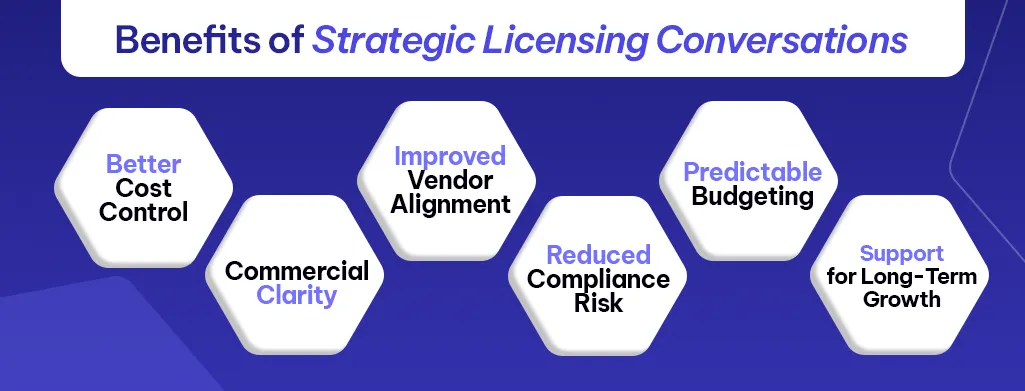
Organisations that approach licensing strategically typically gain several advantages.
- Better Cost Control: Licensing models are structured intentionally rather than evolving randomly.
- Commercial Clarity: Leadership gains visibility into technology spend across platforms.
- Improved Vendor Alignment: Contracts support infrastructure and cloud strategy rather than conflicting with it.
- Reduced Compliance Risk: Licensing entitlements remain aligned with deployed technology.
- Predictable Budgeting: Finance teams can plan technology spend with greater confidence.
- Support for Long-Term Growth: Licensing agreements scale alongside organisational expansion.
Moving from Procurement to Strategy
Licensing should not begin with a vendor quote.
Instead, organisations should start with key strategic questions:
- How will our technology environment evolve over the next three years?
- Which platforms are central to our operations?
- Which workloads will scale significantly?
- Where can commitments reduce long-term costs?
- Which licensing models support our transformation roadmap?
Answering these questions allows licensing to become part of strategic planning rather than a reactive purchase.
Why Choose Exigo Tech as Your Managed Intelligence Partner
At Exigo Tech, we approach licensing differently.
Rather than treating licences as isolated transactions, we examine how licensing decisions influence the entire technology ecosystem.
As your Managed Intelligence Partner, we help organisations:
- Align IT, finance, and procurement perspectives.
- Review licensing across the full technology stack
- Model alternative commercial structures.
- Consolidate vendor agreements.
- Optimise licensing as environments evolve.
Our consultancy-first approach ensures licensing supports business objectives rather than becoming an unmanaged operational expense.
 Exigo Tech - Ask AI (Beta)