 India
India Australia
 Singapore
 Philippines
6.14 MIN READ
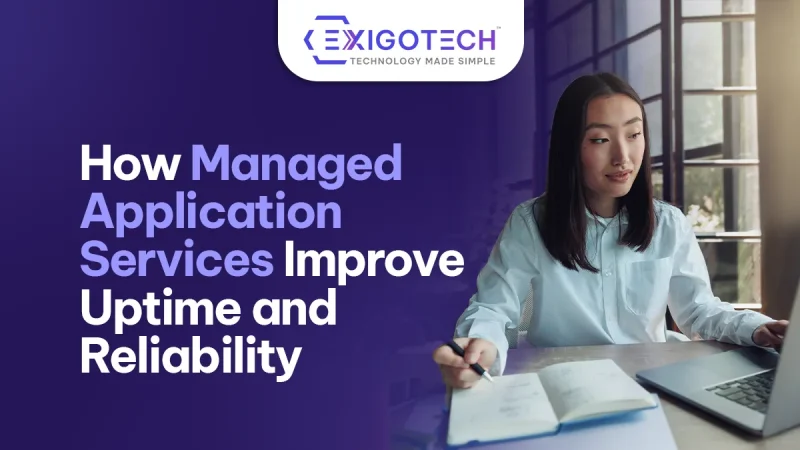
How Managed Application Services Improve Uptime and Reliability
 Vinay Joshi | Oct 07, 2026
Business applications have become essential to day-to-day operations. ERP platforms manage financial processes, CRM systems support customer relationships, and custom applications help teams manage everything from field operations to employee workflows.
When these applications become slow, unavailable, or unreliable, the impact quickly extends beyond IT.
Employees lose productivity, customers experience delays, and critical business processes can come to a standstill.
This is where Managed Application Services can make a difference. Instead of relying solely on internal teams to maintain applications, organisations can use a dedicated managed service to monitor, maintain, support, and continuously optimise their business applications.
At Exigo Tech, we help organisations improve application performance and reliability as their Managed Intelligence Partner, combining application expertise, cloud capabilities, monitoring, security, and proactive support.
What Are Managed Application Services?
Managed Application Services provide ongoing support and management for business applications throughout their lifecycle.
Depending on the organisation’s requirements, services may include:
- Application monitoring
- Performance management
- Application support
- Incident management
- Security updates
- Application maintenance
- Integration support
- User support
- Performance optimisation
- Continuous improvement
Instead of addressing application problems only when they occur, managed services take a proactive approach to maintaining application health.
Why Application Uptime Matters
Application downtime can have a direct impact on business operations.
For example, an unavailable ERP system could prevent employees from processing orders or accessing financial information. A CRM outage could affect sales and customer service teams.
The consequences may include:
- Lost productivity
- Delayed customer service
- Missed transactions
- Operational disruption
- Revenue impact
- Increased IT support costs
Even when an application remains technically available, poor performance can create similar problems.
Slow applications can reduce employee productivity and frustrate users, making application performance just as important as availability.
1. Continuous Application Monitoring
One of the key benefits of Managed Application Services is ongoing monitoring.
Instead of waiting for employees to report problems, managed service teams can monitor application health and identify potential issues proactively.
Monitoring can cover:
- Application availability
- Performance
- Response times
- Infrastructure health
- Database performance
- Integration status
- Error rates
Early detection allows issues to be investigated before they become major disruptions.
2. Proactive Issue Resolution
Traditional application support can often be reactive.
A problem occurs, users report it, and IT begins troubleshooting.
Managed Application Services introduce a more proactive approach.
By monitoring application performance and identifying recurring issues, service teams can address underlying causes rather than repeatedly fixing the same symptoms.
This can help reduce:
- Recurring incidents
- Unplanned downtime
- Support tickets
- Performance degradation

3. Faster Incident Response
Not every application issue can be prevented.
When incidents occur, response time becomes critical.
Managed Application Services provide defined support processes for identifying, prioritising, escalating, and resolving application incidents.
Depending on the service model, organisations can benefit from:
- Defined response times
- Escalation procedures
- Specialist application support
- Incident tracking
- Root cause analysis
A structured response process helps minimise the operational impact of application problems.
4. Application Performance Optimisation
Reliability isn’t just about keeping an application online.
An application can technically be available while still performing poorly.
Managed services can identify performance bottlenecks across areas such as:
- Databases
- Integrations
- APIs
- Infrastructure
- Application configuration
- Network connectivity
Regular optimisation helps applications remain responsive as user numbers, transaction volumes, and business requirements increase.
5. Keeping Applications Secure and Up to Date
Outdated applications can introduce security vulnerabilities and compatibility issues.
Managed Application Services can help organisations maintain appropriate application versions, updates, patches, and security configurations.
This is particularly important for business-critical platforms that integrate with cloud services, operating systems, databases, and third-party applications.
Keeping the application environment maintained helps reduce technical debt while supporting a more stable technology environment.
6. Reducing Pressure on Internal IT Teams
Internal IT teams are often responsible for multiple priorities, including infrastructure, cybersecurity, users, cloud environments, and strategic technology projects.
Application management can consume significant time, particularly when specialised knowledge is required.
Managed Application Services provide access to specialist expertise while allowing internal teams to focus on higher-value initiatives.
This can be particularly useful for SMBs that need application expertise without maintaining a large specialist team internally.
Managed Application Services vs Reactive Support
The difference can be summarised simply:
| Reactive Application Support | Managed Application Services |
| Responds after issues occur | Continuously monitors application health |
| Focuses on fixing incidents | Focuses on preventing recurring issues |
| Limited visibility between incidents | Ongoing performance visibility |
| Primarily break-fix | Proactive maintenance and optimisation |
| Internal teams carry most responsibility | Shared or outsourced specialist responsibility |
| Improvement often follows major incidents | Continuous improvement is built into the service |
Which Applications Can Be Managed?
Managed Application Services can support a wide range of business platforms, including:
- Enterprise Resource Planning (ERP)
- Customer Relationship Management (CRM)
- Microsoft Dynamics 365
- Dynamics 365 Business Central
- Power Apps
- Custom business applications
- Microsoft Power Platform solutions
- Integration platforms
- Data and reporting applications
Why Choose Exigo Tech as Your Managed Intelligence Partner
At Exigo Tech, we help organisations manage and optimise business applications throughout their lifecycle.
As your Managed Intelligence Partner, we combine application management with broader technology capabilities, including:
- Managed Application Services
- Microsoft Dynamics 365
- Business Central
- Power Apps and Power Platform
- Application Monitoring
- Application Support and Maintenance
- Integration Management
- Cloud Infrastructure
- Security and Governance
- Data and Analytics
Our approach goes beyond keeping applications running. We focus on application performance, reliability, security, and continuous improvement so technology continues to support business outcomes.

 Exigo Tech - Ask AI (Beta)