
 India
India Australia
 Singapore
 Philippines
7 MIN READ
Business Resilience vs Business Continuity: What Is the Difference?
 Niten Devalia | Oct 05, 2026
Businesses face disruption from many directions. Cyberattacks, cloud outages, infrastructure failures, supply chain interruptions, extreme weather, and technology failures can all affect critical operations.
Two terms frequently used when discussing how organisations prepare for these events are business continuity and business resilience. While they are closely connected, they are not the same thing.
Business continuity focuses on keeping critical operations running during and after a disruption. Business resilience takes a broader view, helping an organisation prepare for disruption, respond effectively, recover quickly, and adapt to changing circumstances.
Understanding the difference can help Australian businesses build a more comprehensive approach to protecting operations, technology, people, and customers.
At Exigo Tech, we help organisations strengthen their technology foundations as a Managed Intelligence Partner, combining infrastructure, cloud, cybersecurity, data, and managed services to support resilient business operations.
What Is Business Continuity?
Business continuity is the ability of an organisation to maintain or quickly restore its critical operations when a disruptive event occurs.
A business continuity plan typically answers questions such as:
- Which business functions are critical?
- What happens if a key system becomes unavailable?
- Who is responsible for responding?
- How will employees continue working?
- How quickly must systems be restored?
- What alternative processes are available?
The focus is on maintaining essential operations and restoring normal activities.
For example, if a ransomware attack takes down business applications, a continuity plan may define how employees access alternative systems, how critical operations continue, and how technology is restored.
What Is Business Resilience?
Business resilience goes beyond responding to a specific disruption.
It is an organisation’s broader ability to anticipate, withstand, respond to, recover from, and adapt to disruption.
Resilience considers a wider range of factors, including:
- Technology
- Cybersecurity
- People
- Suppliers
- Processes
- Data
- Financial stability
- Customer relationships
Rather than asking only, “How do we recover?”, resilience asks:
“How do we continue operating, adapt to disruption, and become better prepared for the next one?”

Business Continuity vs Business Resilience
The simplest way to understand the difference is through their focus.
| Business Continuity | Business Resilience |
| Focuses on maintaining critical operations | Focuses on the organisation’s ability to withstand and adapt to disruption |
| Often centred around specific disruption scenarios | Takes a broader, organisation-wide view |
| Emphasises response and recovery | Includes preparation, response, recovery, and adaptation |
| Uses continuity and recovery plans | Combines multiple capabilities and strategies |
| Often focuses heavily on operational processes and IT recovery | Considers technology, people, suppliers, processes, and customers |
Why Business Continuity Still Matters
Business resilience does not make business continuity unnecessary.
A strong continuity plan remains essential for managing specific disruptions.
For example, an organisation may have documented procedures for:
- Cybersecurity incidents
- Cloud service outages
- Power failures
- Data loss
- Building closures
- Critical supplier disruptions
These plans provide employees with clear actions during high-pressure situations.
Without documented procedures, organisations may waste valuable time deciding what to do while the disruption is already affecting customers and operations.
Why Business Resilience Goes Further
A continuity plan may help an organisation respond to a known scenario.
Resilience prepares the business for a wider range of possibilities.
For example, consider a manufacturing company that depends on a critical supplier.
A business continuity plan may explain what happens if that supplier becomes unavailable.
A resilience strategy could go further by:
- Identifying supplier concentration risks
- Establishing alternative suppliers
- Maintaining appropriate inventory
- Monitoring supplier risk
- Reviewing contractual arrangements
- Testing alternative processes
This approach reduces dependency on a single recovery plan and strengthens the organisation’s ability to adapt.
The Role of Technology in Business Resilience
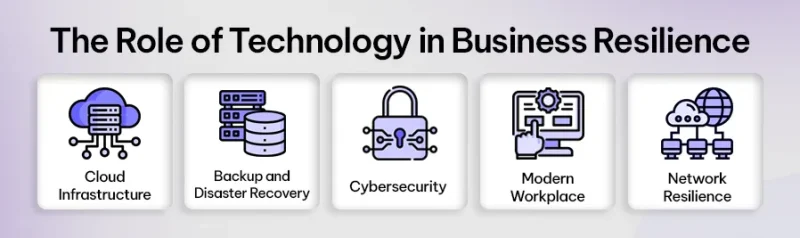
Technology is now central to business operations.
A resilient technology environment should support organisations before, during, and after disruption.
Important capabilities include:
-
Cloud Infrastructure
Cloud platforms such as Microsoft Azure can provide scalable infrastructure and support recovery strategies for critical workloads.
-
Backup and Disaster Recovery
Regular backups and tested recovery processes help organisations restore data and systems following failures or cyber incidents.
-
Cybersecurity
Preventing and containing cyber incidents is a critical part of resilience. Security monitoring, identity protection, endpoint security, and incident response all contribute to operational continuity.
-
Modern Workplace
Microsoft 365 and cloud-based collaboration tools can help employees continue working when traditional workplaces or infrastructure are unavailable.
-
Network Resilience
Redundant connectivity and appropriately designed network infrastructure can reduce the impact of connectivity failures.
Recovery Objectives Matter
Business continuity and resilience strategies should be based on clearly defined recovery objectives.
Two important measurements are:
-
Recovery Time Objective (RTO):
How quickly a system or service needs to be restored after disruption.
-
Recovery Point Objective (RPO):
How much data loss, measured in time, the organisation can tolerate.
For example, a critical financial application might require a shorter RTO and RPO than a non-critical internal application.
These requirements should be determined by business impact, not simply by what technology is available.
No posts found in the same category.
How to Build a Resilient Business
Building resilience is an ongoing process.
A practical approach includes:
1. Identify Critical Operations
Determine which services, systems, people, and suppliers are essential to the business.
2. Assess Potential Disruptions
Consider cybersecurity incidents, technology failures, natural disasters, supplier issues, and other operational risks.
3. Conduct a Business Impact Analysis
Understand the financial and operational consequences if critical activities become unavailable.
4. Establish Recovery Requirements
Define appropriate RTOs, RPOs, recovery procedures, and escalation processes.
5. Implement Appropriate Controls
Invest in cybersecurity, backup, disaster recovery, cloud infrastructure, redundancy, and monitoring based on business requirements.
6. Test and Improve
Regularly test plans and update them as the organisation, technology, and risk environment change.
Why Choose Exigo Tech as Your Managed Intelligence Partner
At Exigo Tech, we help organisations build resilient technology environments that support business continuity and long-term operational resilience.
As your Managed Intelligence Partner, our capabilities include:
- Business Continuity and Disaster Recovery Consulting
- Azure Infrastructure and Cloud Services
- Backup and Disaster Recovery
- Cybersecurity and Managed Security
- Microsoft 365 and Modern Workplace
- Network Infrastructure
- Cloud Security and Governance
- Ongoing Managed IT Services
We take a business-first approach, helping organisations align technology resilience with their operational priorities and recovery requirements.



 Exigo Tech - Ask AI (Beta)