Australia
 Singapore
 Philippines
 India
7.11 MIN READ
How AI Improves Operational Efficiency Without Replacing Employees
 Alpesh Prajapati | Oct 28, 2026
Artificial intelligence is changing how businesses work, but one of the biggest misconceptions around AI is that its primary purpose is to replace employees.
For most organisations, the greater opportunity is different: use AI to help people spend less time on repetitive work and more time on work that requires judgement, creativity, and human interaction.
AI can summarise information, automate routine processes, identify patterns, draft content, assist customers, and support decision-making. When implemented responsibly, these capabilities can improve operational efficiency without removing the human expertise that keeps businesses running.
At Exigo Tech, we help organisations achieve that balance as their Managed Intelligence Partner, combining AI, automation, data, security, and business applications to improve productivity while keeping people at the centre of transformation.
AI Should Augment Employees, Not Just Automate Them
Automation has existed for decades. What makes modern AI different is its ability to work with unstructured information, understand context, generate content, and assist with more complex tasks.
This creates an opportunity to redesign how employees work.
Instead of asking:
“Which jobs can AI replace?”
Businesses should ask:
“Which tasks can AI improve so our people can focus on higher-value work?”
This shift creates a more practical approach to AI adoption.
1. Automating Repetitive Administrative Tasks
Employees spend significant amounts of time on repetitive activities such as:
- Data entry
- Document creation
- Meeting summaries
- Email drafting
- Report preparation
- Information searches
- Scheduling
AI can automate or accelerate many of these activities.
2. Helping Employees Find Information Faster
Large organisations often have information spread across emails, documents, SharePoint sites, Teams conversations, business applications, and databases.
Finding the right information can consume significant employee time.
AI assistants can help employees discover relevant information more quickly, summarise lengthy content, and surface useful context.
This can reduce time spent searching and allow employees to focus on applying information rather than locating it.
3. Supporting Better Decision-Making
AI can process large amounts of information far faster than a person can manually review it.
For example, AI-powered analytics can help identify:
- Sales trends
- Operational anomalies
- Customer behaviour
- Inventory patterns
- Financial trends
- Performance changes
4. Improving Customer Service
AI can support customer service teams without removing the human relationship.
AI can:
- Answer routine questions
- Summarise customer histories
- Suggest responses
- Categorise enquiries
- Retrieve relevant information
- Route complex issues
Employees can then spend more time handling situations that require empathy, negotiation, judgement, or problem-solving.
The result is not necessarily fewer customer service employees – it can be more productive customer service teams.
5. Making Employees More Productive
Productivity is one of the clearest opportunities for workplace AI.
An employee who previously spent an hour preparing a report may be able to use AI to create an initial version in minutes.
That doesn’t mean the employee becomes unnecessary.
Instead, their role can shift towards:
- Reviewing the output
- Adding business context
- Validating information
- Making recommendations
- Communicating decisions
6. Supporting IT Teams
IT teams are often overloaded with repetitive requests and operational tasks.
AI can help with:
- Service desk queries
- Knowledge retrieval
- Incident categorisation
- Documentation
- Troubleshooting guidance
- Routine automation
7. Reducing Manual Data Processing
Many business processes still rely on employees manually extracting information from documents and entering it into business systems.
AI-powered document processing can identify and extract information from:
- Invoices
- Purchase orders
- Forms
- Contracts
- Applications
- Customer documents
8. Enabling Smarter Business Processes
AI becomes more valuable when it is integrated into existing workflows.
For example, an organisation could use AI to:
- Receive a customer request.
- Identify the customer’s account.
- Retrieve relevant information.
- Categorise the request.
- Draft a response.
- Escalate complex cases to an employee.
9. Creating New Roles and Skills
AI adoption may reduce the amount of time employees spend on some tasks, but it can also create opportunities for new responsibilities.
Employees may increasingly become:
- AI-enabled analysts
- AI process owners
- Automation specialists
- Data stewards
- AI governance participants
- Workflow designers
Organisations should therefore invest in AI literacy and reskilling, rather than viewing AI purely as a workforce reduction strategy.
10. Keeping Humans in the Decision Loop
Not every process should be fully automated.
Human oversight is particularly important when AI outputs could affect:
- Employees
- Customers
- Financial decisions
- Legal matters
- Compliance
- Safety
- Sensitive information
A practical AI strategy defines where automation is appropriate and where employees must review, approve, or override AI-generated outcomes.
This creates a balance between efficiency and accountability.
The Human + AI Operating Model
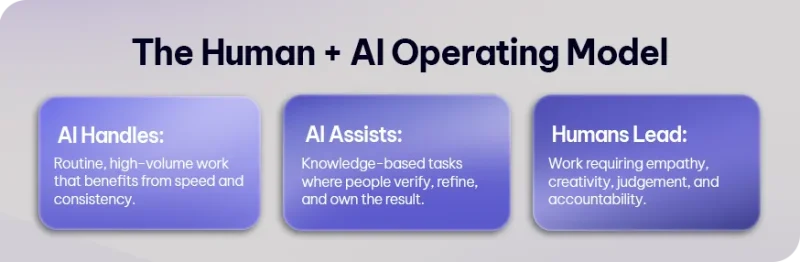
A useful way to approach AI adoption is to divide work into three categories:
AI Handles
High-volume, repetitive, rules-based activities where automation can deliver significant efficiency.
AI Assists
Tasks where AI can generate recommendations, summaries, or first drafts while an employee remains responsible for the outcome.
Humans Lead
Activities requiring judgement, empathy, strategic thinking, creativity, accountability, or complex decision-making.
This framework helps organisations identify where AI can create value without attempting to automate everything.
What Businesses Need Before Scaling AI
AI productivity gains depend on the foundations underneath the technology.
Organisations should consider:
- Data quality
- Identity and access management
- Cybersecurity
- AI governance
- Employee training
- Business process design
- Integration
- Human oversight
Without these foundations, AI can introduce new risks instead of improving efficiency.
Why Choose Exigo Tech as Your Managed Intelligence Partner
At Exigo Tech, we help organisations introduce AI in ways that improve how people work rather than simply replacing existing processes.
As your Managed Intelligence Partner, our capabilities include:
- Microsoft 365 Copilot
- Copilot Studio
- AI Agents
- Azure AI
- Power Platform
- Business Process Automation
- Data & Analytics
- AI Governance
- AI Strategy and Readiness
- Managed IT and Security Services
We focus on identifying the right balance between automation and human expertise, helping businesses achieve measurable productivity improvements while maintaining security, governance, and accountability.


 Exigo Tech - Ask AI (Beta)