Australia
 Singapore
 Philippines
 India
7.50 MIN READ
Agentic AI for Operations Leaders: Turning AI into Action
 Alpesh Prajapati | Oct 23, 2026
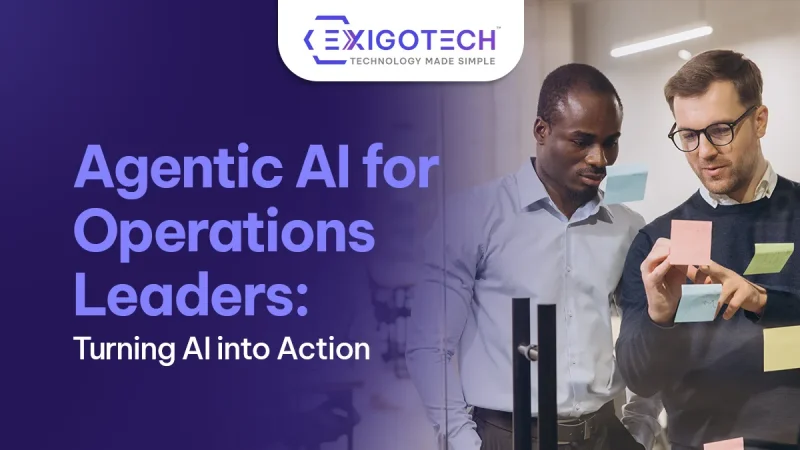
Traditional automation follows predefined rules. Generative AI creates content or provides insights. Agentic AI can go further by coordinating multiple steps in a business process and responding dynamically to changing conditions.
This creates opportunities to improve operational efficiency across service management, finance, supply chain, customer operations, IT, and other business functions.
But deploying AI agents successfully requires more than choosing a platform. Organisations need clear use cases, reliable data, appropriate controls, security, and governance.
At Exigo Tech, we help organisations move from AI experimentation to practical automation as their Managed Intelligence Partner, combining AI, data, business applications, automation, security, and cloud capabilities.
What Is Agentic AI?
Agentic AI refers to AI systems designed to pursue a defined objective by determining and executing a sequence of actions.
Instead of simply responding to a prompt, an AI agent can potentially:
- Understand a request or objective.
- Analyse available information.
- Determine the next steps.
- Interact with business applications.
- Execute actions.
- Evaluate the result.
- Escalate to a person when required.
For operations teams, this creates the possibility of automating processes that previously required employees to coordinate multiple systems and tasks manually.
Why Operations Leaders Should Pay Attention
Operations leaders are responsible for improving efficiency while maintaining quality, reliability, and customer outcomes.
Many operational processes contain repetitive tasks that consume valuable employee time.
Examples include:
- Processing requests
- Updating systems
- Reviewing documents
- Managing exceptions
- Preparing reports
- Coordinating approvals
- Responding to routine enquiries
Agentic AI can help orchestrate these activities, allowing employees to focus on exceptions, judgement, relationships, and strategic priorities.
1. Automating Service Operations
Customer and internal service teams manage large volumes of requests every day.
An AI agent can potentially:
- Understand an incoming request
- Retrieve customer information
- Check relevant systems
- Determine the appropriate workflow
- Provide an initial response
- Update records
- Escalate complex cases
This can reduce manual coordination while helping teams respond more consistently.
Human employees can remain involved when requests require judgement or approval.
2. Streamlining IT Operations
IT operations involve constant monitoring, investigation, and routine administration.
Agentic AI can support activities such as:
- Incident triage
- Ticket categorisation
- Knowledge retrieval
- Routine troubleshooting
- User communication
- Escalation
For example, an agent could analyse a service desk request, identify a known issue, retrieve the appropriate resolution procedure, and guide the user through the next steps.
More advanced workflows can connect agents with approved IT management and monitoring systems.
3. Improving Finance Operations
Finance teams manage numerous repetitive processes.
Agentic AI can support:
- Invoice processing
- Payment enquiries
- Account reconciliation workflows
- Expense reviews
- Reporting preparation
- Exception identification
Rather than automating every financial decision, organisations can use agents to handle the administrative steps around decisions while keeping appropriate human approval points.
4. Supporting Supply Chain Operations
Supply chain operations involve constantly changing information.
AI agents can help monitor:
- Inventory levels
- Orders
- Supplier communications
- Delivery status
- Demand signals
- Exceptions
An agent could identify a potential supply issue, gather relevant information, notify the appropriate team, and initiate an approved workflow.
This can help operations teams respond faster to changing conditions.
5. Managing Business Applications
Modern organisations rely on multiple business applications.
An AI agent can potentially act as an intelligent layer between employees and those systems.
For example, instead of manually checking several applications, an employee could ask an agent for the status of a customer order.
The agent could retrieve information from approved systems and provide a consolidated response.
This reduces the need for employees to navigate multiple platforms for routine information requests.
6. Accelerating Operational Decision-Making
Operations leaders often spend significant time gathering information before making decisions.
Agentic AI can help bring relevant information together from multiple sources.
For example, an operations agent could analyse:
- Performance data
- Customer information
- Inventory levels
- Service tickets
- Financial information
It can then provide a summary, highlight exceptions, and recommend potential actions.
The final decision can remain with the operations leader.
The Role of Human Oversight
Agentic AI should not mean handing complete control of business operations to autonomous systems.
The appropriate level of autonomy depends on the risk associated with the task.
A useful model is:
Assist → Recommend → Act with Approval → Act Autonomously
Low-risk tasks may be automated more extensively.
Higher-risk activities involving financial transactions, sensitive information, customers, employees, or regulatory obligations should have stronger human oversight.
This principle should be built into the agent’s design from the beginning.
Governance Is Critical
As AI agents gain the ability to take action, governance becomes more important than it is with basic generative AI.
Organisations should define:
- What an agent is allowed to access
- What actions it can perform
- Which actions require approval
- What data it can use
- How activity is logged
- Who owns the agent
- How performance is monitored
- What happens when the agent encounters an exception
This creates accountability and helps prevent uncontrolled AI automation.
Building an Agentic AI Strategy
Operations leaders should avoid starting with the technology.
Instead, identify processes that are:
- Repetitive
- Time-consuming
- Rules-driven
- Data-rich
- High-volume
- Currently dependent on multiple systems
Then assess whether an AI agent can improve the process without introducing unacceptable risk.
A successful implementation should have a clearly defined business outcome, such as reducing processing time, improving response times, reducing manual work, or increasing operational capacity.
Microsoft Technologies for Agentic AI
Microsoft’s ecosystem provides several capabilities that organisations can use to build and manage AI-driven workflows.
These include:
- Microsoft Copilot Studio for creating and managing AI agents
- Azure AI for developing intelligent applications
- Microsoft Power Platform for connecting AI with business workflows
- Microsoft Fabric for data and analytics foundations
- Microsoft Entra ID for identity and access management
- Microsoft Purview for data governance and protection
The right combination depends on the organisation’s use cases, existing technology environment, and governance requirements.
Why Choose Exigo Tech as Your Managed Intelligence Partner
At Exigo Tech, we help operations leaders identify where Agentic AI can create practical business value.
As your Managed Intelligence Partner, we bring together:
- AI Strategy and Readiness
- Microsoft Copilot
- Copilot Studio
- AI Agents
- Azure AI
- Power Platform
- Data and Analytics
- AI Governance
- Cybersecurity
- Managed IT Services
Our approach focuses on business outcomes rather than deploying AI for its own sake. We help organisations identify the right processes, establish the required data and security foundations, and introduce automation with appropriate governance.

 Exigo Tech - Ask AI (Beta)