 Australia
 Singapore
 Philippines
 India
India5.37 MIN READ
IT Security for Healthcare: Protecting Patient Data, Systems, and Continuity of Care
 Niten Devalia | Apr 20, 2026
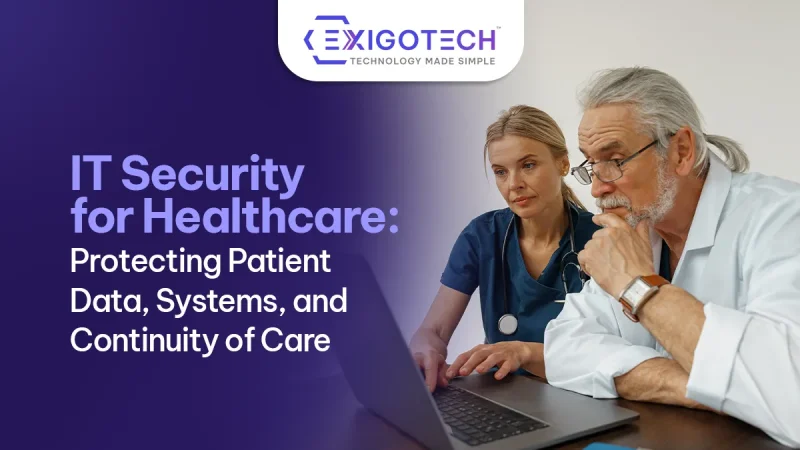
Healthcare organisations are now depending more and more on technology.
Electronic medical records, diagnostic systems, connected medical devices, telehealth platforms, and patient management systems all play a critical role in delivering care. These systems must remain secure, available, and compliant because any disruption can directly impact patient outcomes.
At the same time, healthcare has become one of the most targeted industries for cyberattacks. Sensitive patient data, operational urgency, and complex environments make healthcare organisations particularly vulnerable.
This is why IT security in healthcare is not just about protecting systems; it is about protecting patient safety and continuity of care.
At Exigo Tech, we act as your Managed Intelligence Partner, delivering managed IT security services, expert-led IT security consulting, and specialised support from experienced IT security consultants and IT security specialists customised to healthcare environments.
Why Healthcare Is a High-Value Target for Cyber Threats
Healthcare organisations manage highly sensitive information, including:
- Patient records and clinical data.
- Personal and financial information.
- Diagnostic reports and imaging data.
- Insurance and billing information.
- Research and intellectual property.
This data is extremely valuable, making healthcare organisations attractive targets for cybercriminals. In addition, healthcare environments often operate with:
- Legacy systems.
- Connected medical devices.
- Multiple user roles and access requirements.
- High uptime requirements.
These factors increase both risk and impact.
A security incident in healthcare does not just affect systems; it can delay treatment, disrupt operations, and impact patient safety.
The Complexity of Healthcare IT Environments
Healthcare IT environments include a wide range of systems:
- Electronic Medical Record (EMR/EHR) platforms.
- Hospital management systems.
- Laboratory and diagnostic systems.
- Imaging systems.
- Telehealth platforms.
- Connected medical devices.
- Mobile clinical applications.
These systems must work together seamlessly while maintaining strict security and privacy controls. Without structured oversight, organisations may face:
- Unauthorised access to patient data.
- System downtime affecting care delivery.
- Data breaches and compliance risks.
- Inconsistent access control policies.
This is why healthcare requires a specialised security approach.
What Managed IT Security Services Deliver for Healthcare
Managed IT security services provide continuous protection across healthcare environments.
This includes:
- 24/7 threat monitoring and detection.
- Endpoint and device security.
- Identity and access management.
- Network security across clinical environments.
- Vulnerability and patch management.
- Backup and ransomware protection.
- Incident response and recovery.
These services help ensure systems remain secure while maintaining availability for clinical teams.
The Role of IT Security Consulting in Healthcare
Technology in healthcare must balance accessibility and security. Clinicians need fast access to systems, while patient data must remain protected.
This is where IT security consulting plays a critical role.
An experienced IT security consultant helps healthcare organisations:
- Assess current security posture.
- Identify risks across clinical and administrative systems.
- Align security controls with compliance requirements.
- Define secure access policies for staff and partners.
- Prioritise improvements based on operational impact.
Consulting ensures security measures support care delivery rather than disrupt it.
Why Healthcare Requires an IT Security Specialist
Healthcare environments have unique requirements that general IT security approaches may not address.
An IT security specialist understands:
- Clinical workflow requirements.
- Medical device security considerations.
- Data privacy regulations.
- High availability requirements for critical systems.
- Role-based access for clinical staff.
This expertise ensures that security controls protect sensitive data while maintaining usability.
Key Security Challenges in Healthcare
Healthcare organisations commonly face:
-
Sensitive Data Protection
Patient data must remain confidential and protected.
-
High Availability Requirements
Systems must remain operational to support care delivery.
-
Connected Medical Devices
IoT-enabled devices increase the attack surface.
-
Complex Access Requirements
Multiple roles require different levels of system access.
-
Compliance and Regulatory Requirements
Healthcare organisations must meet strict data protection standards.
Managed IT security services help address these challenges through structured protection and monitoring.
Benefits of a Managed Security Approach for Healthcare
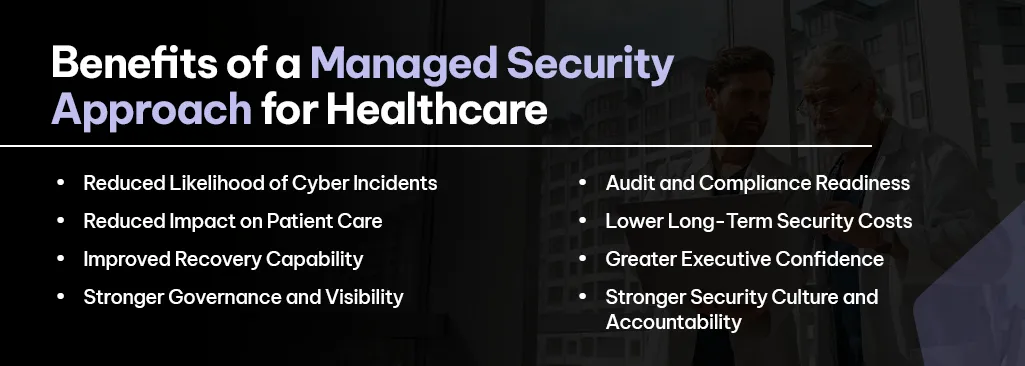
Implementing managed IT security services delivers measurable benefits.
-
Reduced Likelihood of Cyber Incidents
Continuous monitoring reduces exposure to threats.
-
Reduced Impact on Patient Care
Rapid detection and response minimise operational disruption.
-
Improved Recovery Capability
Backup and recovery ensure systems can be restored quickly.
-
Stronger Governance and Visibility
Centralised monitoring provides insight into security posture.
-
Audit and Compliance Readiness
Security controls support healthcare regulatory requirements.
-
Lower Long-Term Security Costs
Preventing incidents reduces financial and operational impact.
-
Greater Executive Confidence
Leadership gains assurance that risks are actively managed.
-
Stronger Security Culture and Accountability
Clear policies reinforce consistent security practices.
Securing Connected Healthcare Environments
Modern healthcare relies on connectivity across:
- Clinical systems.
- Mobile devices.
- Medical equipment.
- Cloud platforms.
- Remote care solutions.
Security must extend across all these components.
Managed IT security services ensure:
- Secure communication between systems.
- Controlled access to patient data.
- Continuous monitoring of device activity.
- Protection against ransomware and data breaches.
This enables healthcare organisations to innovate without increasing risk.
From Reactive Security to Proactive Protection
Many healthcare organisations still rely on reactive security models:
- Addressing incidents after they occur.
- Limited monitoring of threats.
- Inconsistent security policies.
Modern healthcare requires proactive protection:
- Continuous monitoring.
- Real-time threat detection.
- Automated response capabilities.
- Ongoing optimisation of controls.
This proactive approach ensures both security and operational continuity.
Why Choose Exigo Tech as Your Managed Intelligence Partner
At Exigo Tech, we understand the operational and regulatory demands of healthcare environments.
As your Managed Intelligence Partner, we:
- Deliver comprehensive managed IT security services.
- Provide expert IT security consulting.
- Act as your trusted IT security consultant.
- Deploy experienced IT security specialists.
- Align security with clinical and operational workflows.
- Continuously monitor and improve your security posture.
We ensure your healthcare organisation remains secure, compliant, and resilient.
Security as a Foundation for Quality Care
Healthcare organisations depend on technology to deliver timely and effective care. Protecting these systems is essential to maintaining trust, continuity, and patient safety.
With the right security approach, healthcare organisations can focus on delivering care, knowing their systems and data are protected.
 Exigo Tech - Ask AI (Beta)