
 Australia
 Singapore
 Philippines
 India
India6.32 MIN READ
Service Backlogs Don’t Look the Same in Every Council: Why Size and Complexity Matter More Than You Think
 Vinay Joshi | Apr 01, 2026
Service backlogs are not a new problem for local government.
What is often misunderstood is why they take place and why they feel so different from one council to another.
- A small council may feel overwhelmed by a sudden spike in enquiries.
- A medium-sized council may struggle to keep up as service volumes grow year on year.
- A large council may appear well-resourced on paper, yet still face delays caused by handovers, dependencies, and unclear ownership.
Different councils. Different pressures. But in almost every case, the backlog is a symptom, not the root cause.
How Service Backlogs Show Up Differently Across Council Sizes
Backlogs rarely come from a single failure. They emerge from how councils are structured, how work flows, and how complexity is managed.
Small councils: capacity stretched thin
In smaller councils, backlogs usually form because a small number of people are responsible for a very broad range of services.
Common patterns include:
- Officers managing multiple service types at once.
- Heavy reliance on personal knowledge to get work done.
- Manual tracking of requests across emails or spreadsheets.
- Limited ability to prioritise when demand spikes.
When volumes increase, even temporarily, teams struggle to recover. The issue isn’t effort. It’s sustainability.
Medium councils: growing volume, growing friction
Medium-sized councils often experience backlog pressure as a result of scale without structure.
As populations grow and services expand:
- Enquiry volumes increase across more departments.
- Different systems are introduced at different times.
- Processes evolve inconsistently across teams.
Work still gets done, but visibility starts to drop. Requests take longer to move through the system, and residents begin following up simply to understand what’s happening.
Large councils: complexity hides the backlog
In larger councils, backlogs are often less visible, but more damaging.
These councils usually have:
- Multiple departments involved in a single request.
- Formal escalation paths and dependencies.
- Handoffs that slow progress even when teams are busy.
From the outside, everything looks “in progress.” Internally, work gets affected because ownership becomes unclear once requests move across teams.
The backlog isn’t always obvious until complaints rise or risks escalate.
The Manual Workarounds Councils Rely on Under Pressure
When demand increases, councils adapt. They don’t stop delivering services.
Across of all sizes, similar workarounds appear:
- Spreadsheets created to track what systems can’t.
- Shared inboxes used as informal queues.
- Manual follow‑ups replacing automated updates.
- Knowledge living with individuals instead of platforms.
These approaches help teams cope in the short term. The problem is that they don’t scale with size or complexity.
As councils grow or services expand, every workaround adds friction. Staff spend more time managing work than resolving it. Information is duplicated. Requests fall through gaps.
And the backlog grows quietly in the background.
Why Backlog Pressure Is Rarely Just a Resourcing Issue
When backlogs become visible, the default response is often to look at staffing levels.
But many councils find that even after adding resources, pressure remains.
That’s because the real issue is often CX maturity, not headcount.
Low maturity typically shows up as:
- Inconsistent processes across service areas.
- Limited automation for routine requests.
- Poor end‑to‑end visibility.
- Unclear ownership once work crosses teams.
Without addressing these foundations, adding more effort simply adds more work to an already strained system.
The Real Risk: Fixing The Wrong Problem
One of the biggest challenges councils face is knowing where to intervene.
Without a clear view of how work flows end‑to‑end:
- Tools are added without simplifying processes.
- Improvements are made in silos.
- Investment increases without reducing backlog pressure.
This creates frustration, especially at the leadership level, because effort and spend don’t translate into better outcomes.
Why Understanding Maturity Changes the Conversation
A CX maturity helps councils step back from day‑to‑day pressure and see the bigger picture.
Instead of asking: “How do we clear the backlog?”
Councils can ask: “Why is work slowing down, and where does it happen most?”
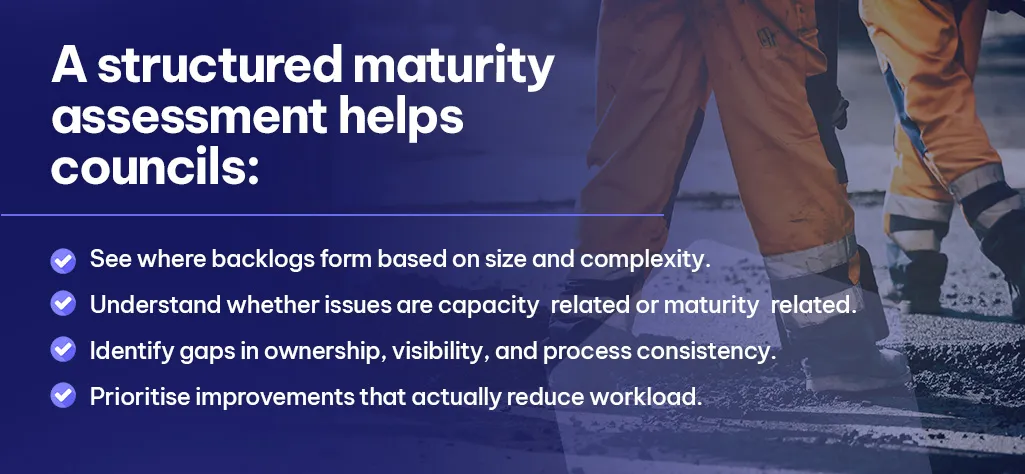
A structured maturity assessment helps councils:
- See where backlogs form based on size and complexity.
- Understand whether issues are capacity‑related or maturity‑related.
- Identify gaps in ownership, visibility, and process consistency.
- Prioritise improvements that actually reduce
This is especially important for councils managing growth, regional expansion, or increasing service complexity.
What Clarity Looks Like for Councils of Different Sizes
For smaller councils, maturity insights often highlight:
- Opportunities to reduce manual effort.
- Simple automation that frees up staff time.
- Clearer prioritisation across services.
For medium-sized councils, maturity insights tend to focus on:
- Process consistency across teams.
- Improving visibility as volume grows.
- Reducing reliance on informal workarounds.
For larger councils, maturity insights typically uncover:
- Ownership gaps between departments.
- Delays caused by handovers rather than workload.
- Opportunities to simplify coordination without replacing systems.
In all cases, clarity comes before change.
How Exigo Tech Approaches This Problem Differently
At Exigo Tech, we work with councils of different sizes and operating models.
What we see consistently is that no two councils experience backlog pressure in exactly the same way.
That’s why we don’t start with technology or assumptions.
Our approach focuses on:
- Understanding how your council actually operates
- Identifying maturity gaps based on size and complexity.
- Highlighting low‑risk improvements that make sense for your environment.
- Providing a clear, prioritised roadmap rather than generic recommendations.
We help councils move away from firefighting and towards sustainable service delivery, without forcing large‑scale system replacement or unnecessary disruption.
Moving Forward with Confidence, Not Guesswork
Service backlogs are not a sign of failure. They are a signal that something in the operating model needs attention.
For councils of every size, understanding why backlogs occur is far more valuable than reacting to their symptoms. With the right clarity, councils can reduce pressure, improve visibility, and strengthen trust, without adding unnecessary complexity.



 Exigo Tech - Ask AI (Beta)