
 Australia
 Singapore
 Philippines
 India
India5.01 MIN READ
Regular Backups: Your Last Line of Defence When Everything Else Fails
 Niten Devalia | Mar 18, 2026

No security control is perfect.
Even with strong security measures, there is always a possibility that something could go wrong. A user may fall victim to phishing. A vulnerability may be exploited. A ransomware attack may bypass other controls.
When that happens, one thing determines whether the organisation experiences a temporary disruption or a full-scale crisis: Reliable, tested, and secure backups.
This is why Regular Backups are a foundational control within the Essential Eight framework. Backups are not just an IT task; they are a business survival strategy.
At Exigo Tech, we view backup and recovery as a resilience capability, not just a storage solution.
Why Backups Matter More Than Ever
Ransomware attacks continue to evolve. Modern attackers don’t just encrypt files; they:
- Target backup systems.
- Steal data before encryption.
- Attempt to delete recovery points.
- Move laterally across networks.
The goal is simple: eliminate recovery options and force payment.
Without strong backup controls, organisations may face:
- Prolonged downtime.
- Permanent data loss.
- Financial loss.
- Regulatory consequences.
- Reputational damage.
Backups ensure that when systems fail or are compromised, recovery remains possible.
What Does “Regular Backups” Actually Mean?
Regular Backups under the Essential Eight framework involve more than copying files occasionally.
They require:
- Frequent backups of critical systems and data.
- Backups stored securely and separately from primary systems.
- Offline or immutable backup copies.
- Regular testing of restoration processes.
- Clear documentation and recovery procedures.
It is not enough to assume backups work. They must be tested and validated.
Why Backups Fail in Real Incidents
Many organisations believe they are protected until they attempt to restore data.
Common issues include:
- Incomplete backup coverage.
- Corrupted backup files.
- Backup systems connected to compromised networks.
- Unclear recovery procedures.
- Lack of restoration testing.
- Overly long recovery times.
A backup that cannot be restored quickly and reliably is not a real safeguard. Regular testing and validation are just as important as the backup itself.

Why Regular Backups Are Essential Eight–Critical
The Essential Eight focuses on preventing incidents, but it also recognises that prevention alone is not enough.
Regular Backups:
- Reduce the impact of ransomware.
- Enable rapid system restoration.
- Support business continuity.
- Protect critical information assets.
When other controls fail, backups prevent total loss. They transform catastrophic events into manageable recovery processes.
What Happens Without Reliable Backups
Organisations without strong backup controls risk:
- Paying ransom demands.
- Losing critical operational data.
- Extended business interruption.
- Breach notification obligations.
- Long-term reputational damage.
In many ransomware cases, organisations were forced to negotiate because backups were either unavailable, compromised, or untested.
What a Good Backup Strategy Looks Like
An effective backup strategy includes:
- Frequent and Automated Backups: Critical systems should be backed up regularly based on business needs.
- Offline or Immutable Copies: Backups must be isolated or protected so attackers cannot easily alter or delete them.
- Segmentation from Production Systems: Backup infrastructure should not share the same risk exposure as operational systems.
- Regular Restoration Testing: Recovery should be tested to confirm systems can be restored quickly and accurately.
- Clear Recovery Objectives: Define Recovery Time Objectives (RTO) and Recovery Point Objectives (RPO).
- Documented Procedures: Ensure recovery processes are clearly defined and accessible.
Backups must support operational resilience, not just compliance checkboxes.
Benefits of Regular Backups
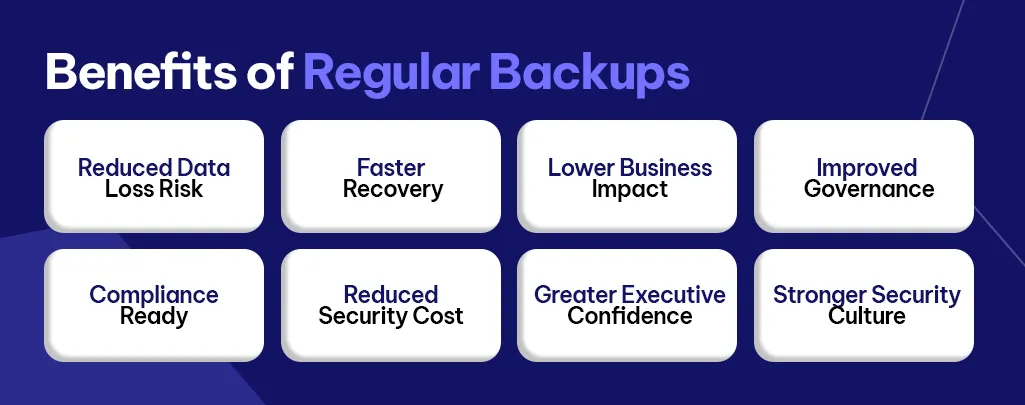
When implemented correctly, regular backups deliver substantial business value.
- Reduced Likelihood of Permanent Data Loss: Data remains recoverable even after serious incidents.
- Improved Recovery Capability: Tested backup processes ensure systems can be restored quickly.
- Reduced Business Impact from Security Incidents: Downtime and disruption are minimised.
- Stronger Governance and Visibility: Backup policies provide clear accountability and control.
- Audit and Compliance Readiness: Many regulations require demonstrable backup and recovery capability.
- Lower Long-Term Security Costs: Avoiding ransom payments and extended downtime reduces financial impact.
- Greater Executive Confidence: Leadership knows the organisation can recover from major disruptions.
- Stronger Security Culture and Accountability: Regular testing reinforces resilience planning and operational discipline.
Common Mistakes Organisations Make
Backup strategy often fails due to:
- Treating backups as a one-time setup.
- Not protecting backup infrastructure.
- Failing to test restoration.
- Backing up too infrequently.
- Ignoring cloud workloads.
- Overlooking SaaS data backup requirements.
Cyber resilience requires continuous review and improvement.
Backups Are About Business Continuity, Not Just IT
Backup strategy should align with:
- Business continuity planning.
- Disaster recovery strategy.
- Risk management frameworks.
- Regulatory compliance requirements.
The question is not: “Do we have backups?”
The real question is: “Can we restore critical operations quickly and confidently?”
That is the difference between operational disruption and operational collapse.
Why Choose Exigo Tech to Implement Regular Backup Strategies
Backup and recovery planning requires more than storage capacity. It requires structured resilience design.
As your Managed Intelligence Partner, we:
- Assess current backup coverage and exposure.
- Design secure and segmented backup architectures.
- Implement immutable and protected backup solutions.
- Conduct restoration testing and validation.
- Align recovery objectives with business priorities.
- Continuously review and improve resilience posture.
We ensure your backup strategy is not just present, but reliable, tested, and business-aligned.




 Exigo Tech - Ask AI (Beta)