 Australia
 Singapore
 Philippines
 India
India5.41 MIN READ
Beyond Chatbots: How Agentic AI Is Reshaping the Future of Non-Profits in APAC
 Ben Opit | May 20, 2026
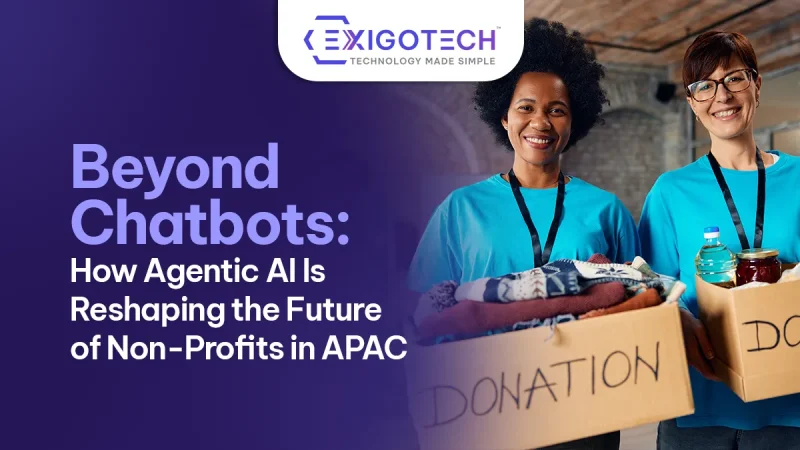
Non-profit organisations across APAC are under increasing pressure to do more with less. Teams are stretched, reporting obligations are growing, funding environments are becoming more competitive, and community expectations continue to rise.
At the same time, many organisations are still managing critical operations through disconnected systems, spreadsheets, manual processes, and resource-intensive administration.
This is where the next evolution of AI is beginning to change the conversation.
Not just AI that answers questions, but AI that can take action.
What Is Agentic AI?
Most people are now familiar with AI assistants that can generate content, summarise meetings, or answer prompts. Agentic AI goes a step further.
An AI “agent” can understand goals, make decisions within defined rules, interact with systems, automate workflows, and complete multi-step tasks with minimal human intervention.
For non-profits, this creates entirely new opportunities to improve operational efficiency while freeing teams to focus on mission-driven work.
Imagine an AI agent that can:
- Draft donor communications
- Follow up incomplete volunteer applications
- Prepare board reporting packs
- Monitor grant deadlines
- Escalate high-risk cases
- Analyse trends across service delivery data
- Generate operational insights in real time
This is no longer future technology. It is already being implemented across organisations globally and increasingly across APAC.
Why This Matters for Non-Profits
Unlike large enterprises, many non-profits operate with lean teams and limited technical resources. Administrative overhead can quickly consume time that should be directed toward community impact.
Agentic AI introduces a practical way to reduce repetitive work without requiring massive transformation programs.
Instead of replacing people, AI agents can support teams by handling:
- Routine administrative tasks
- Data consolidation and reporting
- Workflow coordination
- Internal knowledge retrieval
- Process monitoring and escalation
This allows staff and volunteers to spend more time on strategic initiatives, stakeholder engagement, fundraising, and direct service delivery.
For many organisations, the biggest value is not simply productivity; it is capacity creation.
Moving Beyond Automation
Traditional automation has existed for years. However, many automations are rigid and require technical maintenance.
Agentic AI introduces adaptability.
Modern AI agents can interpret context, work across multiple systems, and respond dynamically to changing situations.
For example:
A traditional workflow might:
- Send a standard email when a form is submitted
An AI agent could:
- Review the form
- Identify missing information
- Draft a personalised follow-up
- Update CRM records
- Notify relevant stakeholders
- Recommend next actions
This shift from static automation to intelligent orchestration is what makes agentic systems so transformative.
The Microsoft Ecosystem Is Accelerating Adoption
One reason many non-profits are now exploring AI is that tools are becoming more accessible within existing Microsoft environments.
Technologies such as:
- Microsoft 365 Copilot
- Microsoft Copilot Studio
- Microsoft Fabric
- Microsoft Azure AI services
- Power Platform
are enabling organisations to build secure, governed AI experiences without needing large internal development teams.
For organisations already using Microsoft 365, this creates a practical pathway toward AI adoption using familiar tools and enterprise-grade governance controls.
Data Still Matters
AI is only as effective as the information it can access.
Many non-profits face challenges with:
- Fragmented reporting
- Legacy databases
- Duplicate records
- Limited visibility across programs
- Manual spreadsheet consolidation
This is why modern data platforms such as Microsoft Fabric are becoming increasingly important.
Unified reporting environments can help organisations:
- Gain real-time operational visibility
- Improve funding and compliance reporting
- Identify service trends faster
- Reduce reporting preparation time
- Support better decision-making
For leadership teams, this means moving from reactive reporting to proactive insight generation.
Governance Cannot Be an Afterthought
As AI adoption increases, governance becomes critical.
Non-profits must ensure:
- Data privacy is protected
- AI usage is transparent
- Human oversight remains in place
- Risk management frameworks are established
- Ethical considerations are addressed
The most successful organisations are not adopting AI recklessly. They are building structured governance models while identifying low-risk, high-value opportunities to begin their journey.
Starting small often delivers the best results.
Where Organisations Should Start
Many non-profits assume AI transformation requires a large investment or complex roadmap.
In reality, the best starting point is usually identifying one or two operational pain points.
Good early candidates include:
- Reporting and dashboard generation
- Volunteer onboarding workflows
- Internal knowledge management
- Fundraising administration
- Meeting summaries and action tracking
- Case management support
- Grant and compliance tracking
Small wins build internal confidence and help organisations develop practical AI capability over time.
Join the Conversation: Agentic AI for Non-Profits in APAC
To help organisations navigate agentic AI, we are hosting an upcoming session focused on how Agentic AI and Microsoft technologies can support modern non-profit operations.
The webinar will explore practical use cases for Microsoft 365 Copilot, Copilot Studio, Microsoft Fabric, and AI-driven automation, along with real-world examples from organisations already adopting these technologies across the region.
Attendees will also gain insights into:
- Identifying high-impact AI opportunities
- Improving operational efficiency and reporting
- Strengthening governance and reducing risk
- Building an AI and automation roadmap for the future
With deep expertise across Microsoft technologies, cloud transformation, automation, and data modernisation, we work closely with organisations to deliver practical, secure, and scalable AI solutions tailored to the unique needs of the non-profit sector.
Why Exigo Tech for Agentic AI in the Non-Profit Sector
Non-profits need more than just AI tools; they need a trusted technology partner that understands operational pressures, governance requirements, and the importance of delivering measurable community impact.
How We Support NFPs
- Identify high-impact AI and automation opportunities
- Reduce manual workloads and operational inefficiencies
- Modernise reporting and data visibility
- Improve governance, security, and compliance
- Build scalable AI roadmaps aligned to organisational goals
Why Organisations Should Partner with Us
- Deep expertise across Microsoft cloud, data, automation, and AI technologies
- Experience supporting organisations across APAC
- Practical, business-focused approach to AI adoption
- Strong focus on governance, security, and responsible AI
- Customised workshops and strategic planning sessions for NFP environments
By combining technology expertise with a strong understanding of non-profit operational challenges, we help organisations move beyond AI experimentation and toward real operational and community outcomes.
 Exigo Tech - Ask AI (Beta)