
 Australia
 Singapore
 Philippines
 India
India6 MIN READ
Funding Models Matter More Than You Think: How Licensing Structure Shapes Long-Term Technology Costs
 Niten Devalia | Mar 23, 2026

When organisations evaluate technology platforms, most of the attention goes to features, performance, and vendor capabilities. Questions about security, scalability, and integration often dominate the conversation.
But there is another factor that quietly influences long-term outcomes just as much as the technology itself: the funding model behind the licensing agreement.
How licences are structured can significantly affect budgeting, operational flexibility, and the total cost of ownership.
Many organisations focus on the technology purchase while overlooking the commercial structure behind it. As a result, they may unknowingly pay more over time or miss opportunities to align licensing with business growth.
As part of our Licensing Campaign, this blog explores why licensing funding models matter more than many organisations realise and how choosing the right structure can create both financial efficiency and operational clarity.
Licensing Is Not Just About What You Buy
Technology licensing decisions often begin with a straightforward question:
“Which product do we need?”
But an equally important question follows:
“How should we structure the agreement?”
Modern platforms offer a wide range of licensing options, including:
- Flexible subscription models.
- Annual commitments.
- Multi-year enterprise agreements.
- Hybrid consumption-based structures.
- Reserved capacity or commitment discounts.
Each model offers different advantages depending on the organisation’s priorities, growth trajectory, and operational maturity.
Choosing the wrong structure can quietly increase costs or limit flexibility.
Understanding the Most Common Licensing Funding Models
Subscription-Based Licensing
Subscription models allow organisations to pay for services on a recurring basis, often monthly.
These models are popular because they offer flexibility. Organisations can scale usage quickly, add users easily, and adjust services as needs change.
However, this convenience often comes at a premium. Subscription pricing tends to be higher over time compared with structured commitment models.
Subscriptions work best when:
- User counts fluctuate frequently.
- Workloads are experimental or temporary.
- Organisations need short-term flexibility.
But when environments stabilise, continuing on pure subscription pricing may no longer be the most efficient option.
Annual Licensing Agreements
Annual agreements introduce a structured commitment while still allowing periodic review.
With annual licensing, organisations typically receive:
- More predictable pricing.
- Better commercial terms.
- Clear renewal cycles.
This model works well for organisations that have reached a certain level of operational stability but still want the flexibility to reassess annually.
Annual agreements often provide a balance between flexibility and cost control.
Multi-Year Agreements
Multi-year agreements introduce a longer planning horizon.
Organisations commit to a licensing structure over multiple years in exchange for improved pricing and commercial stability.
These agreements typically provide:
- Lower long-term licensing costs.
- Consistent budgeting.
- Strategic alignment with technology roadmaps.
However, multi-year agreements require thoughtful planning. Organisations must consider projected growth, technology adoption timelines, and infrastructure evolution.
When structured correctly, they can significantly reduce total licensing costs.
Why Funding Models Should Align with Business Growth
Technology environments rarely remain static.
Organisations expand into new markets, hire additional employees, introduce new platforms, and increase infrastructure capacity.
Licensing models should evolve alongside this growth.
For example:
- Early-stage environments may require flexible subscriptions.
- Growing organisations may benefit from structured annual agreements.
- Mature environments with predictable workloads may benefit from multi-year commitments.
Without this alignment, licensing models may remain stuck in the conditions that existed when the first purchase was made.
As organisations grow, the original licensing structure may no longer be the most efficient.
The Risk of Leaving Licensing Models Unreviewed
Many organisations adopt a licensing model early in their technology journey and rarely revisit it.
Renewals simply follow the original agreement structure.
Over time, this approach can create inefficiencies such as:
- Paying subscription rates for stable workloads.
- Maintaining inflexible agreements that no longer reflect operational needs.
- Missing opportunities for bundled or consolidated agreements.
- Struggling to forecast long-term technology costs.
Funding models should evolve alongside the technology environment. Regular review ensures the licensing structure remains aligned with organisational priorities.
The Benefits of Structuring Licensing Strategically
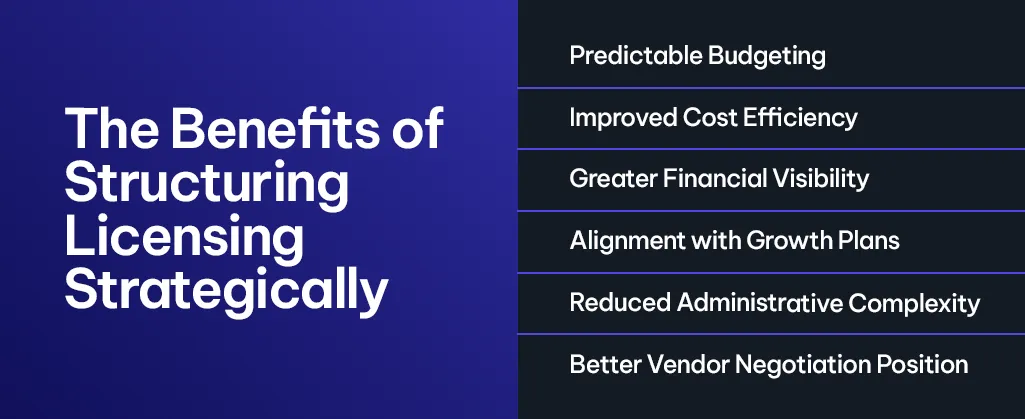
When licensing funding models are aligned with operational and financial goals, organisations gain significant advantages.
- Predictable Budgeting: Structured agreements allow finance teams to forecast technology costs more accurately.
- Improved Cost Efficiency: Commitment-based models often deliver lower long-term pricing.
- Greater Financial Visibility: Consolidated agreements simplify vendor and subscription management.
- Alignment with Growth Plans: Licensing evolves alongside business expansion and infrastructure scaling.
- Reduced Administrative Complexity: Clear agreement structures simplify renewals and vendor management.
- Better Vendor Negotiation Position: Strategic planning enables organisations to structure agreements more effectively.
Why Licensing Funding Models Require Strategic Oversight
Selecting the right licensing model requires more than comparing vendor quotes.
Organisations must consider:
- Current infrastructure architecture.
- Cloud workload behaviour.
- Security platform requirements.
- User growth projections.
- Transformation initiatives.
- Financial planning priorities.
Because licensing affects so many aspects of technology operations, it should be evaluated within the broader context of the entire technology stack.
Optimisation requires visibility across vendors, platforms, and workloads.
Why Choose Exigo Tech as Your Managed Intelligence Partner
At Exigo Tech, licensing is never approached as a simple procurement activity.
We evaluate how licensing structures influence infrastructure design, cloud economics, and long-term business strategy.
As your Managed Intelligence Partner, we help organisations:
- Assess their current licensing funding models.
- Compare alternative commercial structures.
- Align licensing agreements with growth projections.
- Consolidate fragmented vendor relationships.
- Continuously optimise licensing environments.
Our goal is to ensure that licensing models support both operational efficiency and financial control.


 Exigo Tech - Ask AI (Beta)