
 Australia
 Singapore
 Philippines
 India
India4.10 MIN READ
When Service Issues Become Complaints: How CX Breakdowns Create Pressure for Council Leaders
 Vinay Joshi | Apr 27, 2026
Most service issues don’t start as complaints.
They begin as small delays. Missed follow‑ups. Inconsistent answers. Requests that take just a little too long to resolve.
But when those issues remain unresolved or poorly communicated, they escalate. And when they escalate, they don’t land on operational teams alone.
They land on senior leaders.
How Unresolved Service Issues Turn into Complaints
From a resident’s perspective, escalation is rarely the first choice.
Complaints usually happen after:
- Multiple follow‑ups without clear answers.
- Conflicting information from different teams.
- No visibility into progress or ownership.
- Missed expectations that were never formally acknowledged.
At that point, the issue is no longer about the original request. It’s about trust. Once that trust is broken, residents go higher, to councillors, complaint handling bodies, or public forums.
Why Complaints Feel Different at the Leadership Level
For senior council leaders, complaints are not just service events.
They represent:
- Reputational risk.
- Governance attention.
- Political sensitivity.
- Accountability questions that cut across teams.
Unlike operational delays, complaints:
- Demand formal responses.
- Require evidence and reporting.
- Trigger scrutiny of processes, not just outcomes.
- Consume leadership time disproportionately.
The Hidden Connection Between CX Maturity and Trust
In councils with lower CX maturity, trust is often carried by individuals:
- Staff discretion.
- Personal relationships.
- Informal fixes to keep residents satisfied.
This works until scale, complexity, or volume increases. As councils grow, trust shifts from people to systems and processes.
More mature councils:
- Provide consistent responses regardless of channel.
- Make progress visible without follow‑
- Resolve issues before they escalate.
- Surface risks early through reporting, not complaints.
Here, trust becomes predictable, not reactive.
How CX Issues Turn into Governance Challenges
When complaints rise, governance questions follow.
Leadership is asked:
- Why wasn’t this visible earlier?
- Who owned this issue?
- Were processes followed consistently?
- Could this have been prevented?
Without clear end‑to‑end visibility, councils struggle to answer those questions confidently. The issue isn’t effort. It’s maturity.
Why Senior Leaders Feel CX Pressure Most
Frontline teams absorb day‑to‑day service pressure. Senior leaders absorb escalation pressure.
That pressure intensifies when:
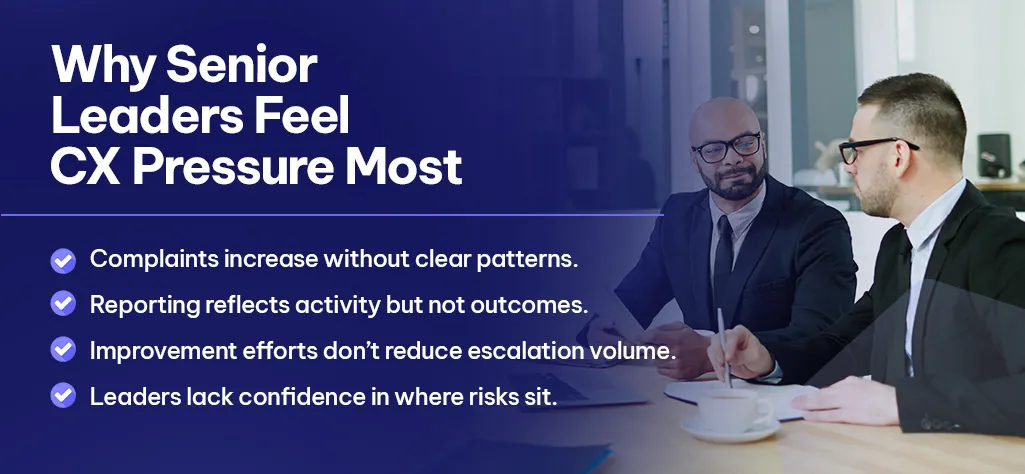
- Complaints increase without clear patterns.
- Reporting reflects activity but not outcomes.
- Improvement efforts don’t reduce escalation volume.
- Leaders lack confidence in where risks sit.
At that point, CX becomes a leadership concern, not just a service one.
Why Fixing Complaints Without Maturity Insight Rarely Works
Councils often respond to rising complaints by:
- Adding escalation steps.
- Tightening communications.
- Introducing new reporting.
- Revising scripts or service standards.
These actions may reduce immediate noise, but often fail to address why issues escalate in the first place.
Without understanding CX maturity:
- Root causes remain hidden.
- Fixes target symptoms, not structure.
- Operational pressure persists.
CX Maturity as a Leadership Tool
A CX maturity assessment gives leaders a different lens.
Instead of responding to complaints as isolated events, councils gain:
- Visibility into systemic service risks.
- Insight into where trust breaks down.
- Clarity on which service areas create the most pressure.
- Evidence to guide investment and change priorities.
Most importantly, it shifts CX conversations from reaction to prevention.
What Maturity Clarity Enables at the Leadership Level
For council leaders, maturity insight supports:
- Stronger governance discussions.
- More confident reporting.
- Better prioritisation of improvement funding.
- Reduced escalation volume over time.
- Clear accountability across services.
It also helps councils explain why change is needed, internally and externally.
Why Exigo Tech Works at the Leadership Layer, Not Just Operations
At Exigo Tech, we engage councils where CX meets governance, trust, and accountability.
Our approach helps leaders:
- See patterns behind complaints, not just volumes.
- Understand how maturity influences risk and reputation.
- Identify improvement opportunities that reduce escalation.
- Build roadmaps grounded in operational reality.
We focus on clarity, so leaders can make informed decisions with confidence.
Turning Pressure into Confidence
Complaints are often seen as failures.
In reality, they are signals.
Signals that:
- Visibility is missing.
- Ownership is unclear.
- Maturity has not kept pace with complexity.
When councils respond with clarity rather than urgency, pressure decreases, and trust is rebuilt.



 Exigo Tech - Ask AI (Beta)