 Australia
 Singapore
 Philippines
 India
India6.07 MIN READ
How SMBs Can Build a Successful Data Analytics Strategy
 Alpesh Prajapati | Aug 05, 2026
Data has become one of the most valuable assets for any business. Every customer interaction, sales transaction, operational process, and financial activity generates information that can help organisations make better decisions.
Yet, many small and medium-sized businesses (SMBs) struggle to turn this data into meaningful insights. Information is often scattered across spreadsheets, accounting software, CRM platforms, ERP systems, and cloud applications, making it difficult to gain a complete view of business performance.
A well-defined data analytics strategy helps SMBs move beyond simply collecting data to using it as a competitive advantage. By bringing data together, improving its quality, and delivering actionable insights, businesses can make faster, more informed decisions that drive growth.
At Exigo Tech, we help organisations unlock the value of their data as their Managed Intelligence Partner, delivering modern data and analytics solutions that transform information into business intelligence.
Why Every SMB Needs a Data Analytics Strategy
Many SMBs rely on instinct and experience when making business decisions. While experience remains valuable, today’s competitive environment requires organisations to make decisions based on accurate, real-time information.
A structured data analytics strategy enables businesses to:
- Make faster decisions
- Improve operational efficiency
- Understand customer behaviour
- Identify new revenue opportunities
- Reduce costs
- Measure business performance
- Support future growth
Rather than reacting to problems after they occur, organisations can identify trends early and make proactive business decisions.
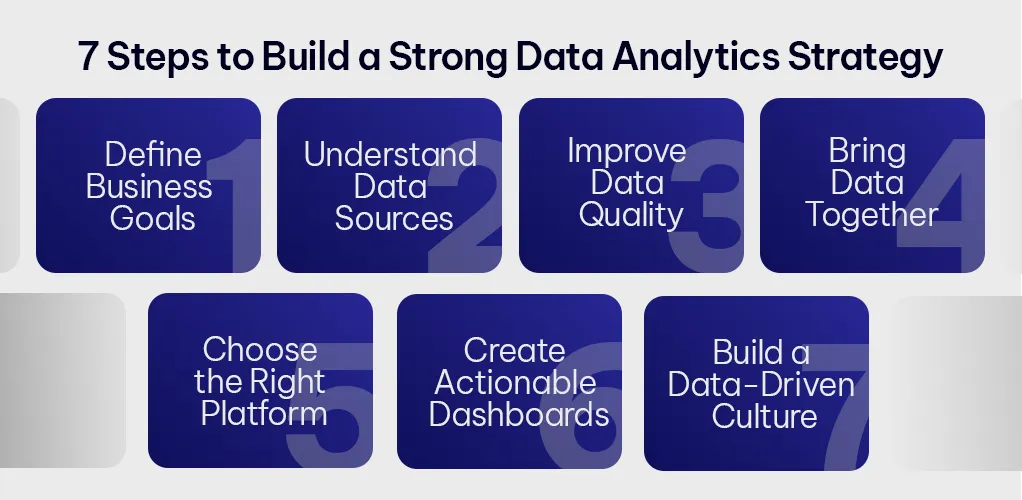
Step 1: Define Your Business Goals
Technology should always support business objectives.
Before selecting analytics tools or building dashboards, identify the outcomes you want to achieve.
Examples include:
- Increasing sales
- Improving customer retention
- Reducing operational costs
- Optimising inventory
- Improving project profitability
- Enhancing customer service
Clear business goals help ensure analytics initiatives focus on measurable outcomes rather than collecting data for its own sake.
Step 2: Understand Your Data Sources
Most SMBs already have valuable data, but it’s spread across multiple systems.
Common data sources include:
- ERP systems
- CRM platforms
- Accounting software
- Microsoft Excel
- Microsoft 365
- Business applications
- E-commerce platforms
- Customer service systems
Understanding where your data resides is the first step toward creating a unified view of your business.
Step 3: Improve Data Quality
Reliable insights depend on reliable data.
Before building reports, organisations should review their data for:
- Duplicate records
- Missing information
- Inconsistent formats
- Outdated data
- Manual entry errors
Poor-quality data can lead to inaccurate reporting and poor business decisions, regardless of how advanced the analytics platform may be.
Step 4: Bring Your Data Together
One of the biggest challenges for SMBs is data silos.
When sales, finance, operations, and customer information exist in separate systems, it becomes difficult to understand the complete picture.
Modern data platforms enable organisations to integrate information from multiple sources into a centralised environment, providing a single source of truth for reporting and analysis.
This allows decision-makers to access consistent information across the business.
Step 5: Choose the Right Analytics Platform
Selecting the right technology is essential for long-term success.
Microsoft solutions such as Microsoft Fabric and Power BI provide SMBs with scalable analytics capabilities that support:
- Interactive dashboards
- Self-service reporting
- Real-time data visualisation
- Automated reporting
- AI-powered insights
- Secure data sharing
Choosing a platform that integrates with your existing Microsoft environment can simplify implementation while supporting future growth.
Step 6: Focus on Actionable Dashboards
Not every metric deserves a dashboard.
Effective reporting focuses on the key performance indicators (KPIs) that support business decisions.
Examples include:
- Revenue performance
- Customer acquisition
- Gross margin
- Project profitability
- Inventory levels
- Cash flow
- Employee productivity
Simple, business-focused dashboards are often more valuable than complex reports containing excessive information.
Step 7: Build a Data-Driven Culture
Technology alone does not create better decisions.
Employees should understand how to use data to support their daily work.
Encourage teams to:
- Use dashboards during meetings
- Measure business outcomes
- Monitor KPIs regularly
- Share insights across departments
- Base decisions on evidence rather than assumptions
When data becomes part of everyday decision-making, organisations gain greater value from their analytics investment.
Step 8: Protect and Govern Your Data
As businesses rely more heavily on data, governance becomes increasingly important.
Your strategy should include:
- Access controls
- Data security
- Backup and recovery
- Compliance requirements
- Data ownership
- Information lifecycle management
Strong governance ensures business information remains accurate, secure, and accessible to authorised users.
Common Mistakes SMBs Should Avoid
Many analytics projects fail because organisations focus on technology before strategy.
Common challenges include:
-
Trying to Measure Everything
Collecting excessive data often creates confusion instead of clarity.
Focus on the metrics that directly support business objectives.
-
Working with Disconnected Systems
Reporting becomes difficult when departments operate independently using different data sources.
Integration is essential for consistent insights.
-
Ignoring Data Quality
Even the most advanced analytics tools cannot compensate for inaccurate or incomplete data.
Improving data quality should be a priority from the beginning.
-
Treating Analytics as an IT Project
Analytics should involve business leaders, department managers, and end users, not just the IT team.
Successful strategies align technology with business priorities.
Looking Beyond Reporting
Modern analytics is about more than historical reporting.
With AI-powered capabilities, organisations can:
- Identify emerging trends
- Forecast future performance
- Detect anomalies
- Automate insights
- Improve operational planning
- Support better strategic decisions
As AI continues to evolve, businesses with strong data foundations will be better positioned to take advantage of intelligent automation and predictive analytics.
Why Choose Exigo Tech as Your Managed Intelligence Partner
At Exigo Tech, we help SMBs build modern data and analytics capabilities that deliver measurable business value.
As your Managed Intelligence Partner, we provide:
- Data Strategy Consulting
- Microsoft Fabric implementation
- Power BI dashboards and reporting
- Data integration services
- Data governance and security
- AI-ready data foundations
- Business intelligence solutions
- Ongoing managed data and analytics services
Our approach helps organisations transform fragmented information into actionable insights that support smarter business decisions.
Turn Data into Your Competitive Advantage
Every business generates valuable data, but only those with a clear strategy can fully unlock its potential.
By defining business objectives, improving data quality, integrating systems, implementing modern analytics platforms, and building a data-driven culture, SMBs can make faster decisions, improve efficiency, and create new opportunities for growth.
Rather than viewing analytics as a reporting exercise, organisations should see it as a strategic capability that enables better planning, stronger customer experiences, and long-term business success.

 Exigo Tech - Ask AI (Beta)