 Australia
 Singapore
 Philippines
 India
India9.05 MIN READ
How Microsoft 365 E7 Helps Businesses Scale AI Securely
 Niten Devalia | Aug 19, 2026
AI adoption is moving quickly from experimentation to everyday business operations.
Many organisations have already introduced Microsoft 365 Copilot, tested AI assistants, or started exploring agents that can perform tasks across business applications. The next challenge is bigger: how do you scale AI without losing control over identity, data, security, and governance?
This is where Microsoft 365 E7 enters the picture.
Microsoft 365 E7, also known as the Frontier Suite, became generally available on 1 May 2026. It brings together Microsoft 365 E5, Microsoft 365 Copilot, Microsoft Entra Suite, and Microsoft Agent 365, alongside advanced Defender, Intune, and Purview capabilities. Microsoft positions it for organisations moving from AI experimentation towards secure, enterprise-scale execution.
But E7 isn’t simply a new licence tier. Its bigger significance is the way it brings AI productivity, identity, security, and agent governance together.
At Exigo Tech, we help Australian organisations evaluate and implement Microsoft technologies as their Managed Intelligence Partner, helping businesses scale AI while keeping security, governance, and business outcomes in focus.
Why Scaling AI Creates a Security Challenge
Using AI for an individual task is relatively straightforward.
Scaling AI across an organisation is different.
Once employees begin using Copilot and organisations deploy AI agents, those systems may interact with business documents, emails, applications, workflows, and other sensitive information.
That creates important questions:
- What information can an AI system access?
- Which users or agents can perform specific actions?
- Who controls AI agents?
- How are agent activities monitored?
- What happens when an agent is no longer required?
- How do security policies apply to AI-driven activity?
Traditional user and application governance doesn’t necessarily address all of these requirements.
Microsoft 365 E7 is designed around this emerging environment, bringing employee and agent security into a more integrated framework.
What Is Microsoft 365 E7?
Microsoft 365 E7 is Microsoft’s Frontier Suite, designed for a human-led, agent-operated enterprise.
It combines:
- Microsoft 365 E5 for productivity, security, and compliance
- Microsoft 365 Copilot for AI-powered productivity
- Microsoft Entra Suite for identity and access management
- Microsoft Agent 365 for managing and securing AI agents
Microsoft describes Agent 365 as the control plane for observing, governing, managing, and securing Microsoft and third-party AI agents.
This combination is important because AI adoption isn’t just about giving employees access to an AI assistant. It is increasingly about managing an environment where people and AI agents work alongside each other.
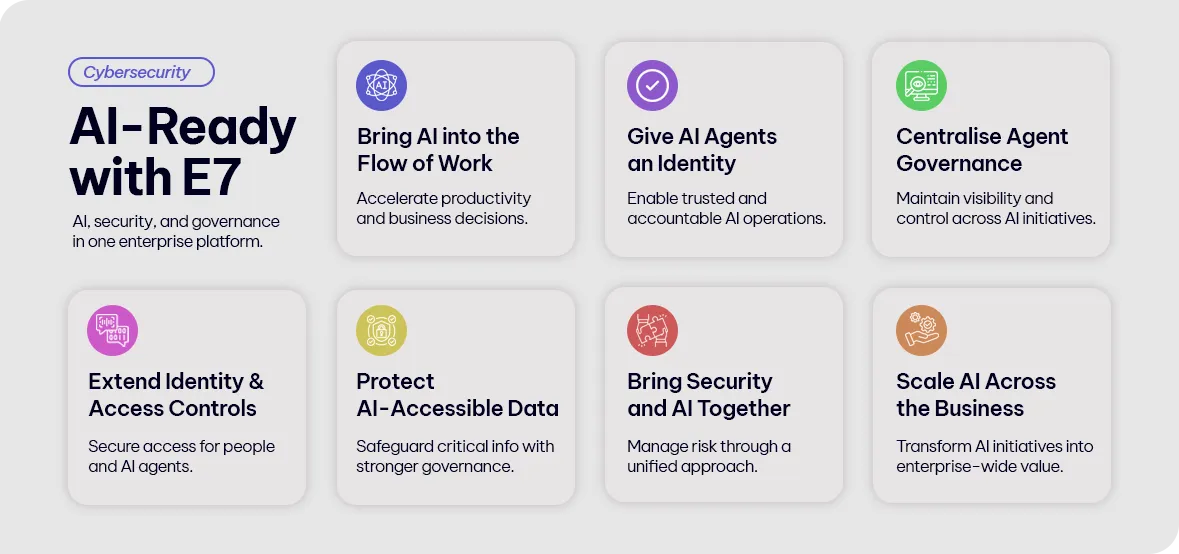
1. Bring AI into the Flow of Work
Microsoft 365 Copilot is a core component of E7.
Instead of introducing a separate AI platform, Copilot works within the Microsoft 365 environment employees already use.
This enables organisations to explore AI across everyday activities such as:
- Drafting and summarising content
- Analysing information
- Preparing presentations
- Working with documents
- Managing communications
- Supporting collaboration
For organisations already planning broader Copilot adoption, having it included within E7 provides a more integrated licensing approach.
However, the value of Copilot depends heavily on the quality and governance of the underlying Microsoft 365 environment.
AI can only work safely when the information it can access is appropriately governed.
2. Give AI Agents an Identity
One of the biggest changes brought by agentic AI is that agents don’t simply provide answers—they can perform actions.
That makes identity particularly important.
Microsoft Agent 365 is designed to provide AI agents with a governed identity and connect them with enterprise security controls. Microsoft states that agents operating with their own identities can be governed through existing frameworks such as Microsoft Entra ID, Conditional Access, information barriers, and sensitivity labels.
This creates a more structured approach to answering questions such as:
Which agent is acting? What can it access? What is it allowed to do?
Instead of treating agents as anonymous pieces of automation, organisations can begin managing them as governed entities within their technology environment.
3. Centralise Agent Governance
As businesses deploy more agents, visibility becomes increasingly important.
Imagine having separate agents supporting sales, customer service, finance, HR, operations, and IT.
Without central governance, organisations can quickly lose track of:
- Which agents exist
- Who owns them
- What systems they access
- What permissions they have
- Whether they are still required
- Whether their behaviour presents a security concern
Agent 365 is designed to provide a central control plane for observing, governing, managing, and securing agents across the organisation.
This is particularly important as businesses move from isolated AI pilots to larger agent ecosystems.
4. Extend Identity and Access Controls
AI doesn’t remove the need for strong identity security. It makes it even more important.
Microsoft Entra Suite within E7 provides organisations with a broader set of identity and access capabilities, while E7 also extends the security model towards agentic environments.
This supports a more consistent approach to:
- Authentication
- Conditional Access
- Privileged access
- Identity governance
- Access management
- Agent access controls
The objective is straightforward: the right user or agent should have the right access, under the right conditions.
5. Protect AI-Accessible Data
One of the most important considerations when scaling AI is data governance.
Copilot and agents can make information significantly easier to find and use. That is valuable—but it also means existing permissions and data governance need to be in good shape.
If sensitive information is incorrectly accessible, AI may make that information easier to surface.
Microsoft’s current Agent 365 guidance highlights the use of existing enterprise controls such as Conditional Access, information barriers, and sensitivity labels to govern how agents interact with content.
This makes data governance an essential part of AI readiness.
Before scaling AI, organisations should review:
- SharePoint permissions
- OneDrive access
- Sensitivity labels
- Data classification
- Information barriers
- DLP policies
- User and agent access
6. Bring Security and AI Together
E7 doesn’t treat AI security as a completely separate discipline.
Microsoft has integrated E7 with advanced security capabilities across Defender, Intune, and Purview, helping organisations extend their existing security and compliance investments into an AI-enabled environment.
This matters because AI introduces new risks without eliminating existing ones.
Organisations still need to protect:
- Endpoints
- Identities
- Applications
- Data
- Cloud environments
- Users
- AI agents
A unified approach can make it easier for security teams to manage these areas together.
7. Move from AI Experiments to Enterprise Adoption
Many businesses have already experimented with AI.
The challenge now is moving from:
“Some employees are using AI.”
to:
“AI is embedded into how our organisation operates.”
That requires more than licences.
Organisations need:
- Clear AI governance
- Data readiness
- Identity controls
- Security policies
- Employee training
- Agent oversight
- Defined business use cases
- Ongoing optimisation
Microsoft positions E7 specifically for organisations ready to move from AI experimentation to scale.
Is Microsoft 365 E7 Right for Every Business?
Not necessarily.
E7 makes the most sense for organisations that are actively looking to scale Copilot and agentic AI while strengthening governance and security around that adoption.
It may be particularly relevant for organisations that:
- Are expanding Microsoft 365 Copilot adoption
- Are developing or deploying multiple AI agents
- Need stronger agent governance
- Already rely heavily on Microsoft 365 E5
- Have complex identity and security requirements
- Want to establish a more structured AI operating model
For organisations still experimenting with AI, a readiness assessment may be more appropriate before moving to the full suite.
The objective should not be to purchase the most advanced licence available. It should be to align licensing with actual business requirements and AI maturity.
What Businesses Should Do Before Moving to E7
Microsoft 365 E7 can provide the technology foundation, but organisations still need to prepare their environment.
-
Assess Your Data
Review where sensitive information resides and who currently has access to it.
-
Review Identity and Permissions
Identify excessive permissions, inactive accounts, and weak access controls before expanding AI.
-
Establish AI Governance
Define which AI tools and agents are approved, how they can be used, and who is responsible for oversight.
-
Assess Copilot Readiness
Evaluate whether your Microsoft 365 environment, data, users, and processes are ready for broader Copilot adoption.
-
Define Agent Use Cases
Don’t deploy agents simply because the technology exists. Identify business processes where agents can deliver measurable value.
-
Plan for Continuous Governance
AI environments will continue to change. Governance should therefore be an ongoing process rather than a one-time implementation.
Why Choose Exigo Tech as Your Managed Intelligence Partner
At Exigo Tech, we help Australian organisations move beyond simply adopting AI tools.
We bring together AI readiness, Microsoft licensing, data governance, identity, security, and managed services to help organisations build an environment where AI can scale safely.
Our capabilities include:
- Microsoft 365 E7 licensing assessments
- Microsoft 365 Copilot readiness assessments
- AI governance advisory
- Microsoft Entra security and identity
- Microsoft Purview and data governance
- Microsoft Agent 365 advisory
- Microsoft 365 Security Health Checks
- Copilot and AI implementation
- Ongoing managed security and IT services
Our role as a Managed Intelligence Partner is to help organisations determine where AI creates value, what needs to change before adoption, and how to keep optimising after deployment.
Scaling AI Requires More Than AI
The next phase of enterprise AI won’t simply be about giving more people access to Copilot.
It will involve AI agents performing tasks, interacting with systems, accessing organisational data, and becoming part of everyday business operations.
That creates an important requirement: AI must scale alongside security and governance.
Microsoft 365 E7 brings Copilot, Entra Suite, Agent 365, Microsoft 365 E5, and advanced security capabilities together to support this shift.
But technology alone isn’t enough.
Businesses need the right data foundations, identity controls, governance policies, security practices, and business use cases to make AI adoption successful.
The organisations that get this balance right will be better positioned to move from AI experimentation to secure, scalable, and measurable business transformation.
 Exigo Tech - Ask AI (Beta)