 Australia
 Singapore
 Philippines
 India
India6.02 MIN READ
The AI Security Gap: Why Businesses Are Adopting AI Faster Than They Can Secure It
 Niten Devalia | Jul 20, 2026
Artificial Intelligence has quickly become a business priority.
Across industries, organisations are using AI to improve productivity, automate repetitive tasks, generate insights, enhance customer experiences, and support decision-making. From Microsoft 365 Copilot to AI-powered analytics and intelligent automation, businesses are finding new opportunities to work smarter and faster.
However, while AI adoption continues to accelerate, security and governance are struggling to keep pace.
Many organisations are deploying AI tools before establishing the policies, controls, and security frameworks needed to manage them responsibly. This growing disconnect, often referred to as the AI security gap, is becoming one of the most significant cybersecurity challenges facing businesses in 2026.
At Exigo Tech, we help organisations bridge this gap as their Managed Intelligence Partner, ensuring AI innovation is supported by strong governance, Microsoft security solutions, and practical risk management.
What Is the AI Security Gap?
The AI security gap is the difference between how quickly organisations adopt AI technologies and how prepared they are to secure them.
Businesses are investing in AI because of the immediate productivity benefits, but many have yet to answer important questions such as:
- Which AI tools are approved?
- What business data can employees share with AI?
- Who governs AI usage?
- How are AI-generated decisions monitored?
- Are security controls keeping pace with AI adoption?
Without clear answers, organisations risk introducing new vulnerabilities alongside new capabilities.
Why AI Adoption Is Accelerating
The rapid growth of enterprise AI is driven by several factors.
Modern AI platforms help employees:
- Draft documents
- Summarise meetings
- Analyse business data
- Automate workflows
- Improve customer service
- Generate reports
- Accelerate software development
Solutions like Microsoft 365 Copilot are also deeply integrated into everyday business applications, making AI easier to adopt than ever before.
For many organisations, AI is no longer viewed as experimental technology; it has become an operational tool that supports daily business activities.
The Security Challenges Behind Rapid AI Adoption
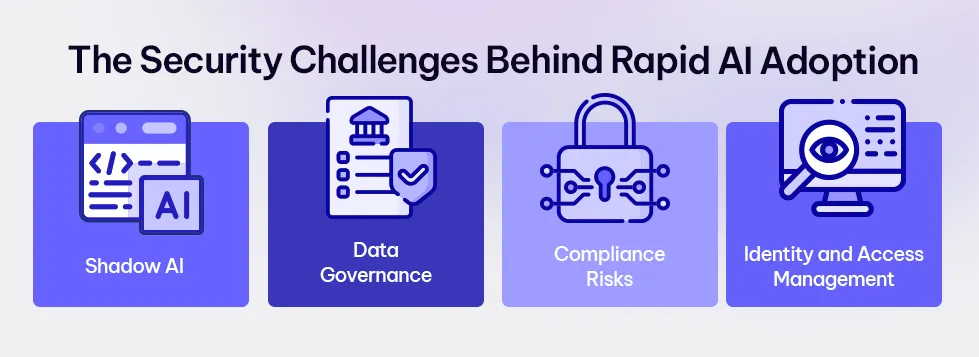
While AI offers enormous benefits, it also introduces new risks when governance is overlooked.
-
Shadow AI
One of the fastest-growing concerns is Shadow AI.
Employees increasingly use public AI tools without approval from IT or security teams.
These applications may receive:
-
- Customer information
- Financial data
- Internal documents
- Contracts
- Business strategies
Without visibility, organisations cannot effectively manage how sensitive information is being used or protected.
Data Governance
AI relies on access to organisational information.
If permissions are poorly managed or sensitive information is not classified correctly, AI systems may expose data to users who should never have seen it.
Strong data governance becomes even more important as AI gains broader access across Microsoft 365 environments.
-
Compliance Risks
Many organisations operate within regulated industries that require careful management of personal and confidential information.
When employees use unauthorised AI services, organisations may unintentionally create compliance challenges related to:
-
- Privacy
- Data residency
- Information governance
- Industry regulations
These risks extend beyond cybersecurity into legal and operational governance.
-
Identity and Access Management
AI systems often operate using existing user permissions.
If identities have excessive access, AI can retrieve and process more information than intended.
This reinforces the importance of:
-
- Microsoft Entra ID
- Least-privilege access
- Conditional Access
- Identity governance
Identity security becomes a critical part of responsible AI adoption.
Why Microsoft 365 Governance Matters
Many organisations adopting AI already use Microsoft 365 as their primary business platform.
This means AI capabilities often interact with:
- SharePoint
- Teams
- Outlook
- OneDrive
- Microsoft Fabric
- Dynamics 365
Without proper governance, existing permission issues become more visible and potentially more impactful.
Before expanding AI across Microsoft 365, organisations should review:
- User permissions
- Data classification
- Sensitivity labels
- Data Loss Prevention (DLP)
- Retention policies
Governance creates the secure foundation AI needs to deliver trusted outcomes.
Building an AI-Ready Security Strategy
Closing the AI security gap requires more than deploying new security tools.
It requires a balanced approach that supports innovation while managing risk.
-
Establish AI Governance
Every organisation should define:
-
- Approved AI platforms
- Acceptable use policies
- Data handling guidelines
- Governance responsibilities
Clear policies help employees use AI confidently and responsibly.
-
Improve Data Visibility
Organisations need to understand:
-
- What information they hold
- Where it is stored
- Who can access it
- How AI interacts with that data
Microsoft Purview provides valuable capabilities for discovering, classifying, and protecting sensitive information across Microsoft 365.
-
Strengthen Identity Security
Identity remains one of the strongest security controls available.
Using Microsoft Entra ID, organisations can implement:
-
- Multi-Factor Authentication
- Conditional Access
- Role-Based Access Control
- Privileged Identity Management
These controls help ensure AI systems operate within secure identity frameworks.
-
Educate Employees
Technology alone cannot eliminate AI-related risks.
Employees should understand:
-
- Which AI tools are approved
- What information should never be shared
- How AI supports business operations
- Security responsibilities when using AI
Training encourages responsible adoption rather than limiting innovation.
-
Continuously Review AI Usage
AI technologies evolve rapidly.
Regular reviews help organisations assess:
-
- New AI platforms
- Emerging risks
- Governance effectiveness
- Security controls
- Business outcomes
Continuous improvement ensures governance evolves alongside AI capabilities.
-
AI Security Is a Business Responsibility
Although IT teams often lead AI implementation, governance should involve the entire organisation.
Successful AI adoption requires collaboration between:
-
- Executive leadership
- IT
- Security
- Compliance
- Legal
- Business units
Treating AI governance as a business initiative rather than simply a technology project leads to stronger long-term outcomes.
Why Choose Exigo Tech as Your Managed Intelligence Partner
At Exigo Tech, we help organisations adopt AI securely while maintaining strong governance across Microsoft environments.
As your Managed Intelligence Partner, we provide:
- AI strategy and consulting
- Microsoft 365 Copilot Readiness Assessments
- Microsoft Purview implementation
- AI governance frameworks
- Microsoft Entra ID optimisation
- Microsoft 365 Security Health Checks
- Managed Security as a Service (MSaaS)
- Ongoing AI and cybersecurity advisory services
Our approach helps organisations unlock AI’s potential while protecting business data, reducing risk, and supporting long-term digital transformation.
Secure AI Adoption Starts with Strong Governance
AI is transforming how businesses operate, collaborate, and innovate.
However, successful AI adoption depends on more than deploying intelligent tools. It requires secure identities, governed data, clear policies, and continuous oversight.
Organisations that address the AI security gap today will be better positioned to embrace future innovations with confidence, improve operational efficiency, and build lasting trust in their AI initiatives.
By combining strong governance with modern Microsoft security capabilities, businesses can accelerate AI adoption without compromising security or compliance.
 Exigo Tech - Ask AI (Beta)