 India
India Australia
 Singapore
 Philippines
5.16 MIN READ
Endpoint Security Solutions for Businesses in the Philippines
 Niten Devalia | Aug 24, 2026
Endpoint Security Solutions for Businesses in the Philippines
The workplace has changed. Employees now work from offices, homes, client locations, and mobile environments while accessing business applications and data from laptops, desktops, smartphones, and other connected devices.
This flexibility creates productivity benefits, but it also expands the organisation’s attack surface.
Every endpoint can become a potential entry point for malware, ransomware, credential theft, phishing, or unauthorised access. Traditional antivirus alone is no longer enough to protect modern businesses, particularly as attackers increasingly use sophisticated techniques that can bypass signature-based detection.
For businesses in the Philippines, strengthening endpoint security is therefore an important part of building a resilient cybersecurity strategy.
At Exigo Tech, we help organisations strengthen endpoint protection through a combination of security technologies, proactive monitoring, identity controls, and managed cybersecurity services.
Why Endpoint Security Matters
An endpoint is any device that connects to an organisation’s IT environment.
This can include:
- Laptops and desktops
- Mobile devices
- Servers
- Workstations
- Remote employee devices
- Corporate applications and connected systems
As more employees work remotely and organisations adopt cloud applications, the number of endpoints requiring protection continues to grow.
A compromised device can give attackers a pathway into corporate applications, sensitive information, and other connected systems.
Endpoint security therefore needs to protect the device while also detecting suspicious behaviour and limiting what an attacker can do after gaining access.
Why Traditional Antivirus Is No Longer Enough
Traditional antivirus primarily relies on known malware signatures and predefined detection techniques.
That approach remains useful, but modern attacks can be more difficult to identify.
Attackers increasingly use:
- Fileless attacks
- Ransomware
- Credential theft
- Living-off-the-land techniques
- Polymorphic malware
- Zero-day vulnerabilities
- Malicious scripts
Modern endpoint protection combines prevention with behavioural detection, investigation, and response.
Endpoint Protection Platforms (EPP) can prevent known and emerging threats, while Endpoint Detection and Response (EDR) provides deeper visibility into suspicious activity and enables security teams to investigate and respond.
This layered approach is increasingly important for businesses operating across hybrid and cloud environments.
The Growing Risk of Remote and Hybrid Work
Remote work has changed how employees access company resources.
Employees may connect to business systems from:
- Home networks
- Public Wi-Fi
- Personal devices
- Customer locations
- Shared workspaces
This makes it difficult for businesses to rely solely on traditional network perimeter security.
Endpoint security helps extend protection directly to the device, regardless of where the employee is working.
Organisations can combine endpoint protection with device management, identity security, and Conditional Access to ensure that only trusted and compliant devices can access sensitive business resources.
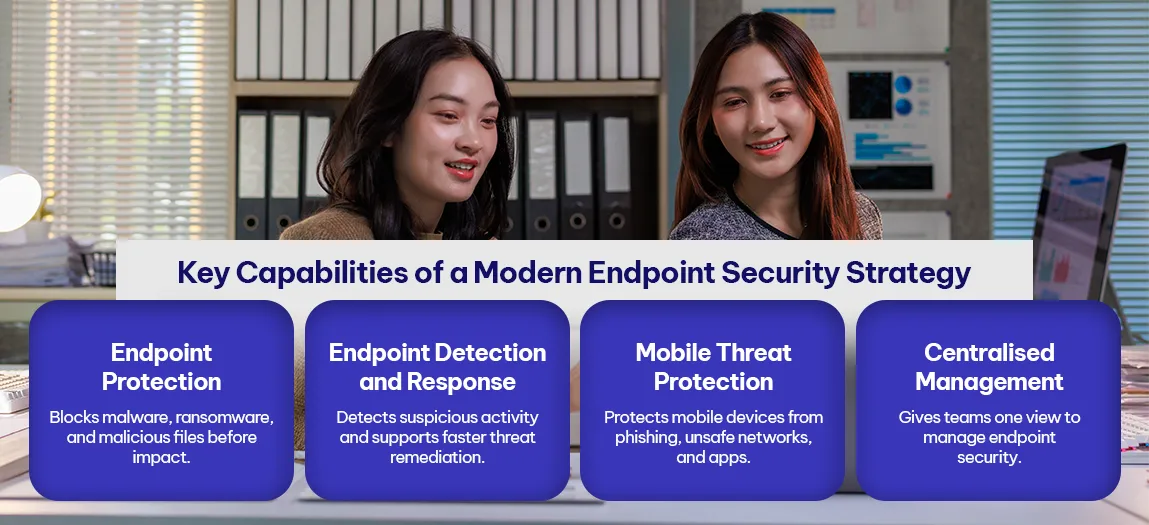
Key Capabilities of a Modern Endpoint Security Strategy
-
Endpoint Protection
Endpoint Protection Platforms provide a first layer of defence against malware, ransomware, malicious files, and other threats.
Modern solutions can combine signature-based protection with behavioural analysis and automated prevention.
-
Endpoint Detection and Response
EDR provides visibility into endpoint activity and helps security teams identify suspicious behaviour.
Rather than simply blocking a file, EDR can help investigate what happened, identify affected devices, and support remediation.
-
Mobile Threat Protection
Smartphones and tablets increasingly access corporate email, applications, and data.
Mobile threat protection helps identify malicious applications, phishing attempts, unsafe networks, and other mobile-specific risks.
-
Centralised Management
Security teams need a centralised view of endpoint security.
Centralised management can help organisations monitor devices, apply security policies, investigate alerts, and maintain consistent protection across distributed environments.
Endpoint Security and Compliance
Endpoint security is also closely connected to data protection and compliance.
Businesses may need to demonstrate that appropriate controls are in place to protect sensitive information.
Endpoint security can support these requirements through:
- Device encryption
- Access controls
- Security policies
- Malware protection
- Activity monitoring
- Patch management
- Data loss prevention
The specific compliance requirements will vary by organisation and industry, but endpoint security should form part of the broader governance framework rather than operate as an isolated technology.
How to Build a Strong Endpoint Security Strategy
-
Identify Every Endpoint
You cannot secure devices you do not know exist.
Maintain an accurate inventory of corporate and authorised devices connecting to business resources.
-
Keep Devices Updated
Unpatched operating systems and applications can leave known vulnerabilities exposed.
Establish processes for timely security updates and patch management.
-
Enforce Device Compliance
Use device management and identity controls to ensure that only compliant devices can access sensitive applications and data.
-
Monitor Behaviour
Security teams should look beyond known malware and monitor for unusual endpoint behaviour that may indicate compromise.
-
Prepare for Incident Response
When an endpoint is compromised, speed matters.
Organisations should have processes for isolating devices, investigating activity, removing threats, and restoring normal operations.
Endpoint Security Should Work with the Rest of Your Security Environment
Endpoint protection is strongest when it is connected to other security controls.
For example, endpoint telemetry can complement:
- Identity security
- Email security
- Cloud security
- Network security
- SIEM
- Managed Detection and Response
- Security awareness training
This broader approach helps organisations detect threats across multiple parts of the environment rather than viewing each endpoint in isolation.
Why Choose Exigo Tech
At Exigo Tech, we help organisations build endpoint security strategies that combine technology with ongoing expertise and management.
Our capabilities include:
- Endpoint security assessments
- Endpoint Protection Platform implementation
- Endpoint Detection and Response
- Microsoft Defender deployment
- Mobile and device security
- Patch management
- Identity and Conditional Access
- Managed Security as a Service (MSaaS)
- Security monitoring and incident response
Our approach helps businesses move from basic device protection towards a more proactive security model.
Protect Every Endpoint, Wherever Work Happens
Endpoints remain one of the most important parts of an organisation’s cybersecurity environment.
As businesses in the Philippines continue adopting cloud applications, hybrid work, and connected technologies, endpoint security needs to evolve beyond traditional antivirus.
A modern strategy combines prevention, behavioural detection, device management, identity controls, monitoring, and rapid response.
The objective is simple: protect every device, reduce the attack surface, and limit the impact of threats when they occur.

 Exigo Tech - Ask AI (Beta)