 India
India Australia
 Singapore
 Philippines
5.53 MIN READ
AI Adoption Roadmap: A Practical Guide for Businesses
 Alpesh Prajapati | Sep 16, 2026
Artificial intelligence is moving from experimentation to everyday business use.
Organisations are already using AI to automate repetitive work, improve customer experiences, analyse information, support employees, and accelerate decision-making. As AI capabilities continue to mature, the challenge is no longer simply deciding whether to use AI. It is deciding where to start, how to scale, and how to manage it responsibly.
Without a structured approach, businesses can end up with disconnected AI tools, inconsistent adoption, security risks, unclear ownership, and investments that fail to deliver meaningful business outcomes.
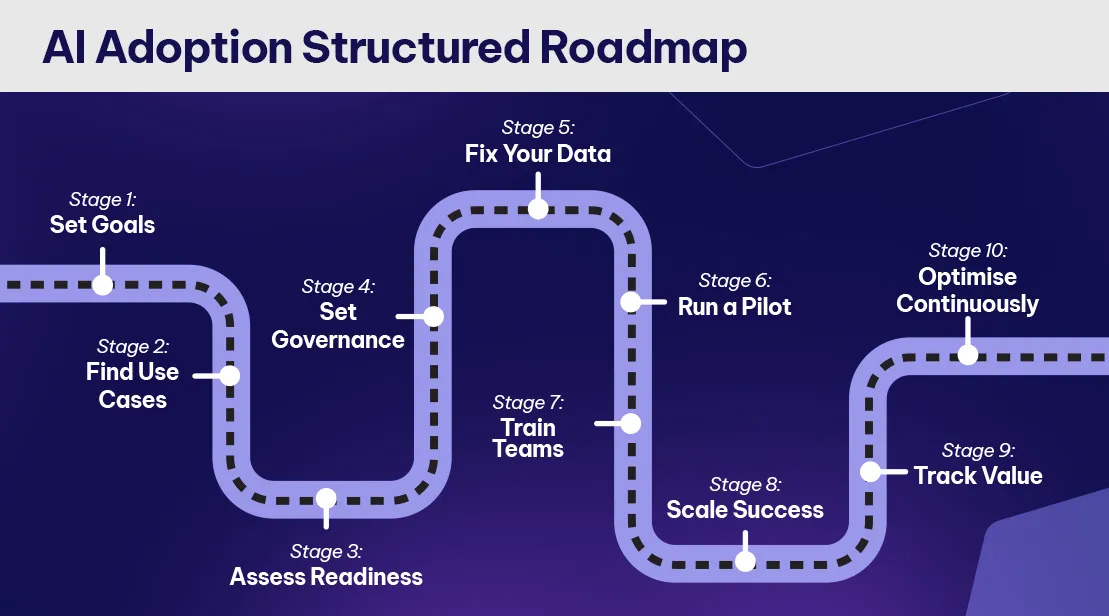
An AI adoption roadmap provides a structured path from identifying opportunities to deploying, measuring, and continuously improving AI across the organisation.
At Exigo Tech, we help businesses move from AI experimentation to practical adoption as their Managed Intelligence Partner, connecting AI, data, security, governance, and business strategy.
Why Businesses Need an AI Adoption Roadmap
AI adoption is not a single technology project.
It affects people, processes, data, applications, security, and organisational strategy. Businesses therefore need to consider more than which AI tool they should purchase.
A structured roadmap helps organisations:
- Identify high-value AI opportunities
- Assess technology and data readiness
- Establish AI governance
- Prepare employees
- Prioritise investments
- Manage security and compliance risks
- Measure business outcomes
The goal is to create a clear path from AI ambition to measurable business value.
Stage 1: Define Your AI Business Objectives
Start with the business problem, not the AI technology.
Identify where AI could improve measurable outcomes such as:
- Employee productivity
- Customer service
- Operational efficiency
- Sales performance
- Data analysis
- Decision-making
- Cost management
For example, rather than saying “we need AI”, a business might define its objective as reducing the time employees spend searching for information or improving the speed of customer enquiry responses.
Clear objectives provide a foundation for prioritising AI initiatives.
Stage 2: Identify High-Value AI Use Cases
Once business objectives are clear, identify processes where AI can make a meaningful difference.
Potential use cases include:
-
Employee Productivity
AI assistants can help employees draft content, summarise meetings, analyse information, and find relevant knowledge.
-
Customer Experience
AI can support customer service teams, automate common enquiries, and provide faster access to customer information.
-
Business Operations
AI can assist with workflow automation, document processing, forecasting, and repetitive administrative tasks.
-
Data and Decision-Making
AI-powered analytics can help organisations identify patterns, trends, anomalies, and opportunities within business data.
Prioritise use cases based on business value, feasibility, risk, and expected adoption.
Stage 3: Assess Your AI Readiness
Before implementing AI, understand whether your technology environment is ready.
Assess four key areas:
- Technology: Are your applications, devices, networks, and cloud platforms ready?
- Data: Is business data accessible, accurate, secure, and properly governed?
- Security: Are identity, access, endpoint, and information protection controls strong enough?
- People: Do employees have the skills and understanding required to use AI effectively?
A readiness assessment helps identify gaps before they become barriers to adoption.
Stage 4: Establish AI Governance
AI adoption without governance can introduce significant business risks.
Your AI governance framework should address:
- Approved AI tools
- Data usage
- Privacy
- Security
- Intellectual property
- Human oversight
- Responsible AI
- Acceptable use
- Risk management
Stage 5: Strengthen Your Data Foundation
AI depends on quality data.
If information is fragmented across spreadsheets, applications, file repositories, and disconnected systems, AI may struggle to provide reliable insights.
Before scaling AI, organisations should focus on:
- Data quality
- Data integration
- Data classification
- Access controls
- Data governance
- Data architecture
Modern platforms such as Microsoft Fabric can help organisations build stronger data foundations for analytics and AI.
The better your data foundation, the more value you can derive from AI.
Stage 6: Start with a Controlled Pilot
Avoid attempting an organisation-wide AI rollout immediately.
Select a specific department, user group, or business process for an initial pilot.
A pilot allows you to test:
- Technology
- Security controls
- Governance
- User experience
- Training requirements
- Business value
For example, an organisation might begin with Microsoft 365 Copilot for a selected group of employees before expanding adoption across the wider workforce.
The objective is to learn, refine, and demonstrate value before scaling.
Stage 7: Prepare Your Workforce
AI adoption is ultimately a people challenge as much as a technology challenge.
Employees need to understand:
- How AI tools work
- Where AI can add value
- How to write effective prompts
- What information should not be shared
- How to validate AI-generated content
- When human judgement is required
Training should be practical and role-specific.
Employees are more likely to embrace AI when they understand how it improves their own work rather than viewing it simply as another technology initiative.
Stage 8: Scale Successful Use Cases
Once a pilot demonstrates measurable value, expand the successful use case.
Scaling should include:
- Broader user adoption
- Additional business departments
- Improved integrations
- Advanced automation
- More sophisticated AI capabilities
At this stage, governance and security controls should scale alongside adoption.
AI should become part of the organisation’s operating model rather than remain an isolated experiment.
Stage 9: Measure Business Outcomes
AI investments need measurable outcomes.
Depending on the use case, organisations can track:
- Time saved
- Productivity improvements
- Cost reduction
- Customer response times
- Process completion times
- Employee adoption
- Error reduction
- Revenue impact
Measuring these outcomes helps leadership understand whether AI investments are creating genuine business value.
Stage 10: Continuously Optimise
AI adoption does not end when a solution goes live.
New capabilities, business requirements, security risks, and employee expectations will continue to evolve.
Regularly review:
- AI performance
- User adoption
- Governance policies
- Security controls
- Data quality
- Business outcomes
- New AI opportunities
Continuous optimisation ensures AI remains aligned with changing business priorities.
Common AI Adoption Mistakes
-
Starting with Technology
Choosing an AI platform before identifying the business problem can lead to poor adoption and wasted investment.
-
Ignoring Data Readiness
Poor-quality or poorly governed data can limit AI effectiveness and increase risk.
-
Deploying Without Governance
Employees need clear rules around acceptable AI use, data protection, and responsible decision-making.
-
Trying to Transform Everything at Once
A phased approach allows businesses to demonstrate value, learn from experience, and scale with confidence.
-
Focusing Only on Productivity
AI can deliver value across customer experience, operations, analytics, security, and decision-making, not just employee productivity.
Why Choose Exigo Tech as Your Managed Intelligence Partner
At Exigo Tech, we help organisations develop practical AI adoption strategies that connect technology with measurable business outcomes.
As your Managed Intelligence Partner, we can support the complete AI journey through:
- AI Readiness Assessments
- AI Strategy and Roadmap Development
- Microsoft Copilot Readiness
- Copilot Studio Solutions
- Microsoft Fabric and Data Analytics
- AI Governance
- Microsoft Cloud and Security
- AI Automation
- User Training and Adoption
- Ongoing AI Optimisation
Our approach brings together AI, data, security, automation, and managed technology to help organisations adopt AI sustainably.

 Exigo Tech - Ask AI (Beta)