Australia
 Singapore
 Philippines
 India
7.02 MIN READ
Preparing for Quantum-Resistant Security: A Practical Roadmap for Australian Businesses
 Niten Devalia | Nov 09, 2026
Quantum computing could eventually undermine some of the cryptographic methods businesses rely on to protect sensitive information, verify identities and secure digital transactions. Although a cryptographically relevant quantum computer does not currently exist, preparing for this risk requires more than waiting for the technology to mature.
Australian organisations need to understand where cryptography is used, which information would be most exposed and how easily their systems could transition to new standards. This is known as post-quantum cryptography (PQC) readiness.
The Australian Signals Directorate (ASD) recommends planning for the transition away from traditional asymmetric cryptography by the end of 2030.
What Does Post-Quantum Cryptography Protect Against?
Post-quantum cryptography refers to cryptographic algorithms designed to resist attacks from both conventional computers and future quantum computers.
- Many existing security systems use public-key cryptography, including RSA and elliptic-curve cryptography, for functions such as establishing secure connections, exchanging encryption keys and verifying digital signatures. A sufficiently capable quantum computer could break widely used public-key algorithms, potentially exposing information and undermining trust in digital systems.
One concern is the harvest now, decrypt later threat. An attacker could collect encrypted information today and retain it until future technology makes decryption feasible.
This matters when data needs to remain confidential for many years. Sensitive commercial information, intellectual property, financial records and personal information may still require protection long after the original transaction.
- PQC readiness is therefore not just a future infrastructure concern. It is a risk-management decision based on the sensitivity of information, how long it must remain protected and the time required to change the systems that secure it.
Which Cryptographic Dependencies Should Businesses Inventory?
You cannot plan a migration if you do not know where cryptography is used. Many organisations rely on encryption and digital signatures across applications, cloud services, networks and third-party platforms without maintaining a central inventory.
Start by identifying the systems and services that use cryptographic protection, including:
- Network connections: Transport Layer Security (TLS), virtual private networks (VPNs), secure remote access and other protected communications.
- Identity and authentication: Certificates, public-key infrastructure, digital signatures and certificate-based authentication.
- Applications and APIs: Encryption libraries, secure integrations, code signing and authentication between services.
- Data storage and backups: Encryption protecting databases, file repositories, archived records and backup environments.
- Cloud and managed services: Cryptographic dependencies within cloud platforms, SaaS applications, security tools and third-party infrastructure.
- Devices and infrastructure: Network equipment, hardware security modules, firmware and systems with long replacement cycles.
How Should Businesses Classify Data by Sensitivity and Retention?
Not every system needs to migrate at the same time. Prioritisation should reflect the potential impact of a cryptographic compromise and the practical difficulty of replacing the technology.
Begin by classifying information according to its sensitivity, business value and required retention period.
Assess each major data category against three questions:
- How sensitive is the information? Consider the commercial, legal, privacy and operational impact if confidentiality or integrity is compromised.
- How long must it remain protected? Include regulatory retention requirements, contractual obligations and the expected useful life of the information.
- How difficult is the dependency to replace? Legacy applications, embedded devices and specialist vendor systems may require lengthy upgrades or procurement cycles.
Combine these findings with system criticality and exposure to prioritise migration activities. High-value information with long confidentiality requirements and difficult-to-replace dependencies should receive early attention.
What Should You Ask Cloud, Software and Security Vendors?
Third-party readiness can become a major constraint. Even if your internal systems are prepared, a critical application or supplier may not support the cryptographic changes you need.
Use vendor reviews to establish:
- Which cryptographic algorithms and protocols does the product currently support?
- What is the vendor’s PQC migration roadmap, and which milestones are committed?
- Will updates require new licences, hardware, professional services or downtime?
- Can the product support updated standards without a complete replacement?
- How will compatibility be maintained across integrations and third-party systems?
- What testing, validation and support will be available during migration?
Ask vendors to distinguish existing capabilities from planned features. Record their responses, dependencies and expected delivery dates so procurement and security teams can use them in migration planning.
Your First-Year PQC Readiness Action Plan
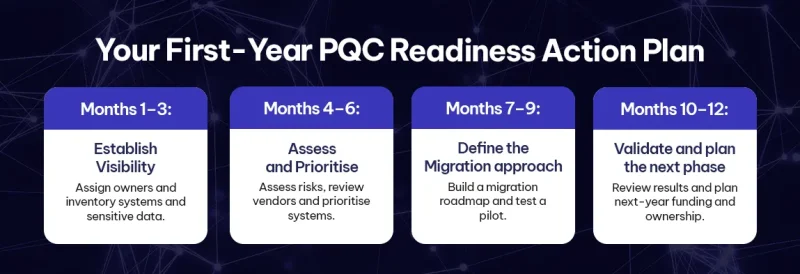
A practical first year should focus on building the foundations for a controlled transition.
Months 1–3: Establish visibility. Assign an executive sponsor and technical owner. Identify critical systems, begin the cryptographic inventory and classify sensitive information by confidentiality requirements and retention period.
Months 4–6: Assess and prioritise. Identify vulnerable cryptographic dependencies, assess vendor roadmaps and evaluate which systems are hardest to replace. Develop a risk-based priority list and estimate costs, resources and potential business disruption.
Months 7–9: Define the migration approach. Develop a roadmap with target milestones, technical requirements and procurement considerations. Select a suitable pilot environment and test compatibility, performance and recovery procedures before wider implementation.
Months 10–12: Validate and plan the next phase. Review pilot findings, update the inventory and refine the migration plan. Establish ownership, funding and progress reporting for the following year.
The outcome should be a documented, prioritised roadmap—not a claim that every system is already quantum-safe.
Why Choose Exigo Tech as Your Managed Intelligence Partner
Preparing for post-quantum cryptography requires coordination across security architecture, infrastructure, applications, data and supplier management.
We help organisations assess technology dependencies, identify security risks and plan practical improvements aligned with business priorities.
- Cybersecurity Assessment: Review security architecture, critical systems and cryptographic dependencies to identify areas requiring further investigation.
- Security Architecture Consulting: Assess infrastructure and application dependencies, upgrade constraints and opportunities to improve crypto-agility.
- Cloud and Infrastructure Services: Review relevant cloud and infrastructure environments and coordinate with technology vendors on supported security capabilities.
- Managed Security Services: Strengthen ongoing security monitoring, risk management and operational visibility as your security requirements evolve.
As your Managed Intelligence Partner, we connect security planning with technology decisions and ongoing optimisation, helping your organisation prepare for emerging risks without losing sight of current business priorities.


 Exigo Tech - Ask AI (Beta)