 Australia
 Singapore
 Philippines
 India
India4.47 MIN READ
IT Health Check: Identifying Risks, Improving Performance, and Strengthening Your IT Environment
 Niten Devalia | Apr 17, 2026
Many organisations only notice IT problems when something goes wrong.
A system slows down. Users cannot access applications. Security alerts appear. Backups fail. Or worse, operations are disrupted by an incident.
By the time these issues occur, they have already started impacting productivity, security, and business continuity.
An IT health check helps prevent this reactive cycle. It provides a structured assessment of your IT environment to identify risks, inefficiencies, and improvement opportunities before they turn into operational problems.
At Exigo Tech, we deliver IT health checks as part of our role as your Managed Intelligence Partner, helping organisations gain visibility into their technology landscape and align IT with business objectives.
What Is an IT Health Check?
An IT health check is a comprehensive review of your IT environment, covering infrastructure, security, performance, and operational processes.
The goal is to answer key questions such as:
- Are systems performing efficiently?
- Are there security gaps that increase risk?
- Is infrastructure aligned with business needs?
- Are backups and recovery processes reliable?
- Are users experiencing avoidable performance issues?
Rather than focusing on a single area, an IT health check evaluates the entire ecosystem.
This comprehensive approach helps organisations understand both immediate risks and long-term improvement opportunities.
Why Organisations Need an IT Health Check
IT environments evolve over time.
New systems are added, users increase, cloud services expand, and legacy platforms remain in place longer than expected. Without periodic review, environments become complex and difficult to manage.
An IT health check helps organisations:
- Identify hidden risks.
- Improve performance and reliability.
- Strengthen security posture.
- Align infrastructure with growth.
- Reduce operational inefficiencies.
It moves IT from reactive maintenance to proactive optimisation.

What an IT Health Check Typically Covers
A structured IT-health check evaluates multiple areas of your environment.
-
Infrastructure Assessment
Review of servers, networks, endpoints, and system performance.
-
Security Review
Assessment of access controls, endpoint protection, patching, and vulnerability exposure.
-
Backup and Recovery Validation
Verification of backup coverage and recovery readiness.
-
Cloud Environment Review
Analysis of cloud configurations, usage, and optimisation opportunities.
-
Identity and Access Management
Evaluation of authentication controls and user access policies.
-
Monitoring and Operational Visibility
Review of logging, alerting, and system monitoring capabilities.
Together, these areas provide a comprehensive view of IT health.
Common Issues Identified During IT Health Checks
Many organisations discover issues they were not aware of, such as:
- Outdated systems lacking security updates.
- Over-provisioned infrastructure increasing costs.
- Backup failures or incomplete coverage.
- Excessive administrative privileges.
- Poor network performance.
- Unused or redundant applications.
These issues often develop gradually and remain unnoticed without structured review. An IT-health check brings them to light.
7 Benefits of an IT Health Check
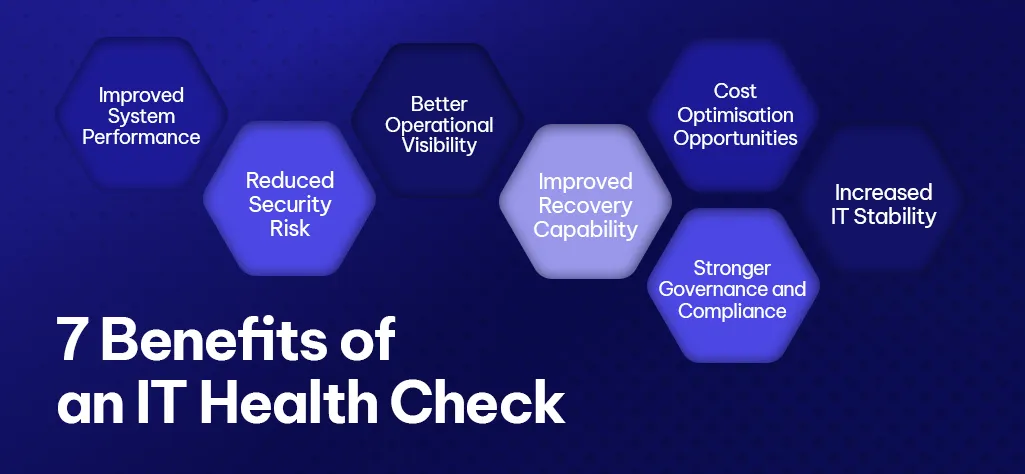
A proactive IT health check delivers measurable business benefits.
-
Improved System Performance
Optimising infrastructure reduces slowdowns and improves user experience.
-
Reduced Security Risk
Identifying vulnerabilities helps prevent potential incidents.
-
Better Operational Visibility
Organisations gain a clearer understanding of their IT environment.
-
Improved Recovery Capability
Validated backup and recovery processes strengthen resilience.
-
Cost Optimisation Opportunities
Unused resources and inefficiencies can be identified and addressed.
-
Stronger Governance and Compliance
Structured review supports audit readiness and policy alignment.
-
Increased IT Stability
Proactive improvements reduce unexpected disruptions.
IT Health Check vs Reactive Troubleshooting
Reactive IT support focuses on fixing issues after they occur.
An IT health check focuses on preventing them.
Reactive approach:
- Issues discovered during outages.
- Limited visibility into root causes.
- Short-term fixes.
Proactive health check approach:
- Early detection of risks.
- Structured improvement recommendations.
- Long-term optimisation.
This shift improves reliability and reduces operational stress.
When Should You Conduct an IT Health Check?
An IT health check is especially valuable when:
- Systems have grown over time without review.
- Organisations are planning cloud migration or upgrades.
- Security concerns are increasing.
- Performance issues are becoming more frequent.
- IT costs are rising without a clear explanation.
- Businesses are preparing for growth or transformation.
Regular health checks ensure IT environments remain aligned with business needs.
Why Choose Exigo Tech as Your Managed Intelligence Partner for IT Health Check
At Exigo Tech, IT-health checks go beyond technical assessments.
We focus on understanding how IT supports your business operations and identifying improvements that deliver real value.
As your Managed Intelligence Partner, we:
- Conduct comprehensive environment assessments.
- Identify risks and optimisation opportunities.
- Provide clear, actionable recommendations.
- Align IT improvements with business goals.
- Support implementation and continuous optimisation.
Our approach ensures your IT environment remains secure, efficient, and future-ready.
From IT Visibility to IT Confidence
An IT health check provides more than a technical report. It delivers clarity.
By understanding the current state of your environment, organisations can make informed decisions, reduce risk, and improve performance.
Instead of waiting for problems to appear, an IT health check enables proactive management, turning IT into a stable foundation for growth.




 Exigo Tech - Ask AI (Beta)