 Australia
 Singapore
 Philippines
 India
India6.09 MIN READ
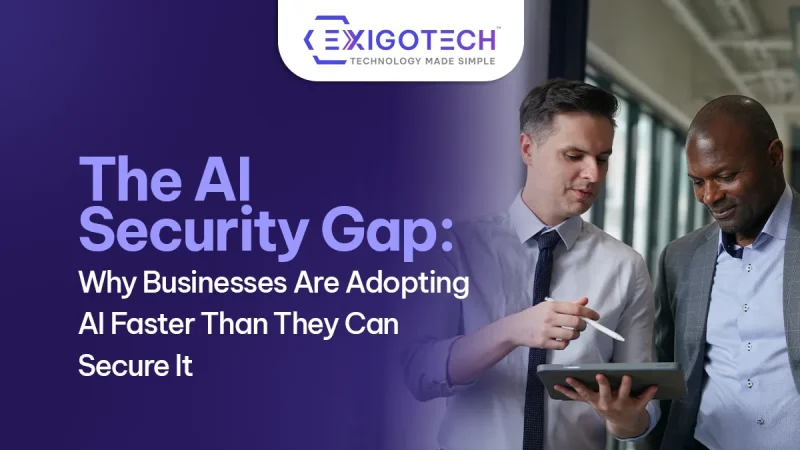
The AI Security Gap: Why Businesses Are Adopting AI Faster Than They Can Secure It
 Niten Devalia | Jun 17, 2026
From content creation and customer service to analytics, automation, and decision-making, organisations are adopting AI to improve efficiency and remain competitive. For many businesses, AI is already being used across departments.
The challenge is that AI adoption is moving faster than AI governance and security.
Many organisations have embraced tools such as Microsoft Copilot, ChatGPT, Gemini, and AI-powered business applications without fully understanding the security, compliance, and data governance implications.
This growing disconnect is creating what many security experts now call the AI Security Gap.
At Exigo Tech, we help organisations close this gap as their Managed Intelligence Partner, ensuring AI adoption is supported by the right governance, security controls, and operational frameworks.
What Is the AI Security Gap?
The AI Security Gap is the difference between how quickly organisations are adopting AI and how prepared they are to manage the risks that come with it.
Most businesses recognise that AI introduces security challenges. The issue is that many organisations have not yet implemented the policies, controls, and governance frameworks needed to manage those risks effectively.
Recent industry research highlights this challenge:
- 77% of organisations say they have updated their security strategy for AI
- Only 26% have the architecture required to enforce those controls
- 78% reported confirmed or suspected AI-related security incidents within the last year
The result is a growing gap between intention and execution.
AI Adoption Is Accelerating Across Australia
Australian businesses are embracing AI at an increasingly rapid pace.
Recent data shows:
- 43% of Australian SMEs have adopted AI in some form
- Adoption reached 44% in early 2026, the highest level in several months
- Businesses are moving beyond experimentation and using AI across multiple business functions
However, adoption does not automatically equal readiness.
Research also found that only a small percentage of businesses are fully prepared to realise the benefits of AI through proper governance, security, and operational controls.
Many organisations remain in the experimentation phase, deploying tools independently without formal oversight or risk management processes.
This is where exposure often begins.
Why the AI Security Gap Exists
Several common challenges contribute to the gap.
Strategy Without Enforcement
Many organisations have AI policies or strategic plans, but the underlying controls have not been implemented.
Identity management, access controls, data governance, and monitoring frameworks often lag behind AI deployment.
As a result, businesses understand the risks but lack the mechanisms to manage them effectively.
Complexity Without Visibility
AI introduces new layers of complexity.
Organisations must now manage:
- AI applications
- Data access
- User permissions
- Third-party AI services
- AI-generated content
- Regulatory obligations
Without visibility into how AI is being used, security teams struggle to identify and manage risk.
Investment Without Governance
Businesses are investing heavily in AI tools but often without governance frameworks to support them.
This creates situations where AI capabilities expand rapidly while oversight remains limited.
The Growing Risk of Shadow AI
One of the biggest challenges facing organisations today is Shadow AI.
Shadow AI refers to employees using AI tools that have not been approved, assessed, or monitored by IT teams.
This may include:
- ChatGPT
- Claude
- Gemini
- AI writing assistants
- AI analytics platforms
- Browser-based AI services
In many organisations, employees adopt these tools independently to improve productivity.
While the intention is often positive, the security implications can be significant.
Sensitive information may be uploaded into external AI platforms without approval, including:
- Customer information
- Financial data
- Internal reports
- Intellectual property
- Business strategies
The organisation may have no visibility into how that information is being stored or processed.
Simply put, businesses cannot protect what they cannot see.
Why Microsoft Copilot Governance Matters
For organisations using Microsoft 365, Copilot represents one of the most significant AI opportunities available today.
Copilot integrates with:
- Outlook
- Teams
- Word
- Excel
- PowerPoint
- SharePoint
- OneDrive
Its power comes from its ability to access the information users already have permission to access.
This is also where risk can emerge.
If permissions within Microsoft 365 are poorly managed, Copilot may surface information that users should not easily discover.
For example:
- Sensitive HR documents
- Financial records
- Executive communications
- Confidential project files
Copilot does not create permission problems.
It simply exposes existing governance weaknesses much more quickly.
This is why organisations should assess permissions, access controls, and data classification before expanding AI adoption.
Regulatory Expectations Are Increasing
AI governance is no longer just a security issue.
It is becoming a compliance requirement.
Australian organisations are facing increasing expectations around transparency and accountability in AI usage.
Upcoming changes to privacy and automated decision-making requirements will require businesses to better understand:
- Which AI systems they use
- What data those systems access
- How decisions are made
- How individuals may be affected
Organisations that wait until regulations take effect may find themselves scrambling to establish governance frameworks under pressure.
The businesses that start now will be in a much stronger position.
Practical Steps to Close the AI Security Gap
Closing the AI Security Gap does not require a complete transformation overnight.
It starts with a structured approach.
Establish an AI Governance Policy
Define:
- Approved AI tools
- Acceptable use guidelines
- Data handling requirements
- Ownership and accountability
A governance policy provides a foundation for responsible AI adoption.
Review Microsoft 365 Permissions
Before expanding Copilot usage, organisations should review:
- SharePoint permissions
- OneDrive access
- Teams memberships
- Administrative privileges
This helps reduce unnecessary exposure.
Classify and Protect Sensitive Data
Data classification and protection controls help ensure AI tools interact appropriately with business information.
Solutions such as Microsoft Purview can support this effort.
Identify Shadow AI Usage
Organisations should gain visibility into what AI tools employees are already using.
Understanding current usage is essential for effective governance.
Update Security Awareness Training
Employees need guidance on:
- AI-related risks
- Sensitive data handling
- Responsible AI usage
- AI-powered phishing threats
Awareness remains a critical security control.
Take a Phased Approach
AI adoption should be treated as an ongoing journey rather than a single deployment project.
Starting with controlled pilots allows organisations to improve governance while scaling adoption safely.
Why Choose Exigo Tech as Your Managed Intelligence Partner
At Exigo Tech, we help organisations adopt AI securely and strategically.
As your Managed Intelligence Partner, we provide:
- Microsoft 365 Copilot Readiness Assessments
- AI governance advisory services
- Microsoft 365 Security Health Checks
- Managed Security as a Service (MSaaS)
- Data classification and governance guidance
- IT security consulting and risk management support
Our goal is to help businesses unlock the benefits of AI while maintaining control, security, and compliance.



 Exigo Tech - Ask AI (Beta)