 Australia
 Singapore
 Philippines
 India
India6.13 MIN READ
Compliance and Cybersecurity Challenges Facing Australia’s Trading and Distribution Industry
 Niten Devalia | Sep 11, 2026
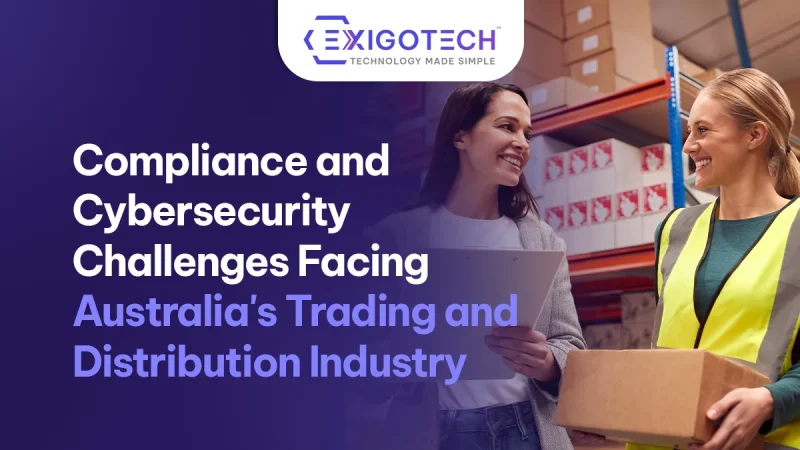
Technology is now sitting at the centre of Australia’s trading and distribution industry. ERP platforms, inventory systems, e-commerce portals, supplier integrations, cloud applications, and customer data platforms help businesses manage increasingly complex operations.
However, greater connectivity also introduces greater risk.
A cyberattack can disrupt order processing, expose commercial information, compromise supplier payments, or bring critical systems offline. At the same time, trading and distribution businesses must manage privacy obligations, contractual requirements, and growing customer expectations around cybersecurity.
At Exigo Tech, we help organisations strengthen their technology foundations as their Managed Intelligence Partner, combining cybersecurity, governance, and modern technology solutions to support secure and resilient business operations.
Why Trading and Distribution Businesses Are Attractive Targets
Trading and distribution businesses manage a combination of valuable data, financial transactions, and interconnected systems.
A typical organisation may process:
- Customer and supplier information
- Pricing and contract data
- Purchase orders and invoices
- Inventory information
- Payment details
- Product and distribution records
- Commercial agreements
Cybercriminals often target these environments because successful attacks can create immediate financial opportunities.
Common threats include:
- Business email compromise
- Ransomware
- Credential theft
- Invoice fraud
- Supply chain attacks
- Third-party compromises
- Data theft
For businesses operating on tight margins and strict delivery commitments, even a short disruption can have significant consequences.
Challenge 1: Protecting ERP and Business-Critical Systems
ERP systems are central to many trading and distribution operations.
They may manage purchasing, inventory, sales, finance, suppliers, and customer orders from a single platform.
When an ERP system becomes unavailable, the impact can quickly spread across the business.
Employees may be unable to:
- Process orders
- Check inventory
- Create invoices
- Manage purchase orders
- Access customer information
- Track financial transactions
Cybersecurity and business continuity planning must therefore focus on protecting the availability and integrity of these critical systems.
Regular security assessments, access reviews, backups, and recovery planning can help reduce the impact of an incident.
Challenge 2: Business Email Compromise and Invoice Fraud
Trading and distribution businesses process large volumes of supplier communications and financial transactions.
This makes them particularly attractive targets for Business Email Compromise (BEC).
Attackers may gain access to an email account and monitor conversations involving:
- Supplier payments
- Purchase orders
- Invoice approvals
- Bank account changes
- Delivery arrangements
Instead of sending obvious phishing emails, attackers may wait for the right moment before changing payment details or requesting fraudulent transfers.
Strong identity security, Multi-Factor Authentication (MFA), email protection, and payment verification processes are essential for reducing this risk.
Challenge 3: Managing Supplier and Third-Party Access
Trading and distribution businesses depend heavily on external relationships.
Suppliers, manufacturers, logistics providers, software vendors, and customers may all connect to business systems or exchange information digitally.
This creates a broader attack surface.
A vulnerability in a supplier or software provider could potentially affect connected systems and business operations.
Organisations should therefore consider:
- Vendor security assessments
- Third-party access controls
- Integration monitoring
- Regular access reviews
- Security requirements in contracts
Managing third-party risk is increasingly important as digital supply chains become more interconnected.
Challenge 4: Protecting Commercially Sensitive Data
Not all valuable business data is personal information.
Trading and distribution organisations also manage commercially sensitive information that could affect their competitive position.
This may include:
- Product pricing
- Supplier agreements
- Customer contracts
- Discount structures
- Sales forecasts
- Inventory levels
- Product sourcing information
Unauthorised access to this information can create financial and competitive risks.
Data classification and access management help organisations understand what information they hold and who should be able to access it.
Challenge 5: Managing Cybersecurity Across Hybrid Environments
Many trading and distribution businesses operate a combination of:
- On-premises infrastructure
- Cloud applications
- ERP platforms
- Microsoft 365
- Mobile devices
- Warehouse technologies
- E-commerce platforms
Managing security consistently across these environments can be challenging.
Common issues include:
- Inconsistent access policies
- Excessive user permissions
- Unpatched applications
- Shadow IT
- Unsecured remote access
- Limited visibility across systems
A unified security strategy helps organisations reduce gaps between different technologies and environments.
Challenge 6: Compliance and Customer Expectations
Compliance requirements can vary depending on the type of information and services a business manages.
Organisations handling personal information must consider their obligations under Australia’s privacy framework. Businesses may also face contractual security requirements from larger customers, suppliers, or partners.
Increasingly, organisations are being asked to demonstrate that they have appropriate controls in place.
These expectations may include:
- Data protection policies
- Identity and access controls
- Cybersecurity governance
- Incident response procedures
- Business continuity planning
- Third-party risk management
Cybersecurity maturity is becoming an important factor in maintaining and winning business relationships.
Challenge 7: Ransomware and Operational Disruption
Ransomware can affect far more than IT systems.
For trading and distribution businesses, an attack may interrupt:
- Order processing
- Inventory management
- Supplier communication
- Customer service
- Invoicing
- Financial operations
Even when systems are eventually restored, the business may face backlogs, delayed orders, customer dissatisfaction, and lost revenue.
A strong ransomware strategy should include prevention, detection, response, and recovery.
This means maintaining secure and tested backups, monitoring suspicious activity, segmenting critical systems, and having a clear incident response plan.
Building a Strong Cybersecurity and Compliance Strategy
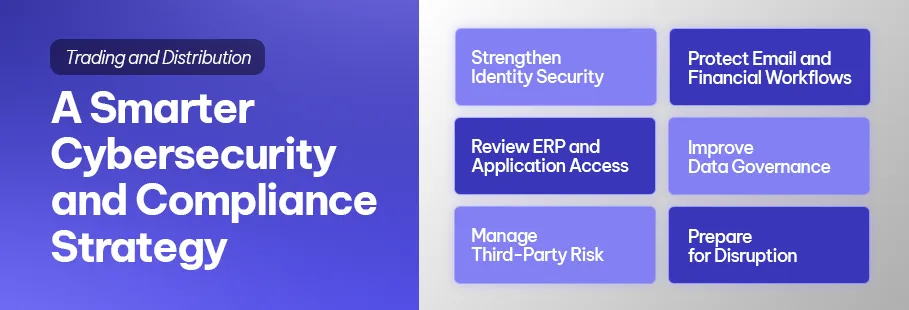
Trading and distribution businesses need a practical approach that protects critical operations without creating unnecessary complexity.
-
Strengthen Identity Security
Protect user accounts with Multi-Factor Authentication, Conditional Access, and least-privilege access controls.
Identity security is particularly important for protecting email, ERP systems, financial platforms, and cloud applications.
-
Protect Email and Financial Workflows
Deploy advanced email security and establish verification procedures for payment changes and sensitive financial requests.
Employees should know how to identify suspicious requests, even when they appear to come from trusted contacts.
-
Review ERP and Application Access
Regularly review who has access to business-critical applications and remove permissions that are no longer required.
This helps reduce the impact of compromised accounts.
-
Improve Data Governance
Identify commercially sensitive and personal information, apply appropriate access controls, and establish clear policies for handling and sharing data.
-
Manage Third-Party Risk
Understand which external organisations and applications have access to your systems or data.
Review these relationships regularly and restrict access where possible.
-
Prepare for Disruption
Test backups, incident response procedures, and recovery plans to ensure the organisation can continue operating during a cyber incident.
Cybersecurity Supports Business Continuity
For trading and distribution organisations, cybersecurity is directly connected to operational performance.
Strong cybersecurity can help businesses:
- Protect revenue
- Maintain order processing
- Reduce financial fraud
- Protect commercial information
- Maintain customer confidence
- Strengthen supplier relationships
- Improve operational resilience
The goal is not simply to prevent every possible cyberattack. It is to build an environment capable of detecting threats, responding quickly, and recovering with minimal business disruption.
Why Choose Exigo Tech as Your Managed Intelligence Partner
At Exigo Tech, we help Australian trading and distribution businesses strengthen cybersecurity, improve technology governance, and protect critical business operations.
As your Managed Intelligence Partner, we provide:
- Cybersecurity and IT Health Checks
- Managed Security as a Service (MSaaS)
- Microsoft 365 security
- Identity and access management
- Microsoft Entra ID and Conditional Access
- Cloud security and governance
- Security monitoring and incident response
- Data protection and governance
- Managed IT services
Our approach helps organisations understand their risks, prioritise improvements, and build a more secure and resilient technology environment.

 Exigo Tech - Ask AI (Beta)