
 India
India Australia
 Singapore
 Philippines
4.58 MIN READ
Why Cloud Disaster Recovery Is No Longer Optional for Modern Businesses
 Maurice Bonotto | Jan 19, 2026
Every organisation plans for growth. And very few plan properly for disruption. System outages, cyber incidents, human error, and cloud service failures are no longer rare events. They are part of operating in a digital world. When these disruptions happen, the difference between a temporary inconvenience and a major business crisis often comes down to one thing: disaster recovery.
Cloud Disaster Recovery is no longer just an IT concern. It is a business continuity requirement.
What Is Cloud Disaster Recovery?
Cloud Disaster Recovery (Cloud DR) is the ability to restore systems, applications, and data using cloud-based infrastructure after a major disruption.
It goes beyond simple backups.
While backups help recover data, disaster recovery focuses on:
- How quickly can systems be restored.
- Whether applications can run again.
- How much data is lost.
- How long has the business been impacted.
Cloud DR uses cloud platforms to provide flexible, scalable recovery options without the cost and complexity of traditional disaster recovery environments.
Why Traditional Disaster Recovery Often Falls Short
Historically, disaster recovery relied on secondary data centres, duplicate hardware, and complex replication setups. These approaches are expensive, difficult to maintain, and often poorly tested.
Common issues include:
- High upfront and ongoing costs.
- Limited scalability.
- Infrequent testing due to complexity.
- Recovery processes that rely on manual intervention.
As a result, many organisations have DR plans that look good on paper but fail during real incidents.
The Real Risks of Not Having Effective Disaster Recovery
When systems go down, the impact is immediate and severe.
Without effective DR, organisations face:
- Extended downtime
- Lost productivity
- Revenue loss
- Reputational damage
- Regulatory and compliance risks
In cyber incidents such as ransomware, recovery speed is critical. Delayed restoration increases pressure to pay ransoms and prolongs business disruption.

How Cloud Disaster Recovery Changes the Game
Cloud Disaster Recovery removes many of the barriers that make traditional DR impractical.
Key advantages include:
- On-demand recovery infrastructure.
- Faster recovery times.
- Reduced dependency on physical hardware.
- Easier testing and validation.
Cloud DR allows organisations to pay for recovery resources only when needed, making robust disaster recovery accessible to businesses of all sizes.
Backup vs Disaster Recovery: A Critical Difference
One of the most common misunderstandings is assuming backups equal disaster recovery.
Backups answer the question: “Can we restore our data?”
Disaster recovery answers: “Can we resume operations quickly and reliably?”
Without DR:
- Restoring backups may take days.
- Applications may need manual reconfiguration.
- Dependencies may be missed.
Cloud DR focuses on restoring entire environments, not just files.
Benefits of Cloud Disaster Recovery
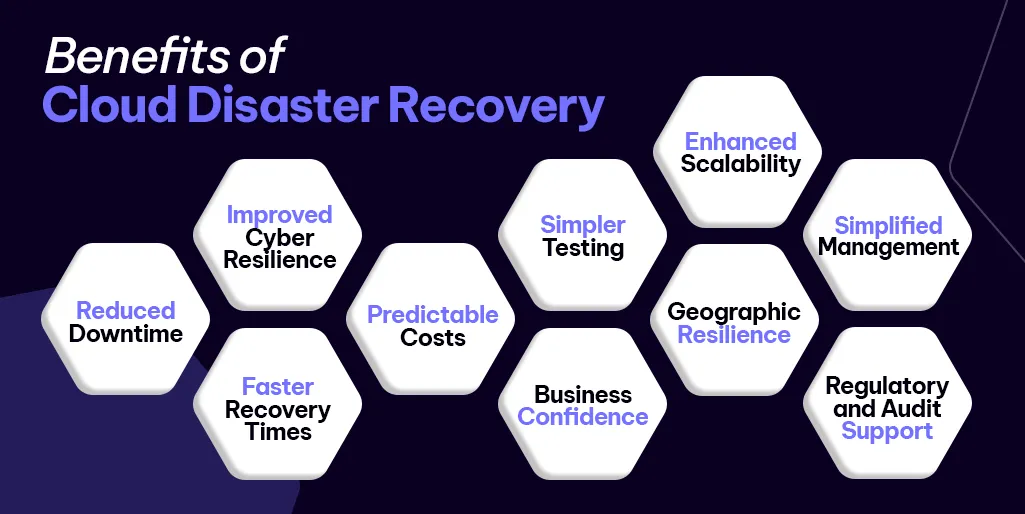
A well-designed cloud disaster recovery strategy delivers meaningful business benefits:
Reduced Downtime
Cloud-based recovery environments can be activated quickly, significantly reducing system outages.
Faster Recovery Times
Automated recovery processes help meet tighter recovery time objectives.
Improved Cyber Resilience
Cloud DR supports clean recovery points, reducing the risk of reintroducing compromised systems.
Predictable Costs
Organisations avoid maintaining unused hardware and only pay for recovery resources when needed.
Simpler Testing
Cloud DR makes it easier to test recovery plans without disrupting production systems.
Business Confidence
Leadership knows that critical systems can be restored when it matters most.
Enhanced Scalability
Cloud DR environments can grow or shrink instantly to match business needs.
Geographic Resilience
Workloads can be restored in different regions to protect against local outages.
Simplified Management
Centralised dashboards make it easier to maintain and monitor recovery readiness.
Regulatory and Audit Support
Cloud DR helps demonstrate recovery capabilities to meet compliance requirements.
Common Mistakes Organisations Make with Cloud DR
Even with cloud technologies, disaster recovery can fail if poorly planned.
Common mistakes include:
- Treating backups as full DR.
- Not testing recovery plans regularly.
- Underestimating application dependencies.
- Ignoring identity and access recovery.
- Lacking clear recovery roles and responsibilities.
Effective DR requires planning, testing, and ownership, not just tools.
What Good Cloud Disaster Recovery Looks Like
A strong Cloud DR strategy includes:
- Clear recovery time and recovery point objectives.
- Application-aware recovery planning.
- Regular testing and validation.
- Documented recovery procedures.
- Ongoing monitoring and improvement.
Disaster recovery is not a one-time project. It is an ongoing capability.
Why Choose Exigo Tech for Cloud Disaster Recovery
At Exigo Tech, we design and manage Cloud Disaster Recovery solutions that are practical, tested, and aligned to business priorities.
As a Managed Service Provider, we:
- Assess risk and recovery requirements.
- Design fit-for-purpose Cloud DR architectures.
- Implement and test recovery plans.
- Monitor and maintain DR readiness.
- Act as a trusted partner during incidents.
Our focus is not just recovery, it’s business continuity with confidence.
Final Words
Cloud Disaster Recovery is not about preparing for worst-case scenarios. It’s about ensuring your business can continue operating when disruption occurs.
The question is no longer if something will go wrong, but how prepared you are when it does.



 Exigo Tech - Ask AI (Beta)