Singapore
 Australia
 Philippines
 India
8.05 MIN READ
Microsoft Sovereign Cloud and Azure Local: A Decision Guide for Australian Regulated Organisations
 Niten Devalia | Nov 25, 2026
Australian organisations handling sensitive information must consider more than where their data is stored. They also need to understand who can access it, how systems are operated, what happens when connectivity is disrupted, and whether their technology environment meets sector-specific obligations.
For government agencies, critical infrastructure operators, financial services providers and healthcare organisations, these questions can influence cloud architecture, procurement and risk management. Microsoft Sovereign Cloud and Azure Local offer capabilities that may help address some of these requirements, but they solve different problems and are not automatically necessary for every organisation.
The right starting point is to identify the level of control each workload requires, then choose an environment that balances security, compliance, resilience, operational complexity and cost.
What Does Cloud Sovereignty Mean for Australian Organisations?
Cloud sovereignty refers to an organisation’s ability to maintain appropriate control over its data, technology, operations and dependencies in line with legal, regulatory and business requirements.
It is closely related to data residency, but the two are not interchangeable.
- Data residency: Where data is stored and, depending on the service, processed.
- Data sovereignty: How jurisdiction, access rights, operational arrangements and control over data and systems affect the organisation.
- Operational sovereignty: Who can administer, maintain and access the environment, and how much control the organisation retains over those activities.
- Digital sovereignty: The broader ability to control critical technology, infrastructure, dependencies and operational decisions.
Keeping information in an Australian cloud region may address a data-location requirement, but it does not automatically satisfy every operational or jurisdictional concern. Equally, running systems locally does not remove the need for strong identity controls, encryption, monitoring, patching and governance.
What Is Microsoft Sovereign Cloud?
Microsoft Sovereign Cloud is an evolving set of capabilities and deployment models intended to help governments and regulated organisations meet demanding data residency, compliance and operational-control requirements. It is not simply another name for Azure Local, nor does it mean every customer must operate a completely isolated cloud.
Depending on the requirements, organisations may evaluate:
- Azure public cloud with governance controls: For workloads that can operate in public cloud regions with appropriate security, residency and policy configurations.
- Sovereign controls and landing zones: To establish governance guardrails, security baselines and policy enforcement for eligible Azure environments.
- Azure Local: To run supported infrastructure and workloads on customer-controlled hardware at local sites or datacentres.
- Disconnected or restricted-connectivity environments: For scenarios where workloads must continue operating without a persistent connection to Azure, subject to the capabilities and prerequisites of the chosen deployment.
Where Does Azure Local Fit?
Azure Local extends Azure infrastructure capabilities to environments operated on customer-controlled hardware. It can support workloads that need to run closer to local data, equipment or users, or that have requirements for local processing and infrastructure control.
For Australian organisations, Azure Local may be worth evaluating when:
- Sensitive workloads need to remain within a controlled local environment.
- require low-latency processing.
- Connectivity limitations make continuous cloud access unsuitable.
- Business continuity requirements call for local workload operation.
- Existing applications cannot yet move fully to public cloud.
Which Australian Organisations Should Evaluate Sovereign Cloud?
Sovereign-cloud and local-processing requirements are particularly relevant to organisations whose risk profile, contracts or regulatory obligations demand additional control.
Government
Government agencies should assess classification requirements, applicable Australian Government cloud policies, security obligations and procurement conditions. The Australian Government’s whole-of-government cloud policy, effective from 1 July 2026, provides a framework for cloud adoption by non-corporate Commonwealth entities. It does not mean every government workload must run on local infrastructure.
Critical infrastructure
Operators in sectors such as energy, communications, transport, healthcare and financial services may need to consider how technology dependencies affect essential services. The Security of Critical Infrastructure Act 2018 establishes obligations for covered entities and assets, but the requirements depend on the organisation’s circumstances and applicable provisions.
Financial services
Financial institutions should evaluate customer-data handling, third-party risk, operational resilience, access controls and relevant regulatory expectations. A sovereign or hybrid architecture may be appropriate for selected workloads, but it should be justified against documented obligations and risk assessments.
Healthcare
Healthcare providers and related organisations may handle sensitive patient information across clinical systems, imaging platforms and connected medical environments. Local processing can be relevant where latency, connectivity, information handling or operational continuity requirements make it appropriate.
Other highly regulated organisations
Research institutions, sensitive industrial operators and organisations with contractual or local-processing requirements may also benefit from evaluating these options. The deciding factor is the workload’s risk and control requirements, not the organisation’s industry label alone.
Six Factors to Evaluate Before Choosing a Deployment Model
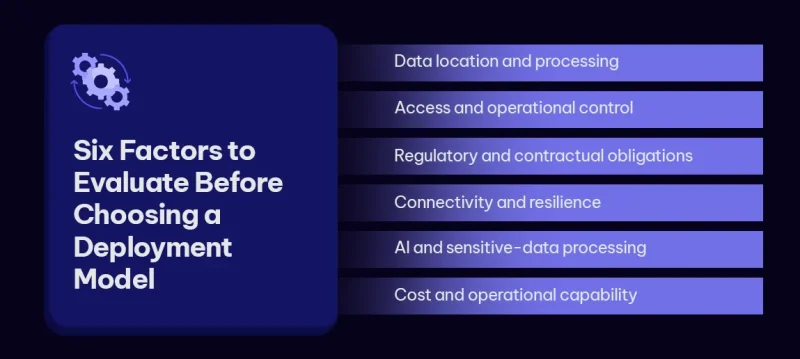
Before investing in sovereign-cloud capabilities or Azure Local, assess the following areas.
- Data location and processing: Identify where information is stored, processed, replicated, backed up and transferred. Check service-specific commitments rather than relying on a general statement about Australian data residency.
- Access and operational control: Determine who can administer systems, approve privileged access and support the environment. Review identity management, logging, access approval and the division of responsibilities between your organisation and providers.
- Regulatory and contractual obligations: Map relevant legislation, sector guidance, contracts, security classifications and customer requirements to specific technical and operational controls. Obtain specialist advice where interpretation is required.
- Connectivity and resilience: Establish whether workloads must continue operating during an internet or cloud-connectivity outage. Test recovery procedures, dependencies and the practical limits of disconnected operation.
- AI and sensitive-data processing: Identify where models execute, where prompts and outputs are handled, and which services or external dependencies process information. Local model inference may suit selected scenarios, but it does not make an entire AI solution sovereign by itself.
- Cost and operational capability: Compare infrastructure, licensing, support, staffing, security, maintenance and disaster recovery costs. Azure Local can increase local control while also introducing responsibilities that public-cloud services may otherwise handle.
Public Cloud, Azure Local or Hybrid Cloud?
These options are not mutually exclusive. A hybrid model may allow organisations to keep workloads requiring greater local control on Azure Local while using Azure public cloud for applications that can meet their requirements there.
- For example, an organisation might process sensitive operational data locally while using public cloud services for approved analytics, reporting or other business applications. Such a design requires carefully managed interfaces, data flows, identities and security policies.
The decision should be made workload by workload. Start with the required outcomes and controls, then assess the architecture that can meet them. Avoid selecting infrastructure first and trying to fit compliance requirements around it later.
Why Choose Exigo Tech as Your Managed Intelligence Partner
We help organisations connect infrastructure decisions with security, data requirements and business outcomes. Its Azure, hybrid-cloud and managed-services capabilities can support a structured assessment of where workloads should run and how they should be governed.
Relevant capabilities include:
- Azure and hybrid-cloud consulting: Assess workload suitability, architecture, migration pathways and the role of Azure Local.
- Infrastructure and network services: Evaluate connectivity, local infrastructure dependencies, performance and resilience.
- Security and governance: Strengthen identity controls, monitoring, access management and security practices across environments.
- Data and AI readiness: Assess data flows, processing requirements and governance considerations before expanding AI adoption.
- Managed and professional services: Support implementation, ongoing management, optimisation and operational improvement.
As a Managed Intelligence Partner, we focus on aligning technology choices with the controls organisations need and the outcomes they want to achieve.

 Exigo Tech - Ask AI (Beta)