 Singapore
 Australia
 Philippines
 India
India5.49 MIN READ
Licensed Doesn’t Mean Optimised: Why Buying Software Licences Is Only the First Step
 Niten Devalia | Mar 09, 2026
A few clicks online, a credit card payment, and users immediately gain access to platforms like Microsoft 365, Azure, security tools, backup solutions, or cloud infrastructure services. From a procurement perspective, everything appears simple.
But over time, something changes.
Licences accumulate. Vendors multiply. Billing becomes fragmented. Costs rise quietly. And organisations begin to lose visibility into what they are actually paying for and whether those licences are structured correctly.
This is the reality many organisations face today.
Being licensed does not mean being optimised.
This blog explores the difference between simply purchasing licences and strategically structuring them and why licensing optimisation has become essential for cost control, governance, and long-term IT planning.
The Misconception of “We are Already Covered”
Most organisations assume licensing is under control because:
- Users have access to the required tools.
- Renewals are processed annually.
- Vendors are paid on time.
- Systems are operational.
On the surface, everything works.
However, licensing environments evolve quickly. New users join. Projects expand. Cloud workloads grow. Departments independently purchase subscriptions. Contracts renew automatically. Without structured oversight, licensing environments gradually become complex and inefficient.
The result is rarely obvious overspending; it is incremental commercial inefficiency spread across multiple platforms.
Licensed vs Optimised: Understanding the Real Difference
Licensed Environment
A licensed organisation typically has:
- Active subscriptions across vendors.
- Multiple billing arrangements.
- Licences assigned broadly rather than strategically.
- Limited visibility into utilisation.
- Renewals driven by expiry dates.
Compliance may exist, but optimisation does not.
Optimised Licensing Environment
An optimised organisation has:
- Licences aligned to user roles and workloads.
- Structured agreement models.
- Consolidated billing visibility.
- Reduced duplication across platforms.
- Continuous cost and usage review.
- Licensing aligned with growth strategy.
Optimisation transforms licensing from an operational expense into a strategic asset.
The Hidden Complexity of Self-Managed Licensing
Buying licences online works well initially. Managing them across years and vendors is far more difficult.
Organisations managing licensing internally often encounter:
- Separate invoices from multiple vendors.
- Different billing cycles and renewal terms.
- Credit card–based subscriptions scattered across teams.
- Annual commitments that are difficult to adjust.
- Limited ability to bundle services.
- Vendor-specific support channels.
- No proactive optimisation reviews.
Over time, visibility decreases while costs increase. Licensing becomes fragmented, both financially and operationally.

Why Licensing Complexity Has Increased
Modern IT environments rarely rely on a single vendor.
Today’s organisations operate across:
- Microsoft 365 collaboration platforms.
- Azure cloud workloads.
- Infrastructure licensing.
- Backup and recovery solutions.
- Security platforms.
- Virtualisation environments.
- Hybrid and multi-cloud deployments.
Each platform introduces its own licensing rules, subscription models, and commercial structures.
Optimising one vendor in isolation no longer works. True efficiency requires visibility across the entire technology stack.
Introducing Licensing Optimisation
Licensing optimisation is the process of structuring licences intentionally, based on how technology is actually used.
It answers critical questions such as:
- Do all users need premium licensing tiers?
- Are unused licences still being paid for?
- Could agreement restructuring reduce long-term costs?
- Are cloud workloads licensed efficiently?
- Are overlapping tools performing the same function?
Optimisation focuses on alignment between technology usage, commercial models, and business objectives.
Sometimes optimisation means upgrading. Often, it means simplifying. And occasionally, it means downgrading.
The goal is always value, not volume.
The Commercial Impact of Poor Licence Structuring
Licensing inefficiencies typically appear in subtle ways:
- Over-Licensing: Users assigned enterprise-level licences despite basic requirements.
- Duplicate Capabilities: Multiple tools delivering similar functionality across departments.
- Inflexible Contracts: Commitments that no longer reflect business size or usage.
- Underused Features: Security or productivity capabilities already paid for but never enabled.
- Fragmented Billing: Finance teams managing disconnected vendor invoices.
Individually small, these inefficiencies collectively create significant overspend.
Benefits of Licensing Optimisation
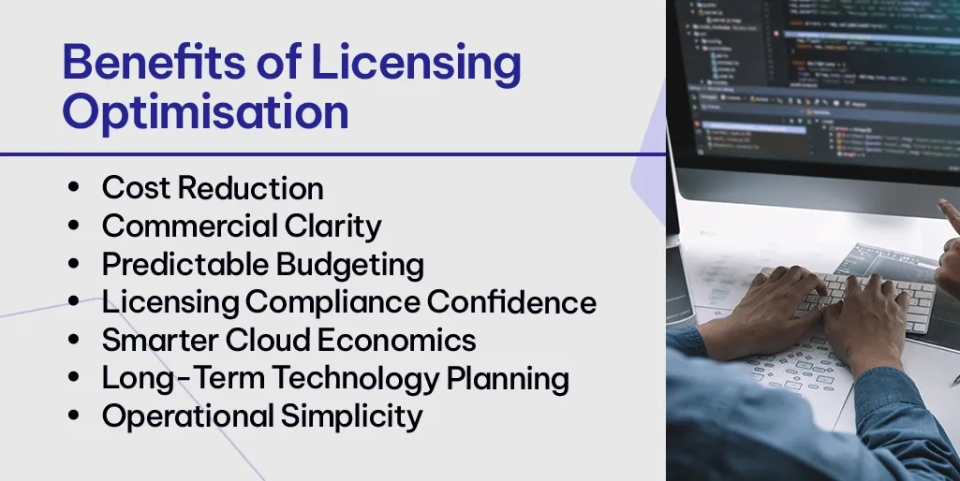
A structured licensing approach delivers measurable outcomes across both IT and finance functions.
Cost Reduction
Eliminate unnecessary licences and align subscriptions with real usage.
Commercial Clarity
Gain full visibility into licensing commitments and spend.
Predictable Budgeting
Consolidated billing simplifies financial planning.
Licensing Compliance Confidence
Correct entitlement alignment reduces audit exposure.
Smarter Cloud Economics
Optimised Azure and hybrid workloads prevent unnecessary consumption costs.
Long-Term Technology Planning
Licensing decisions support growth rather than reacting to renewals.
Operational Simplicity
Reduced administrative overhead across vendors and agreements.
Why Licensing Should Be Consultancy-Led
Licensing decisions influence far more than procurement.
They affect:
- Security capability
- Infrastructure architecture
- Cloud scalability
- Automation initiatives
- AI adoption
- Operational efficiency
A consultancy-first approach asks better questions:
- Is E5 necessary, or would E3 suffice?
- Are business users over-licensed?
- Could bundled agreements reduce cost?
- Are subscriptions aligned to future growth?
Optimisation is not about selling more licences. It is about structuring them intelligently.
From Vendor Management to Full-Stack Licensing Strategy
Many partners specialise in a single platform.
But modern environments require cross-vendor understanding.
At Exigo Tech, we consider licensing optimisation as the full ecosystem, including infrastructure, cloud, security, backup, automation, AI environments, etc. This ensures decisions in one area do not create inefficiencies elsewhere.
This comprehensive approach enables:
- Consolidated commercial modelling.
- Reduced duplication.
- Strategic contract structuring.
- Scalable licensing aligned to transformation initiatives.
Why Choose Exigo Tech as Your Managed Intelligence Partner for Licensing Strategy
Licensing optimisation requires technical understanding, commercial insight, and ongoing oversight.
As your Managed Intelligence Partner, we:
- Assess your complete licensing footprint.
- Identify inefficiencies across vendors.
- Consolidate billing and agreements.
- Align licensing with operational and growth plans.
- Provide continuous optimisation, not one-time audits.
We don’t just manage licences. We help organisations take control of their licensing strategy.

 Exigo Tech - Ask AI (Beta)