 Singapore
 Australia
 Philippines
 India
India5.05 MIN READ
Inconsistent Multichannel Service: How Small Gaps Create Big Risks for Growing Councils
 Vinay Joshi | Apr 15, 2026
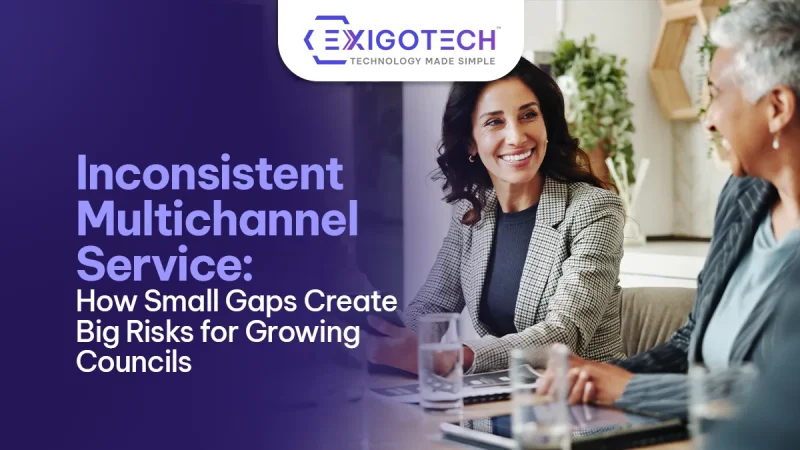
Most councils today offer residents more ways to get in touch than ever before.
Phone. Email. Online forms. Customer portals. In‑person service counters.
More channels should mean better accessibility and better service.
In reality, when those channels aren’t aligned, they often introduce new operational, reputational, and compliance‑related risks that councils don’t immediately see.
When the Same Request Feels Different Depending on the Channel
One of the clearest warning signs of inconsistency is when residents receive different experiences for the same issue, depending on how they contact the council.
For example:
- A phone enquiry receives immediate advice, but no formal record.
- An email request is logged but takes days to be acknowledged.
- An online form captures data, but doesn’t reflect updates provided elsewhere.
- An in‑person visit resets the conversation entirely.
From the resident’s perspective, the council feels unpredictable and fragmented.
From the council’s perspective, teams are genuinely trying to help, but working from different views of the same request.
How Inconsistency Quietly Creates Risk
Inconsistent multichannel service doesn’t just affect satisfaction. Over time, it introduces risk that compounds as councils grow.
Common issues include:
- Requests being duplicated or missed entirely.
- Advice given verbally that doesn’t match system records.
- Incomplete audit trails across channels.
- Escalations triggered because information differs depending on who was contacted.
These gaps become especially problematic when requests involve:
- Regulatory obligations.
- Time‑sensitive approvals.
- Safety‑related issues.
- Complaints and reviews.
What starts as a CX issue quickly becomes a governance and compliance concern.
The Link Between Inconsistency and Complaints
Councils often see complaint volumes increase without an obvious service failure.
In many cases, the root cause is inconsistency:
- Residents told different things by different teams.
- Promises made in one channel that aren’t visible in another.
- No single, shared view of progress.
When residents escalate, it’s rarely because nothing was done. It’s because what was done wasn’t visible or consistent.
This creates additional workload for staff, pulls leaders into avoidable issues, and damages confidence, even when the underlying service effort is high.
Why This Risk Grows with Council Size and Complexity
In smaller councils, inconsistency may be manageable because:
- Teams are close‑knit.
- Information flows informally.
- Fewer handoffs are involved.
As councils grow, that informal model breaks down.
Medium and larger councils face:
- More service areas involved in a single request.
- Multiple teams managing different channels.
- Systems introduced at different times for different purposes.
- Greater separation between frontline staff and back‑office teams.
Without a unifying approach, inconsistency becomes systemic, not incidental.
Why “Adding Another Channel” Often Makes Things Worse
A common response to accessibility pressure is to introduce another channel.
Another form. Another inbox. Another portal.
Without improving consistency, this often:
- Increases fragmentation.
- Spreads information thinner.
- Makes ownership harder to define.
- Amplifies reporting and compliance gaps.
The risk isn’t the number of channels. The risk is a lack of maturity across them.
Understanding Consistency as a Maturity Issue
Multichannel consistency doesn’t happen by accident. It’s a sign of CX maturity.
Lower‑maturity environments typically show:
- Channel‑specific processes.
- Manual reconciliation between systems.
- Different update rules depending on contact method.
- Limited insight across the full lifecycle.
More mature councils:
- Treat channels as entry points, not silos.
- Maintain a consistent view of requests across touchpoints.
- Define ownership regardless of how a resident engages.
- Reduce reliance on individuals to “join the dots”.
Understanding where your council sits on this scale is critical before attempting improvements.
Why Councils Struggle to Prioritise Fixes Correctly
When inconsistency is visible, councils often try to fix everything at once:
- Standardise scripts.
- Redesign forms.
- Upgrade portals.
- Introduce new reporting.
Without clarity, these efforts can:
- Disrupt staff.
- Overload teams.
- Deliver limited improvement.
A maturity‑led approach allows councils to:
- Identify which channels create the most risk.
- Prioritise accessibility gaps with the highest impact.
- Focus effort where consistency will reduce complaints and pressure fastest.
How a Maturity Assessment Brings Focus
A CX maturity assessment helps councils step back from channels and examine how service delivery works end‑to‑end.
It provides:
- Insight into where channel inconsistency creates risk.
- Visibility into accessibility gaps across services.
- A realistic view of what can be improved incrementally.
- Clear priorities aligned to council size and complexity.
Instead of reacting to symptoms, councils gain a structured way to reduce risk without over‑engineering change.
Why Exigo Tech Approaches Multichannel CX Differently
At Exigo Tech, we work with councils navigating increasing service complexity and growing community expectations.
What we consistently see is that:
- Inconsistency is rarely intentional.
- Risk emerges from gaps between systems, teams, and channels.
- Councils don’t need more channels; they need better alignment.
Our approach focuses on:
- Assessing maturity across channels, not in isolation.
- Identifying low‑risk improvements that strengthen consistency.
- Supporting councils in improving accessibility without introducing new silos.
- Delivering clear, prioritised recommendations suited to your operating model.
Reducing Risk by Restoring Consistency
Multichannel service should make it easier for residents to engage, not more confusing.
When councils address consistency and accessibility through a maturity lens, they:
- Reduce complaints.
- Strengthen compliance confidence.
- Lower operational pressure.
- Build trust across growing communities.


 Exigo Tech - Ask AI (Beta)