 Singapore
 Australia
 Philippines
 India
India6.05 MIN READ
Multi-Cloud vs Single Cloud: Choosing the Right Strategy for Australian Compliance
 Niten Devalia | Jul 03, 2026
Organisations are increasingly moving workloads, applications, and data to the cloud to improve scalability, agility, and operational efficiency. However, as cloud environments become more sophisticated, businesses are faced with an important strategic decision:
Should you adopt a single-cloud strategy or embrace a multi-cloud approach?
While cost, performance, and flexibility often influence this decision, Australian organisations must also consider an equally important factor: compliance.
Data sovereignty, regulatory requirements, cybersecurity obligations, and governance frameworks all play a role in determining the right cloud architecture.
At Exigo Tech, we help organisations design secure and compliant cloud environments as their Managed Intelligence Partner, ensuring cloud strategies align with both business goals and Australian regulatory expectations.
Understanding Single Cloud and Multi-Cloud
Before comparing the two approaches, it’s important to understand what each means.
Single Cloud
A single-cloud strategy uses one cloud provider for the majority of business workloads.
For example, an organisation may choose Microsoft Azure for infrastructure, storage, applications, and disaster recovery.
Using a single provider creates a unified environment with consistent management, security controls, and support.
Multi-Cloud
A multi-cloud strategy involves using services from multiple clouds.
For example, an organisation might use different cloud platforms for applications, workloads, AI services, etc.
While this approach offers flexibility, it also introduces additional complexity.
Why Compliance Matters in Australia
Australian organisations operate under increasing regulatory scrutiny regarding how information is collected, stored, protected, and managed.
Depending on the industry, organisations may need to consider:
- Australian Privacy Act obligations
- Data sovereignty requirements
- Industry-specific regulations
- Information security standards
- Customer contractual requirements
- Cyber insurance expectations
Regardless of whether an organisation operates in healthcare, finance, government, education, or professional services, maintaining strong governance across cloud environments is essential.
Benefits of a Single Cloud Strategy
For many Australian businesses, a single-cloud approach offers significant advantages.
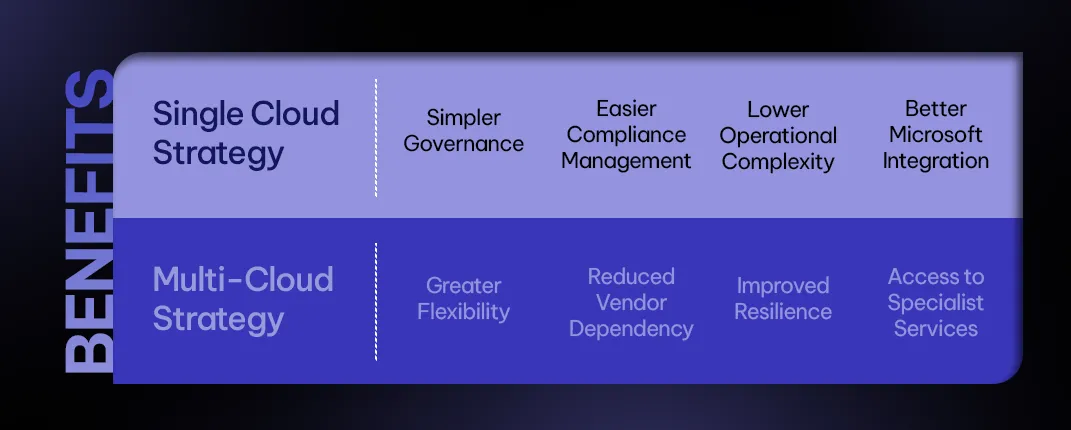
Simpler Governance
Managing one cloud platform makes it easier to maintain:
- Security policies
- Identity management
- User permissions
- Monitoring
- Compliance controls
Consistency reduces administrative overhead.
Easier Compliance Management
When all workloads operate within a single environment, organisations typically find it easier to:
- Audit systems
- Track data locations
- Apply security policies
- Maintain governance standards
This simplifies compliance reporting and risk management.
Lower Operational Complexity
IT teams only need to develop expertise in one cloud platform.
This often results in:
- Faster issue resolution
- Simpler operations
- Lower training costs
- Improved standardisation
Better Microsoft Integration
Many Australian organisations already rely heavily on Microsoft technologies.
Using Microsoft Azure alongside Microsoft 365, Entra ID, Defender, Purview, and Copilot creates a highly integrated environment that simplifies both security and administration.
Benefits of a Multi-Cloud Strategy
While more complex, multi-cloud environments can provide strategic advantages.
-
Greater Flexibility
Organisations can choose the most appropriate platform for specific workloads rather than relying on a single provider.
-
Reduced Vendor Dependency
A multi-cloud approach reduces reliance on one cloud vendor, helping avoid vendor lock-in.
-
Improved Resilience
Distributing workloads across multiple providers can improve availability and reduce the impact of provider-specific outages.
-
Access to Specialist Services
Different cloud providers offer unique strengths in areas such as:
-
- Artificial intelligence
- Data analytics
- High-performance computing
- Industry-specific solutions
Businesses can leverage these capabilities where they deliver the greatest value.
Compliance Challenges of Multi-Cloud
Although multi-cloud offers flexibility, it also increases governance responsibilities.
-
Data Visibility
Understanding where data is stored becomes more difficult when information spans multiple platforms.
Maintaining visibility is essential for meeting compliance obligations.
-
Security Consistency
Each cloud provider has different:
-
- Security tools
- Identity models
- Monitoring capabilities
- Configuration approaches
Maintaining consistent security policies across platforms requires careful planning.
-
Identity Management
Managing user access across multiple cloud providers increases complexity.
Without centralised identity management, organisations risk inconsistent permissions and greater security exposure.
-
Increased Governance Overhead
Multi-cloud environments require broader operational expertise and more mature governance processes.
Without these controls, complexity can quickly become a business risk.
Key Questions Australian Businesses Should Ask
When evaluating cloud strategies, organisations should consider:
- Where will sensitive data be stored?
- Do regulatory requirements specify data residency expectations?
- How will security policies be enforced consistently?
- Can IT teams effectively manage multiple cloud environments?
- Does the business require specialised cloud capabilities?
- How will compliance be monitored across platforms?
The answers often determine whether a single-cloud or multi-cloud approach is more appropriate.
Building a Compliant Cloud Strategy
Regardless of the cloud model selected, organisations should establish strong governance from the outset.
Key priorities include:
-
Identity and Access Management
Implement consistent authentication, least-privilege access, and multi-factor authentication across cloud environments.
-
Data Governance
Understand where information resides, who can access it, and how it is protected.
-
Continuous Monitoring
Security monitoring should provide visibility across all cloud services and workloads.
-
Regular Security Assessments
Cloud environments should be reviewed regularly to identify configuration issues, security gaps, and compliance risks.
-
Backup and Disaster Recovery
Business continuity plans should include cloud workloads and be tested regularly.
A well-governed cloud environment supports both operational resilience and regulatory compliance.
Which Approach Is Right for Your Business?
There is no universal answer.
For many Australian organisations, a single-cloud strategy provides simplicity, stronger governance, and easier compliance management.
For larger or more complex organisations, multi-cloud may deliver greater flexibility and support specialised workloads.
The right choice depends on:
- Business objectives
- Regulatory requirements
- Existing technology investments
- Internal expertise
- Long-term digital transformation plans
Rather than focusing solely on technology, organisations should choose the approach that best supports both business growth and compliance obligations.
Why Choose Exigo Tech as Your Managed Intelligence Partner
At Exigo Tech, we help organisations design secure, compliant, and scalable cloud environments.
As your Managed Intelligence Partner, we provide:
- Cloud strategy and architecture consulting
- Cloud migration planning
- Multi-cloud and hybrid cloud advisory
- Cloud security and governance assessments
- Microsoft Azure consulting
- Cloud cost optimisation
- Compliance and risk management
- Ongoing cloud management and support
Our focus is on helping businesses maximise the value of cloud technology while maintaining strong security and governance.
Cloud Strategy Should Balance Innovation and Compliance
Cloud adoption is about far more than choosing a provider.
It is about building an environment that supports innovation while protecting business data, meeting compliance obligations, and enabling long-term growth.
Whether your organisation chooses a single-cloud or multi-cloud approach, success depends on having the right governance, security controls, and strategic guidance in place.
With a well-designed cloud strategy, Australian businesses can confidently embrace digital transformation while maintaining compliance and operational resilience.


 Exigo Tech - Ask AI (Beta)