 Singapore
 Australia
 Philippines
 India
India7.27 MIN READ
AI-Powered Business Resilience: Preparing for Disruption in 2027
 Ben Opit | Oct 14, 2026
Cyberattacks, technology outages, supply chain interruptions, extreme weather, economic volatility, and rapidly changing customer expectations can all affect how organisations operate. At the same time, businesses are becoming increasingly dependent on digital platforms, cloud infrastructure, data, and AI.
This creates a new challenge for business leaders: how do you build resilience when the next disruption may look completely different from the last one?
AI is becoming an important part of the answer.
Rather than using AI only for productivity and automation, organisations can apply it to identify risks, predict potential disruptions, automate responses, and help decision-makers act faster.
As businesses prepare for 2027, AI-powered resilience can help organisations move from simply recovering from disruption to becoming more proactive, adaptable, and prepared.
At Exigo Tech, we help organisations strengthen technology and operational resilience as their Managed Intelligence Partner, combining AI, cloud, cybersecurity, data, automation, and managed services to support business continuity and long-term growth.
Why Traditional Resilience Strategies Need to Evolve
Traditional business continuity and disaster recovery strategies remain essential, but many were designed around known scenarios.
Organisations typically prepare for:
- System outages
- Cybersecurity incidents
- Data loss
- Infrastructure failures
- Workplace disruptions
- Supplier interruptions
These plans provide valuable guidance, but modern organisations face increasingly interconnected risks.
- A cloud outage can affect multiple applications.
- A compromised supplier can create downstream security risks.
- A cyberattack can disrupt both IT and operational environments.
AI can help organisations analyse these interconnected risks and respond more dynamically.
How AI Can Strengthen Business Resilience
AI does not replace business continuity planning.
Instead, it adds intelligence to existing resilience capabilities.
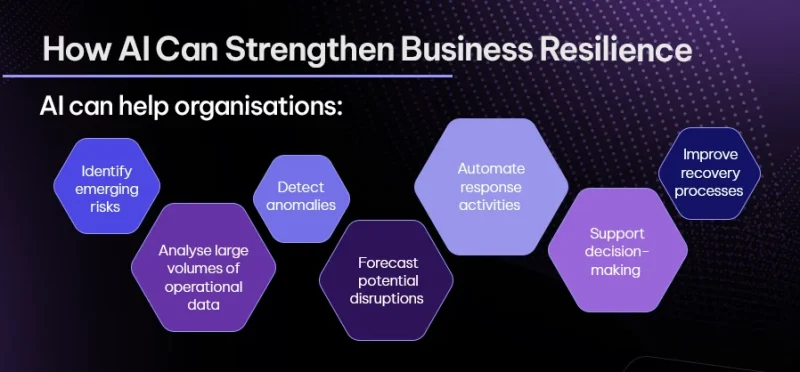
AI can help organisations:
- Identify emerging risks
- Analyse large volumes of operational data
- Detect anomalies
- Forecast potential disruptions
- Automate response activities
- Support decision-making
- Improve recovery processes
This allows resilience strategies to become more dynamic and data-driven.
1. Predicting Potential Disruptions
One of AI’s biggest opportunities is identifying patterns that humans may not easily detect.
By analysing historical and real-time information, AI can help identify signals associated with:
- Equipment failure
- Network performance issues
- Cybersecurity threats
- Supply chain disruption
- Demand fluctuations
- Operational bottlenecks
For example, unusual system behaviour could indicate an emerging infrastructure problem before it develops into a major outage.
Early warning gives organisations more time to act.
2. AI-Powered Cybersecurity
Cybersecurity is central to business resilience.
AI can analyse large volumes of security events and help identify suspicious behaviour faster than manual processes alone.
AI-powered security capabilities can support:
- Threat detection
- Anomaly identification
- Identity monitoring
- Alert investigation
- Incident analysis
- Automated response
For organisations operating hybrid and cloud environments, this can provide greater visibility across increasingly complex technology ecosystems.
3. Intelligent Incident Response
When disruption occurs, speed matters.
AI can help response teams quickly understand what is happening by analysing available information and identifying relevant systems, users, and dependencies.
For example, during a security incident, AI can help:
- Summarise alerts
- Correlate related events
- Identify affected systems
- Recommend response actions
- Generate incident documentation
Human oversight remains essential for high-impact decisions, but AI can reduce the time required to understand an incident.
4. Predictive IT Operations
AI can also help prevent technology failures.
AI-powered IT operations can analyse system performance and identify unusual behaviour across:
- Servers
- Networks
- Applications
- Cloud environments
- Databases
- Endpoints
Instead of waiting for users to report an outage, IT teams can investigate emerging problems proactively.
This supports a shift from reactive IT support towards predictive operations.

5. Smarter Backup and Disaster Recovery
Backup is an essential component of resilience, but simply having backups does not guarantee recoverability.
AI can support disaster recovery by helping organisations analyse:
- Backup health
- Recovery performance
- System dependencies
- Workload priorities
- Recovery patterns
This information can help businesses determine which systems require the fastest recovery and where improvements may be needed.
Regular testing remains critical. AI should complement, not replace, proven recovery processes.
6. Supply Chain Risk Intelligence
Supply chain disruptions can quickly affect business operations.
AI can analyse information from suppliers, logistics systems, market conditions, and operational data to identify potential risks.
Businesses can use these insights to:
- Identify supplier dependencies
- Detect emerging risks
- Forecast demand changes
- Evaluate alternative suppliers
- Optimise inventory
This helps organisations move from reacting to supply chain disruptions towards anticipating them.
7. AI-Powered Scenario Planning
Business leaders cannot predict exactly what will happen in 2027.
They can, however, prepare for multiple scenarios.
AI can help organisations model potential situations such as:
- Major cyberattacks
- Cloud outages
- Supplier failures
- Demand fluctuations
- Infrastructure disruptions
- Workforce shortages
Scenario modelling allows leadership teams to evaluate potential consequences and develop appropriate response strategies before disruption occurs.
8. Protecting Business Knowledge
People are another important component of business resilience.
Critical operational knowledge often sits with individual employees rather than documented systems.
AI can help organisations capture and organise knowledge from:
- Internal documentation
- Policies
- Procedures
- Support records
- Project information
- Business applications
When employees leave or become unavailable during a disruption, accessible organisational knowledge can help teams maintain continuity.
Building an AI-Powered Resilience Strategy for 2027
AI should be introduced as part of a broader resilience strategy rather than as a standalone technology project.
A practical approach includes:
-
Assess Critical Business Services
Identify the applications, systems, people, suppliers, and data required to maintain operations.
-
Identify High-Value AI Opportunities
Focus on areas where AI can improve prediction, detection, response, or recovery.
-
Strengthen Data Foundations
AI requires reliable and accessible data. Data quality and governance should therefore be treated as core resilience capabilities.
-
Secure AI Adoption
Implement appropriate identity, access, data protection, and AI governance controls.
-
Keep Humans in the Loop
AI can support decision-making, but critical business and recovery decisions should have appropriate human oversight.
-
Test and Improve
Regularly test resilience processes, measure outcomes, and refine AI models and workflows as the business evolves.
AI Resilience Requires Strong Foundations
AI cannot compensate for weak fundamentals.
Before introducing advanced AI capabilities, organisations should establish strong foundations across:
- Cybersecurity
- Cloud infrastructure
- Data governance
- Identity management
- Backup and recovery
- Business continuity
- Network resilience
- Application management
These capabilities provide the environment AI needs to deliver meaningful resilience improvements.
Why Choose Exigo Tech as Your Managed Intelligence Partner
At Exigo Tech, we help organisations prepare for disruption by bringing together technology, intelligence, and operational resilience.
As your Managed Intelligence Partner, our capabilities include:
- AI Strategy and Readiness
- AI and Automation
- Cybersecurity and Managed Security
- Azure Cloud and Infrastructure
- Data and Analytics
- Business Continuity and Disaster Recovery
- Managed Application Services
- Microsoft 365
- AI Governance
- Ongoing Managed IT Services
We focus on building technology environments that don’t simply recover from disruption but become more intelligent, adaptable, and resilient over time.
 Exigo Tech - Ask AI (Beta)