
 Philippines
 Australia
 Singapore
 India
India5.37 MIN READ
How a Licensing Review Can Reduce Costs Without Reducing Capability
 Niten Devalia | Mar 27, 2026
When organisations look at reducing technology costs, the first instinct is often to cut tools, reduce services, or delay upgrades.
But in many cases, the biggest opportunities for savings do not come from removing technology; they come from structuring existing licensing more intelligently.
Many organisations already own the capabilities they need. The challenge is that licences are often assigned incorrectly, agreements are structured inefficiently, or platforms are being consumed in ways that were never reviewed after initial deployment.
This is where a structured licensing review becomes valuable.
A well-executed licensing review identifies inefficiencies, restructures agreements, and aligns licensing with actual usage, often reducing costs while maintaining or even improving capability.
As part of Exigo Tech’s Licensing Campaign, this blog explores how licensing reviews work and why they are one of the most effective ways to optimise technology spending.
Why Licensing Environments Drift Over Time
Licensing environments rarely remain aligned with original purchasing decisions.
Technology environments evolve quickly:
- New employees join the organisation.
- Cloud workloads scale or change.
- New tools are introduced.
- Departments adopt platforms independently.
- Vendors introduce new licensing models.
Meanwhile, existing agreements continue to renew automatically.
Over time, licensing environments often drift away from operational reality. Organisations may end up paying for licences that are no longer required, while underutilising capabilities already included in their subscriptions.
A licensing review helps realign these environments with how technology is actually used.
The Misconception About Cost Reduction
When people hear “licensing optimisation,” they sometimes assume it means removing features or downgrading capabilities.
In reality, the opposite is often true.
Many organisations already pay for advanced capabilities they are not fully using. Security features, automation tools, data capabilities, and productivity enhancements may already be included in existing licences.
A licensing review focuses on two key questions:
- Are we paying for capabilities we do not use?
- Are there capabilities we already own but have not enabled?
- By answering these questions, organisations often discover opportunities to both reduce costs and unlock additional value.
What a Licensing Review Actually Involves
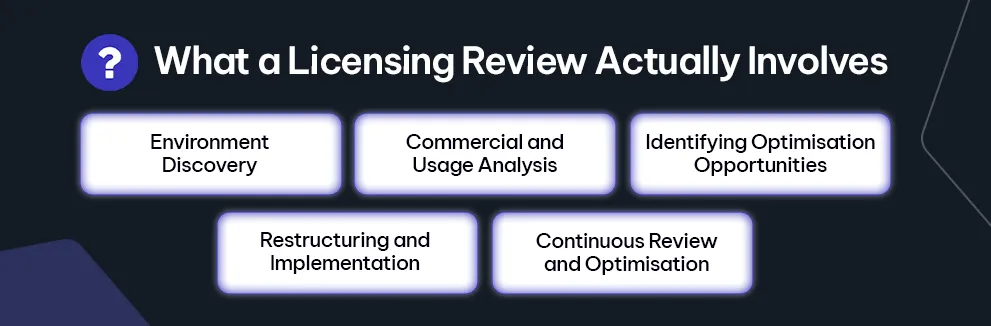
A licensing review is not simply an audit of licence counts. It is a structured assessment of how licensing aligns with infrastructure, cloud workloads, and operational needs.
A typical review includes several stages.
1. Environment Discovery
The first step is understanding the current licensing footprint.
This includes identifying:
- Platforms currently in use.
- Active subscriptions and agreements.
- Licence tiers assigned to users.
- Cloud workload consumption patterns.
- Vendor relationships across the technology stack.
The objective is to gain a clear picture of the entire licensing environment.
2. Commercial and Usage Analysis
Once visibility is established, the next step is analysing how licences are being used.
This may involve:
- Reviewing licence assignment against user roles.
- Identifying unused or inactive licences.
- Evaluating cloud consumption patterns.
- Assessing whether higher licence tiers are necessary.
Often, organisations discover that certain subscriptions remain active even when the original projects or teams that required them have changed.
3. Identifying Optimisation Opportunities
With usage data available, organisations can evaluate alternative licensing structures.
This may include:
- Aligning licence tiers with actual user needs.
- Consolidating vendor agreements.
- Moving stable workloads to commitment-based pricing.
- Eliminating duplicate capabilities across platforms.
- Leveraging bundled capabilities already included in existing licences.
The goal is not to reduce capability, but to ensure capability is structured efficiently.
4. Restructuring and Implementation
Once optimisation opportunities are identified, the next step involves implementing the changes.
This may include:
- Adjusting licence allocations.
- Consolidating agreements.
- Transitioning to new commercial structures.
- Aligning renewal timelines across vendors.
When managed carefully, these changes can be implemented without disruption to users or operations.
5. Continuous Review and Optimisation
Technology environments evolve constantly.
A licensing review should therefore not be treated as a one-time exercise.
Regular reviews ensure that licensing structures remain aligned with business growth, new platforms, and changing workloads.
Continuous optimisation helps organisations avoid returning to fragmented or inefficient licensing models.
Common Outcomes from Licensing Reviews
When licensing reviews are conducted strategically, organisations often experience several positive outcomes.
- Reduced Technology Costs: Unused or misaligned licences can be removed or restructured, reducing unnecessary spend.
- Improved Capability Visibility: Teams gain a better understanding of the features and capabilities already included in their licences.
- Simplified Vendor Management: Consolidated agreements reduce the complexity of managing multiple vendor relationships.
- Better Alignment with Infrastructure and Cloud Strategy: Licensing models can be structured to support long-term technology planning rather than reacting to renewals.
- Improved Financial Predictability: Structured agreements make budgeting more predictable for finance teams.
Why Many Organisations Avoid Licensing Reviews
Despite the benefits, many organisations postpone licensing reviews because they assume the process will be complicated or disruptive.
Common concerns include:
- Fear of operational disruption.
- Uncertainty around licensing rules.
- Lack of internal expertise.
- Concerns about vendor relationships.
In reality, most optimisation opportunities can be implemented gradually and with minimal disruption when managed by experienced specialists.
Licensing Reviews Support Digital Transformation
Technology investments increasingly support broader digital transformation initiatives.
Organisations adopt cloud infrastructure, automation platforms, data analytics tools, and AI capabilities as part of their long-term strategy.
Licensing should support these initiatives rather than become a constraint.
A structured licensing review ensures that commercial structures align with transformation goals and future growth.
Why Choose Exigo Tech as Your Managed Intelligence Partner
At Exigo Tech, licensing reviews are approached as a strategic advisory exercise rather than a simple audit.
As your Managed Intelligence Partner, we help organisations:
- Assess licensing across their full technology stack.
- Identify inefficiencies and optimisation opportunities.
- Align licensing with infrastructure and cloud strategy.
- Consolidate vendor agreements.
- Implement structured commercial models.
- Continuously optimise environments as they evolve.
Our goal is not simply to reduce licensing costs; it is to ensure your organisation receives the full value of its technology investments.

 Exigo Tech - Ask AI (Beta)