
 Philippines
 Australia
 Singapore
 India
India5.23 MIN READ
“Where’s My Request?” Why Ownership and Visibility Gaps Create Hidden Service Delays in Councils
 Vinay Joshi | Apr 08, 2026
For many councils, the most common follow‑up from residents isn’t a complaint.
It’s a question.
“Where’s my request?”
The request may already be logged. It may even be “in progress.”
But when residents feel the need to follow up, it’s a sign that something is missing, not necessarily effort, but clarity.
Across local government, delays are often blamed on workload or volume. In reality, many service delays come from two issues: unclear ownership and limited end‑to‑end visibility.
Why Do Residents Keep Following Up Even When Work Is Underway
In most councils, residents don’t expect instant outcomes. What they do expect is confidence that their request is being handled.
Follow‑ups usually happen when:
- Residents don’t know who owns their request.
- There’s no visible progress or update.
- Information changes depending on who they speak to.
- Requests move between teams without clear communication.
When that happens, residents assume nothing is happening, even when teams are actively working behind the scenes.
This creates unnecessary pressure on frontline staff and increases enquiry volumes without improving service outcomes.
How Ownership Gaps Emerge Across Council Teams
Ownership gaps rarely come from poor intent. They form as councils grow in size, complexity, and service scope.
In smaller councils, ownership is often informal:
- One officer may manage a request from start to finish.
- Knowledge lives with individuals rather than systems.
- Progress depends on availability rather than structure.
As councils grow, this model breaks down.
In medium-sized and larger councils:
- Requests pass between service areas.
- Responsibility shifts at different stages.
- Ownership becomes implied rather than explicit.
- No single team sees the full journey.
The result is a service experience where everyone is involved, but no one feels fully accountable.
The Visibility Problem Leaders Often Don’t See
From a leadership perspective, this is where risk starts to build.
Without clear end‑to‑end visibility:
- Delays aren’t obvious until they escalate.
- Bottlenecks are hard to pinpoint.
- Reporting reflects activity, not progress.
- Issues surface through complaints rather than data.
By the time concerns reach senior leaders, the problem has already affected trust and confidence. What makes this challenging is that the system may appear to be working. Requests are logged. Teams are busy. But visibility into where and why work slows down is missing.

When Lack of Visibility Turns into Operational Risk
Ownership and visibility gaps don’t just affect resident satisfaction. They create broader operational pressure.
Common impacts include:
- Increased follow‑ups that inflate the workload.
- Escalations that bypass normal processes.
- Complaints reaching councillors or executives.
- Reactive decision‑making instead of planned improvement.
- Difficulty demonstrating accountability during audits or reviews.
For senior leaders, this turns CX into a governance issue, not just a service one.
Why Fixing Visibility Without Maturity Insight Often Fails
Many councils recognise these issues and attempt to address them by:
- Adding dashboards.
- Introducing new tracking tools.
- Asking teams to “communicate better”.
- Creating additional handover steps.
These actions often improve surface‑level reporting but don’t resolve the underlying maturity gap.
Without understanding:
- How ownership is defined today.
- Where responsibility shifts.
- How requests flow across teams.
- Which delays are structural vs incidental.
Understanding Ownership and Visibility as A Maturity Issue
Ownership and visibility are not binary; they exist on a maturity spectrum.
Lower maturity environments typically rely on:
- Manual updates.
- Individual follow‑ups.
- Localised ownership.
- Informal escalation paths.
More mature environments:
- Define ownership clearly at each stage.
- Provide consistent visibility across the lifecycle.
- Reduce dependency on individuals.
- Enable leaders to see risks before they escalate.
Understanding where a council sits on this spectrum is critical before attempting fixes.
How A Maturity Assessment Solves the Problems
A CX maturity assessment allows councils to step out of day‑to‑day pressure and examine how ownership and visibility actually work in practice.
It helps councils:
- Identify where ownership becomes unclear.
- Understand how visibility breaks down as requests move.
- Distinguish system gaps from process gaps.
- Prioritise changes that reduce risk, not just workload.
Most importantly, it replaces assumptions with evidence, giving leaders confidence in where to focus.
What Clarity Looks Like for Councils of Different Sizes
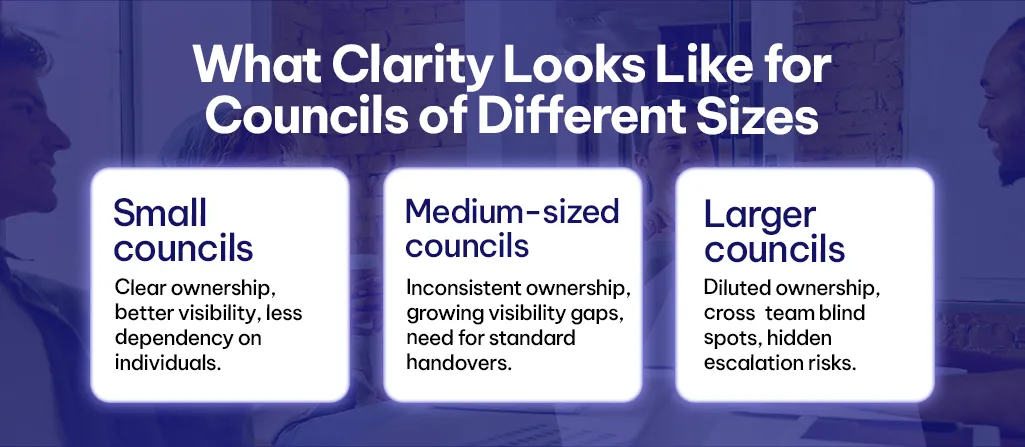
For smaller councils, maturity insights often reveal:
- Opportunities to formalise ownership without bureaucracy.
- Simple visibility improvements that reduce follow‑ups.
- Reduced reliance on individual knowledge.
For medium-sized councils, clarity typically highlights:
- Inconsistent ownership across service areas.
- Visibility gaps as volume increases.
- The need for standardised handover points.
For larger councils, maturity insights often uncover:
- Ownership dilution across complex workflows.
- Visibility blind spots between departments.
- Escalation risks hidden inside “in progress” statuses.
In all cases, clarity enables better decisions without over‑engineering solutions.
Why Exigo Tech Takes a Maturity‑Led Approach
At Exigo Tech, we work with councils at different stages of growth and complexity. What we consistently see is that ownership and visibility issues are rarely technology problems alone.
Our approach focuses on:
- Understanding how your council currently operates.
- Identifying where ownership and visibility break down.
- Assessing maturity in context, not against generic benchmarks.
- Providing a clear, prioritised roadmap for improvement.
We help councils strengthen accountability and transparency without forcing large‑scale change or unnecessary system replacement.
Moving From Follow‑Ups to Confidence
When residents stop asking “Where’s my request?”, it’s not because work disappeared; it’s because clarity improved.
For councils, understanding ownership and visibility maturity is the first step towards achieving that confidence, for residents, teams, and leadership alike.




 Exigo Tech - Ask AI (Beta)