
 Singapore
 Australia
 Philippines
 India
India4.35 MIN READ
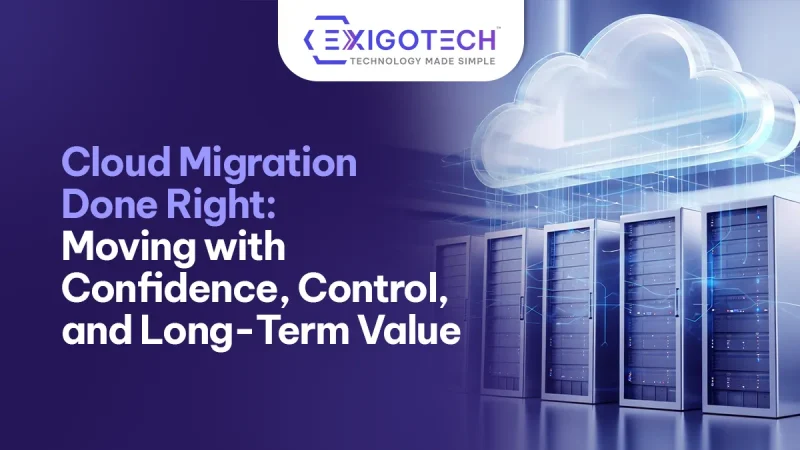
Cloud Migration Done Right: Moving with Confidence, Control, and Long-Term Value
 Maurice Bonotto | Jan 05, 2026
Cloud migration has become one of the most talked-about initiatives in modern IT — yet it’s also one of the most misunderstood. For many organisations, “moving to the cloud” is seen as a simple infrastructure upgrade. In reality, cloud migration is a business-critical transformation that affects security, performance, cost control, compliance, and long-term scalability.
When done with clarity and planning, cloud migration enables organisations to modernise operations and respond faster to change. When rushed or treated as a technical checkbox, it introduces instability, rising costs, and operational risk.
At Exigo Tech, we approach cloud migration as a structured, outcomes-driven journey, not a one-off project.
Why Organisations Should Migrate to the Cloud
The motivations for cloud migration vary, but the most common drivers include:
- Aging on-prem infrastructure reaching the end of life.
- Rising hardware and data centre costs.
- Limited scalability during peak demand.
- Need for improved disaster recovery and resilience.
- Security and compliance modernisation.
- Support for hybrid or remote work.
- Faster deployment of applications and services.
While the benefits are clear, achieving them requires more than simply moving workloads to a cloud platform.
The Biggest Misconception: Cloud Migration Is Just Moving Servers
One of the most common mistakes organisations make is treating cloud migration as a “lift and shift” exercise — moving workloads without understanding their dependencies, performance requirements, or future value.
This approach often leads to:
- Higher cloud bills than expected.
- Poor application performance.
- Security gaps caused by default configurations.
- Complex environments that are hard to manage.
- Missed opportunities for modernisation.
True migration is about making intentional decisions about what to move, how to move it, and whether it should even be moved at all.
Understanding Cloud Migration Pathways
A mature cloud migration strategy uses multiple pathways depending on business needs:
- Rehost (Lift and Shift): Fast migration with minimal change. Useful for time-sensitive moves but rarely cost-efficient in the long term.
- Replatform: Optimises specific components to improve efficiency and performance while maintaining core architecture.
- Refactor: Redesigns applications to take full advantage of cloud-native capabilities.
Higher effort, but delivers maximum scalability and resilience. - Replace: Moves from custom or legacy systems to SaaS solutions.
- Retire: Eliminates applications that no longer deliver business value.
The right migration approach balances risk, cost, business impact, and future goals.
The Risks of Poorly Planned Cloud Migration
Without proper planning and governance, cloud migration can introduce new challenges:
- Unexpected downtime during migration.
- Escalating cloud costs post-migration.
- Security misconfigurations and exposure.
- Performance issues impacting users.
- Unsupported legacy dependencies.
- Poor visibility and operational complexity.
These risks don’t come from the cloud itself — they come from insufficient assessment, design, and execution.
What a Structured Cloud Migration Approach Looks Like
Successful cloud migration follows a clear, phased methodology.
1. Assessment & Readiness
- Application and infrastructure inventory.
- Dependency mapping.
- Risk and compliance review.
- Cost modelling and migration suitability.
2. Migration Planning
- Define migration waves and priorities.
- Select migration strategies per workload.
- Design target architecture.
- Establish governance and security controls.
3. Execution & Transition
- Controlled migration with testing at each stage.
- Data validation and performance checks.
- Minimal disruption to users.
- Clear rollback plans.
4. Optimisation & Stabilisation
- Post-migration performance tuning.
- Cost optimisation and monitoring.
- Security hardening.
- Operational handover and documentation.
Migration success is measured not by completion, but by how well systems perform after the move.
Business Outcomes of a Successful Cloud Migration
When cloud migration is done right, organisations see tangible results:
- Improved reliability and uptime.
- Greater scalability without infrastructure constraints.
- Predictable operational costs.
- Stronger security and resilience.
- Faster deployment of new services.
- Reduced dependency on aging hardware.
Most importantly, IT teams gain the freedom to focus on innovation instead of maintenance.
Why Choose Exigo Tech for Cloud Migration
Cloud migration requires more than technical capability; it requires experience, discipline, and accountability.
At Exigo Tech, we deliver migrations that are:
- Business-led, not tool-driven.
- Risk-aware and security-first.
- Planned for long-term operations, not just go-live.
- Cost-conscious with clear forecasting.
- Supported by strong documentation and governance.
We don’t rush migrations. We design them to succeed and to stay successful long after completion.
Our teams work closely with stakeholders to ensure clarity, transparency, and confidence at every stage of the journey.


 Exigo Tech - Ask AI (Beta)