
 Singapore
 Australia
 Philippines
 India
India5.41 MIN READ
Power Platform Consulting: A Guide to Power Apps, Power Automate, and Power BI Implementation
 Vinay Joshi | Jun 12, 2026

Did you know?
By combining Power Apps, Power Automate, and Power BI, Power Platform enables organisations to build applications, automate workflows, and generate meaningful business insights without the complexity of traditional software development.
However, achieving success with Power Platform requires more than simply deploying the technology. It requires a clear strategy, governance, and implementation approach.
At Exigo Tech, we help organisations unlock the full value of Microsoft Power Platform as their Managed Intelligence Partner, ensuring solutions are aligned with business objectives and designed for long-term success.
Why Organisations Are Investing in Power Platform
Digital transformation is no longer limited to large enterprises.
Businesses of all sizes are looking for ways to:
- Reduce manual processes
- Improve operational efficiency
- Eliminate repetitive tasks
- Improve reporting and visibility
- Enhance employee productivity
- Accelerate decision-making
Power Platform provides a low-code approach that enables organisations to address these challenges quickly and cost-effectively.
Instead of waiting months for custom software development projects, businesses can rapidly build and deploy solutions customised to their specific requirements.
Understanding the Three Core Components of Power Platform
Power Platform is often discussed as a single solution, but it consists of multiple technologies designed to work together.
Understanding the role of each component is critical for successful implementation.
Power Apps: Building Custom Business Applications
Power Apps allows organisations to create custom applications without traditional development complexity.
These applications can be designed to solve specific business challenges, such as:
- Asset management
- Field service operations
- Inspection and compliance processes
- Employee onboarding
- Inventory management
- Service request workflows
Instead of relying on spreadsheets or manual forms, users can interact with purpose-built applications designed around their workflows.
This improves efficiency, accuracy, and user experience.
Power Automate: Streamlining Business Processes
Many business processes still depend on manual intervention.
Approvals, notifications, document routing, and data transfers often require employees to complete repetitive tasks throughout the day.
Power Automate helps eliminate this manual effort by automating workflows across systems and applications.
Common use cases include:
- Approval workflows
- Document processing
- Employee onboarding automation
- Invoice routing
- Notification and alert management
- Data synchronisation between systems
By automating routine activities, organisations can reduce delays, minimise errors, and free up staff to focus on higher-value work.
Power BI: Turning Data into Actionable Insights
Many organisations collect large volumes of data but struggle to convert it into useful information.
Power BI helps businesses transform raw data into meaningful dashboards, reports, and visualisations.
This enables decision-makers to:
- Monitor business performance
- Identify trends
- Track KPIs
- Improve forecasting
- Make data-driven decisions
Rather than relying on static reports or spreadsheets, organisations gain access to real-time business intelligence.

Why Power Platform Consulting Matters
One of the biggest misconceptions about Power Platform is that low-code means no strategy is required.
In reality, organisations often encounter challenges when solutions are developed without proper planning.
These challenges may include:
- Duplicate applications
- Poor governance
- Security risks
- Data quality issues
- Integration challenges
- Limited scalability
Power Platform consulting helps organisations avoid these problems by ensuring solutions are designed with long-term business objectives in mind.
A structured consulting approach ensures that applications, workflows, and reporting capabilities work together effectively.
Key Steps in a Successful Power Platform Implementation
1. Identify Business Priorities
The most successful Power Platform projects begin with business outcomes, not technology.
Organisations should first identify:
- Operational bottlenecks
- Manual processes
- Reporting challenges
- Automation opportunities
This ensures investment is focused on areas that deliver measurable value.
2. Define Governance and Security
As Power Platform adoption grows, governance becomes increasingly important.
Without governance, organisations may experience:
- Uncontrolled application growth
- Security vulnerabilities
- Inconsistent development practices
- Data management issues
A consulting-led approach helps establish policies, standards, and controls from the beginning.
3. Integrate with Existing Systems
Power Platform delivers the greatest value when integrated with existing business systems.
This may include:
- Microsoft 365
- SharePoint
- Dynamics 365
- ERP platforms
- CRM systems
- SQL databases
- Third-party applications
Proper integration ensures data flows seamlessly across the organisation.
4. Enable User Adoption
Technology only delivers value when people use it effectively.
Successful implementation includes:
- User training
- Change management
- Process documentation
- Ongoing support
This helps maximise adoption and long-term success.
5. Continuously Optimise
Business requirements evolve over time.
Power Platform solutions should be reviewed regularly to ensure they continue delivering value.
Ongoing optimisation may include:
- Workflow improvements
- Application enhancements
- Reporting refinements
- Governance updates
This keeps solutions aligned with changing business needs.
Common Power Platform Use Cases
Organisations across industries are using Power Platform to address a wide range of challenges.
Examples include:
-
Operations Management
Streamlining operational workflows and approvals.
-
Field Workforce Enablement
Providing mobile applications for remote teams.
-
Customer Service Improvement
Automating service requests and support processes.
-
Executive Reporting
Creating real-time dashboards and performance reporting.
-
Compliance and Governance
Tracking audits, inspections, and compliance activities.
-
Process Automation
Reducing repetitive manual tasks across departments.
The flexibility of Power Platform allows organisations to address both simple and complex business requirements.
Benefits of Power Platform Consulting
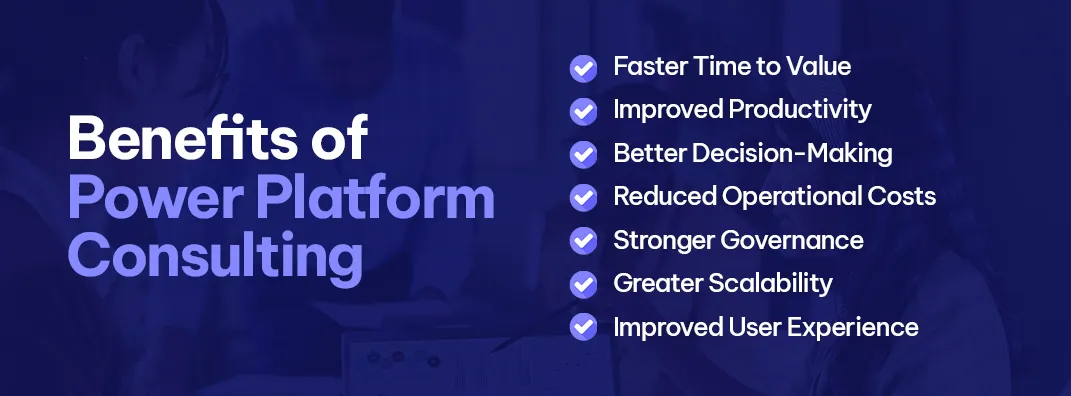
A structured implementation approach delivers significant business benefits.
-
Faster Time to Value
Solutions can be developed and deployed more quickly than traditional software projects.
-
Improved Productivity
Automation reduces manual effort and repetitive tasks.
-
Better Decision-Making
Real-time reporting provides greater visibility across the business.
-
Reduced Operational Costs
Efficient processes lower administrative overhead.
-
Stronger Governance
Structured controls improve security and compliance.
-
Greater Scalability
Solutions can evolve alongside organisational growth.
-
Improved User Experience
Applications are designed around actual business processes and user requirements.
Why Choose Exigo Tech as Your Managed Intelligence Partner
At Exigo Tech, we believe Power Platform should be more than a collection of tools.
As your Managed Intelligence Partner, we help organisations:
- Identify high-value Power Platform opportunities
- Design scalable Power Apps solutions
- Automate business processes with Power Automate
- Build meaningful reporting through Power BI
- Establish governance and security frameworks
- Integrate solutions across existing technology environments
- Support ongoing optimisation and innovation
Our goal is to ensure every Power Platform investment delivers measurable business outcomes.



 Exigo Tech - Ask AI (Beta)