
 Singapore
 Australia
 Philippines
 India
India6.41 MIN READ
Why Your Cloud Bill Is Secretly Growing: Hidden Leaks & Cost Entropy in Indian Enterprises
 Bhalchandra Bapat | Dec 08, 2025
Let me be straightforward — most Indian enterprises today are paying much more for cloud than they need to.
And in many cases, they don’t even know why.
Every month, the bill goes up a little. No one complains. Nothing looks broken. Nothing looks unusual.
But in the background, your cloud environment is quietly becoming messy. That mess has a cost.
And it’s cloud cost entropy — the slow, silent build-up of waste.
What is Cloud Entropy?
In simple words, cloud entropy is what happens when your cloud environment slowly becomes chaotic — unused workloads increase, resources scale on their own, logs expand without limit, and no one really knows who owns what anymore.
The Cloud Cost Reality Check
By the time leadership notices the spike in costs, the waste has already accumulated for months, sometimes years.
“We moved to cloud to save money… so why is the bill going up?”
I hear this a lot in 2025. The promise was:
- Lower infrastructure cost
- Better scaling
- Pay only for what you use
But the reality for many Indian businesses is the opposite. Bills keep rising, budgets keep stretching, and no one is sure why.
And the reason is simple: Cloud waste hides itself extremely well. This is where cloud cost optimization and proper cloud cost management make a difference.
The Problem Isn’t Your Cloud Provider- It’s the Hidden Leaks You Don’t Notice
After analysing multiple Indian enterprise environments, I see the same patterns again and again.
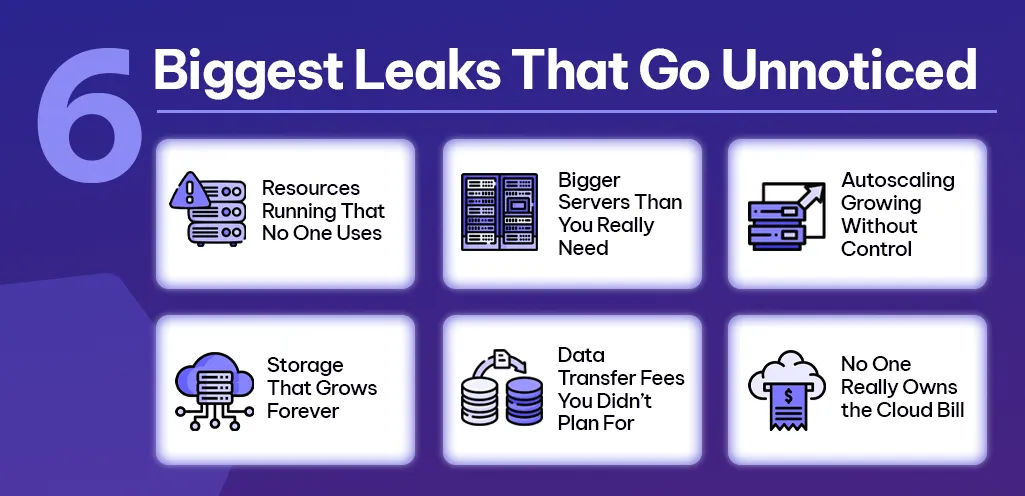
Here are the biggest leaks that go unnoticed:
#1: Resources Running That No One Uses
This includes things like:
- Test servers that were never turned off.
- Snapshots from last year.
- Disks that are no longer attached to any machine.
- Dev environments running all night.
- Old backups that keep piling up.
None of this impact your day-to-day work. So nobody notices them. But you keep paying every single day.
#2: Bigger Servers Than You Really Need
This is extremely common in Indian companies.
Someone says:
“Let’s keep a bigger machine. Just to be safe.”
So instead of standard storage, you choose premium. Instead of a small database, you take the biggest tier.
You pay for the extra capacity, even if you never use it. This is especially true for cloud server cost in India, which can escalate quickly if not monitored.
#3: Autoscaling Growing Without Control
Autoscaling sounds smart. But if it’s not tuned properly, it behaves like this:
- Your traffic increases slightly.
- Cloud automatically adds more machines.
- But it doesn’t scale down properly.
- Your environment keeps growing.
You end up paying for machines you didn’t even know existed. Using cloud cost optimization solutions can help control this in Indian enterprises.
#4: Storage That Grows Forever
Storage is like dust in your house. It just keeps collecting.
Examples:
- Logs that never expire.
- Backup after backup after backup.
- Snapshots taken automatically.
- Old database versions.
- Large files that never get deleted.
Storage doesn’t complain when it grows. It just costs more. Monitoring cloud storage cost and performing cloud storage cost comparison regularly can reduce this waste.
#5: Data Transfer Fees You Didn’t Plan For
Most Indian companies miss this completely.
Cloud providers charge for data going out of the system (egress).
- If your apps talk to each other across regions, the bill grows.
- If you have APIs, the bill grows.
- If you have microservices, the bill grows faster.
This is almost always the most “surprising” cost for CIOs and finance teams. This is where cloud cost optimization services become essential in India.
#6: No One Really Owns the Cloud Bill
This is the silent cultural problem.
- IT thinks DevOps should handle cost.
- DevOps thinks cloud admins should handle it.
- Cloud admins think finance should handle it.
- Finance just pays the bill because the business can’t
In the end, no one takes responsibility.
And cost entropy takes over. Only cloud cost optimization companies can help enforce accountability and guide teams.
Why This Problem Is Worse for Indian Enterprises
Based on what I have seen across Indian mid-sized and large organizations, 3 things make the cost problem especially severe:
- Fast cloud adoption without planning: Teams rush to cloud but don’t set rules or guardrails.
- Heavy use of outsourced vendors: Multiple vendors, multiple teams, but no single owner = chaos.
- “Don’t break anything” mindset: To avoid downtime, teams avoid optimization, even when it’s safe.
What You Should Start Doing Right Now
Here’s what I recommend to every enterprise struggling with cloud costs. You don’t need a major project. Just a few simple steps.
Step 1: Review Your Cloud Frequently
Just clean it up like you clean your house.
- Turn off unused servers.
- Delete old backups.
- Remove stale disks.
- Fix oversizing.
Step 2: Make Someone the “Cost Owner”
It can be a DevOps lead, a cloud engineer, or a FinOps person.
But one name must be responsible.
Step 3: Right-size Your Machines
Match what you need, not what feels “safe.”
Step 4: Put Retention Limits on Storage
Logs and backups shouldn’t live forever. This helps control cloud storage cost.
Step 5: Tag Everything
If you know what belongs to whom, you can trace and reduce waste.
Final Thought: Cloud Isn’t Expensive. Waste Is.
Your cloud bill isn’t growing because of business growth. It’s growing because a little bit of waste appears every week. And no one notices until the bill shocks you.
Remember, cloud cost entropy is slow. But very real.
The sooner you clean it up with cloud cost optimization solutions, the faster your bill drops.
Your Next Steps
If you are unsure where your cloud leaks are, we can help you. At Exigo Tech, we review your environment and share a simple, clear roadmap for your future. No tools, no heavy lift, just answers.
Our focus is to enable Indian enterprises to bring visibility and control back into their cloud spend with cloud cost optimization services. Reach out to us at if you want to start a conversation.


 Exigo Tech - Ask AI (Beta)