
 Philippines
 Australia
 Singapore
 India
India5.56 MIN READ
Over-Licensed or Under-Licensed? Why Both Can Be Expensive for Your Business
 Niten Devalia | Mar 16, 2026

Software licensing decisions are often made with the best intentions.
Some organisations prefer to purchase more licences than required, assuming this avoids compliance issues and future shortages. Others try to minimise costs by purchasing only the minimum needed.
At first glance, both approaches seem reasonable.
But in reality, both over-licensing and under-licensing can become expensive problems. One wastes budget quietly, while the other creates operational and compliance risk that can escalate quickly.
The real challenge is not simply buying licences, it is structuring them correctly and reviewing them regularly.
As part of our Licensing Campaign, we are discussing why licensing imbalances occur, the risks they introduce, and why structured licensing optimisation is essential for cost control and governance.
The Licensing Balance Most Organisations Struggle With
Modern technology environments rarely operate under a single licensing agreement.
Organisations typically manage licences across:
- Microsoft 365 environments.
- Cloud infrastructure platforms.
- Virtualisation and backup solutions.
- Security tools.
- Data and database platforms.
- Hybrid infrastructure deployments.
Each vendor introduces different pricing models, agreement types, subscription tiers, and renewal cycles.
Over time, maintaining the correct balance between too many licences and too few becomes increasingly difficult.
Without structured oversight, organisations often drift toward one of two scenarios: over-licensing or under-licensing.
The Hidden Cost of Over-Licensing
Over-licensing happens when organisations purchase more licences or higher licence tiers than they actually need.
It often occurs for understandable reasons:
- “Better to have extra than run short.”
- “Let’s assign the same licence to everyone.”
- “We might need those features later.”
While this approach may appear cautious, it often leads to quiet but significant overspending.
Common Over-Licensing Scenarios
Over-licensing typically appears in situations such as:
- Assigning premium licences to users who require only basic functionality.
- Keeping inactive or unused licences assigned after employees leave.
- Maintaining legacy subscriptions that no longer align with workloads.
- Running stable cloud workloads on consumption pricing when commitment models would reduce costs.
- Paying for bundled capabilities that remain unused.
Because these inefficiencies are spread across platforms and departments, they rarely attract immediate attention.
Yet over time, they can significantly inflate technology budgets.

The Risks of Under-Licensing
Under-licensing occurs when organisations deploy software or services without sufficient entitlements.
This may happen when:
- User counts grow faster than licence allocation.
- New workloads are deployed without licensing review.
- Teams independently install software without procurement oversight.
- Licensing agreements are misunderstood or misinterpreted.
Unlike over-licensing, which primarily impacts cost efficiency, under-licensing introduces compliance and legal risks.
Potential Consequences of Under-Licensing
When licensing does not match actual usage, organisations may face:
- Vendor audit findings
- Unexpected true-up costs
- Contractual penalties
- Legal disputes
- Reputational concerns with technology partners
In some cases, remediation costs during audits can exceed the price of properly structured licensing in the first place.
Compliance Risk Is Often Underestimated
Many organisations underestimate how frequently vendors perform licensing reviews or audits.
Major vendors periodically verify whether organisations are correctly licensed for deployed services.
When discrepancies are discovered, organisations may be required to:
- Purchase additional licences immediately.
- Pay retroactive costs for previous usage.
- Adjust agreements under less favourable commercial conditions.
These situations often arise not from intentional misuse, but from a lack of visibility across complex licensing environments.
Why Licensing Imbalance Happens
Licensing imbalance usually develops gradually rather than through a single decision.
Several factors contribute:
- Fragmented Vendor Relationships: Different platforms are purchased and managed independently.
- Lack of Consolidated Visibility: IT and finance teams may not have a unified view of licensing across vendors.
- Changing Business Requirements: User roles, projects, and infrastructure evolve faster than licensing structures.
- Automatic Renewals: Subscriptions continue without a periodic strategic review.
- Limited Internal Expertise: Licensing rules can be complex, and few organisations maintain dedicated specialists.
Over time, these factors create environments where licences drift away from actual needs.
The Goal Is Not “More” or “Less”, It Is Alignment
The objective of the licensing strategy is not simply reducing licence counts.
It is ensuring the right licences exist for the right users, workloads, and growth plans.
Optimised licensing environments achieve balance by:
- Matching licence tiers with user roles.
- Removing unused or redundant subscriptions.
- Aligning cloud workloads with cost-effective pricing models.
- Structuring agreements that support business growth.
- Maintaining clear visibility across vendors.
This alignment improves both financial efficiency and compliance confidence.
Benefits of Licensing Optimisation
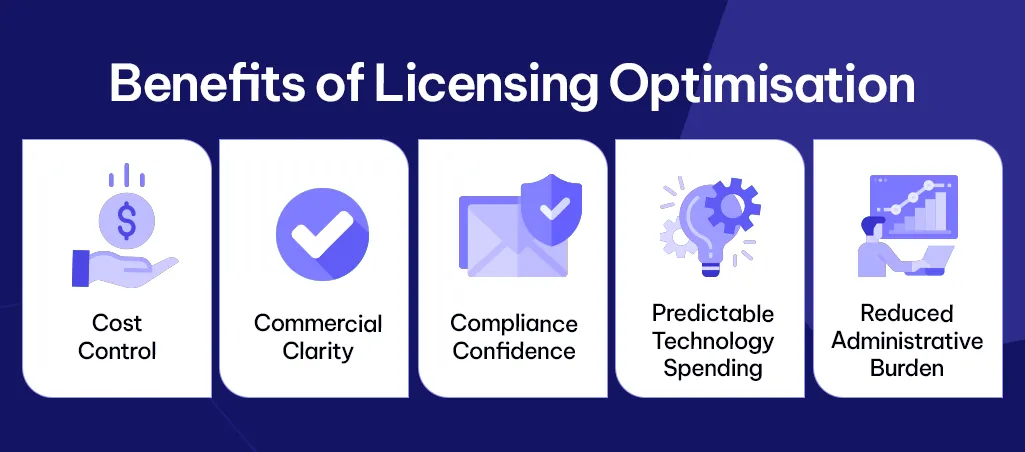
When licensing environments are structured intentionally, organisations gain significant advantages.
- Cost Control: Eliminate unnecessary licences and align subscription models with real usage.
- Commercial Clarity: Understand exactly what services are being paid for across platforms.
- Compliance Confidence: Ensure licensing entitlements match deployed technologies.
- Predictable Technology Spending: Move away from unpredictable consumption spikes.
- Reduced Administrative Burden: Centralised oversight simplifies vendor and subscription management.
- Strategic Planning: Licensing supports infrastructure, cloud, and transformation roadmaps.
Licensing Requires Continuous Review
Technology environments do not remain static.
Workforces grow, projects evolve, and cloud workloads scale.
Licensing must evolve alongside these changes.
Regular licensing reviews ensure organisations avoid both extremes, paying for more than needed while remaining protected from compliance exposure.
Optimisation is not a one-time exercise. It is an ongoing strategy.
Why Choose Exigo Tech as Your Managed Intelligence Partner
At Exigo Tech, licensing is approached from a full-stack perspective.
We look beyond individual vendor agreements to understand how licensing decisions affect your broader technology ecosystem.
As your Managed Intelligence Partner, we help organisations:
- Assess their complete licensing footprint.
- Identify over-licensing and under-licensing risks.
- Align licensing with operational needs.
- Consolidate vendor relationships.
- Structure agreements strategically.
- Continuously optimise commercial models.
Our goal is simple: ensure your organisation pays only for what it truly needs and remains fully compliant while doing so.



 Exigo Tech - Ask AI (Beta)