
 Philippines
 Australia
 Singapore
 India
India5.44 MIN READ
The Hidden Risks of Cloud Security Misconfigurations and How to Prevent Them
 Niten Devalia | Aug 03, 2026
Cloud computing has transformed the way businesses operate, enabling organisations to scale faster, improve collaboration, and support hybrid work. Whether running workloads in Microsoft Azure, storing files in Microsoft 365, or deploying business applications in the cloud, organisations benefit from greater flexibility and agility.
However, moving to the cloud does not automatically make your business secure.
In fact, many of today’s cybersecurity incidents are not caused by sophisticated hackers exploiting unknown vulnerabilities; they’re the result of simple cloud security misconfigurations. A storage account left publicly accessible, excessive user permissions, or an incorrectly configured firewall can create opportunities for attackers to access sensitive business data.
At Exigo Tech, we help organisations strengthen their cloud environments as their Managed Intelligence Partner, ensuring cloud platforms are secure, compliant, and continuously optimised for business growth.
What Are Cloud Security Misconfigurations?
Cloud security misconfigurations occur when cloud resources are deployed or managed with incorrect security settings.
Unlike software vulnerabilities, these issues are typically introduced through human error, inconsistent governance, or inadequate security oversight.
Examples include:
- Publicly accessible storage accounts
- Weak identity and access controls
- Misconfigured virtual networks
- Disabled security monitoring
- Overly permissive user roles
- Unsecured APIs
- Poor encryption settings
As organisations expand their cloud environments, these risks become increasingly difficult to identify without continuous monitoring.
Why Misconfigurations Are a Growing Concern
Modern cloud environments are constantly evolving.
New virtual machines, applications, databases, storage services, and AI workloads are deployed regularly. Each new resource introduces additional security settings that must be configured correctly.
Without consistent governance, security gaps can accumulate over time.
For many businesses, cloud adoption has outpaced security maturity, leaving environments vulnerable despite significant investment in cloud technologies.
Common Cloud Security Misconfigurations
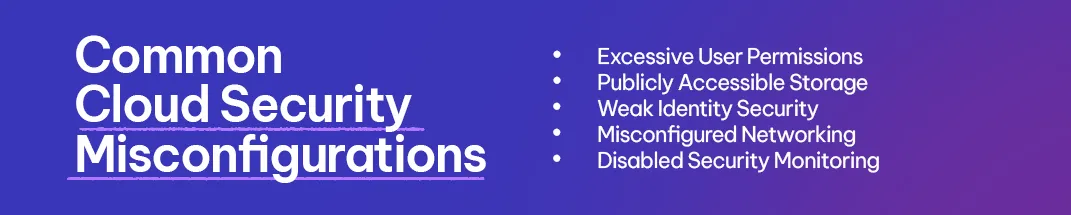
Excessive User Permissions
One of the most common security issues is granting users more access than they require.
When employees have unnecessary administrative privileges or unrestricted access to sensitive resources, the impact of compromised accounts increases significantly.
Implementing Role-Based Access Control (RBAC) and regularly reviewing permissions helps minimise unnecessary exposure.
Publicly Accessible Storage
Cloud storage services often contain confidential business information.
If storage accounts or file repositories are unintentionally exposed to the internet, sensitive data may become accessible without authentication.
Regular security assessments should verify that storage resources are only accessible to authorised users.
Weak Identity Security
Identity has become the new security perimeter.
Without protections such as:
- Multi-Factor Authentication (MFA)
- Conditional Access
- Strong password policies
- Identity monitoring
attackers can exploit compromised credentials to gain access to cloud environments.
Modern identity protection significantly reduces this risk.
Misconfigured Networking
Virtual networks, firewalls, and security groups control how cloud resources communicate.
Poorly configured networking may expose systems that should remain private or allow unnecessary inbound access from the internet.
Regular network reviews help ensure communication pathways remain secure while supporting business operations.
Disabled Security Monitoring
Many cloud platforms include advanced monitoring and threat detection capabilities.
However, these tools are sometimes left unconfigured or are not actively monitored.
Without continuous visibility, organisations may not detect suspicious activity until after an incident has occurred.

The Business Impact of Cloud Misconfigurations
Cloud security misconfigurations affect far more than IT systems.
Potential consequences include:
- Data breaches
- Operational disruption
- Financial loss
- Regulatory penalties
- Loss of customer trust
- Business downtime
- Increased recovery costs
For organisations operating in regulated industries, security incidents may also lead to compliance investigations and reputational damage.
Preventing misconfigurations is often significantly less expensive than responding to a cyber incident.
Best Practices for Preventing Cloud Misconfigurations
Apply the Principle of Least Privilege
Users should only have access to the systems and information required for their role.
Regular access reviews help ensure permissions remain appropriate as responsibilities change.
Strengthen Identity Management
Microsoft Entra ID provides powerful identity protection capabilities, including:
- Multi-Factor Authentication
- Conditional Access
- Identity Protection
- Privileged Identity Management
These controls reduce the likelihood of unauthorised access through compromised credentials.
Continuously Monitor Your Cloud Environment
Cloud security is not a one-time project.
Organisations should continuously monitor:
- Security configurations
- User activity
- Network exposure
- Compliance status
- Threat alerts
- Resource changes
Continuous monitoring helps identify new risks before they become security incidents.
Enable Security Baselines
Cloud platforms provide recommended security baselines and best-practice configurations.
Applying these standards helps organisations maintain consistent security across their cloud environment while reducing configuration drift.
Regularly Review Cloud Resources
As cloud environments grow, unused resources, outdated services, and forgotten workloads often remain active.
Regular reviews help organisations:
- Remove unnecessary resources
- Reduce attack surfaces
- Optimise cloud costs
- Improve operational efficiency
Cloud optimisation and cloud security often go hand in hand.
Cloud Security Is a Shared Responsibility
One of the biggest misconceptions about cloud computing is that the cloud provider manages all security.
While providers such as Microsoft secure the underlying cloud infrastructure, customers remain responsible for securing:
- User identities
- Data
- Applications
- Access permissions
- Operating systems
- Device management
- Configuration settings
Understanding this shared responsibility model is essential for maintaining a secure cloud environment.
Why Continuous Cloud Security Matters
- Cloud environments are constantly changing.
- Employees join and leave the organisation.
- Applications are updated.
- New workloads are deployed.
- AI services are introduced.
Without ongoing governance, even well-designed environments can gradually become vulnerable.
Continuous optimisation helps organisations maintain strong security while supporting business growth and innovation.
Why Choose Exigo Tech as Your Managed Intelligence Partner
At Exigo Tech, we help organisations secure and optimise their cloud environments through proactive management, continuous monitoring, and strategic governance.
As your Managed Intelligence Partner, we provide:
- Cloud Security Assessments
- Microsoft Azure Security Reviews
- Microsoft Entra ID implementation
- Microsoft Defender deployment
- Identity and Access Management
- Security posture optimisation
- Cloud governance and compliance advisory
- Ongoing Managed Cloud and Security Services
Our approach ensures your cloud environment remains secure, resilient, and aligned with your business objectives as technology continues to evolve.



 Exigo Tech - Ask AI (Beta)